 Malcolm Keith 2026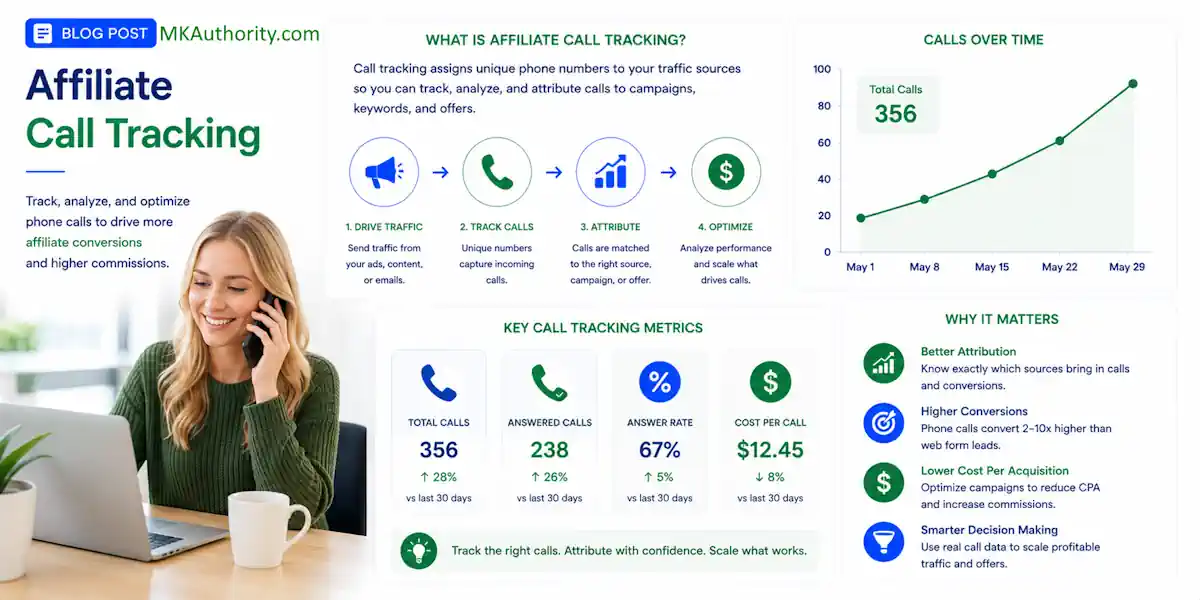

A phone call can be your most valuable affiliate conversion, but only if you can prove where it came from. This means doing affiliate call tracking. In the world of affiliate marketing, sending traffic to an offer is only half the battle.

Generally, affiliate call tracking assigns unique, trackable phone numbers to individual affiliates to attribute incoming calls and offline conversions to specific marketing campaigns.
This allows businesses to monitor key metrics—such as call duration, caller location, and lead quality—ensuring accurate payouts and optimized campaign spend
So knowing which ad, email, landing page, or keyword created a real sale is where the money is, especially when you are running pay per call campaigns.
Affiliate call tracking connects those dots. It serves as a vital component of lead generation, showing you the exact source of the call, what happened during the conversation, and whether that caller became a buyer.
Once your affiliate call tracking is set up correctly, you can stop guessing and start putting your budget behind traffic that produces actual revenue.
Key Takeaways On Affiliate Call Tracking
- A tracked call does not always result in a qualified lead generation opportunity or a successfully completed affiliate sale.
- Use unique phone numbers or dynamic number insertion to accurately connect incoming calls to specific traffic sources.
- Track the entire user journey, including the initial click, the phone call, the lead status, the final sale, and the resulting commission.
- Confirm the specific rules of each affiliate network before running traffic and calls through your own custom tracking setup.
- Protect your tracking data by performing regular testing, conducting manual call reviews, and maintaining clean reporting across your affiliate network.
Start With What You Want to Count
Before setting up your phone numbers, decide what success looks like for the offer. This sounds basic, but it saves a lot of confusion later in your performance marketing campaigns.
Some affiliate programs pay for every valid inbound call. Others pay only when the caller meets certain requirements. A few pay only after a sale closes. Those are three completely different events.
Here is the simple breakdown:
| Event | What It Means | Does It Prove Revenue? |
|---|---|---|
| Phone call | Someone dialed your tracking numbers | No |
| Qualified call | The caller met the conversion criteria | Sometimes |
| Sale | The caller purchased the product or service | Yes |
| Commission | The program approved and credited your payout | Yes |
A call might last 30 seconds and never reach a sales rep. Another call might last 12 minutes, result in a $2,000 sale, and create a strong commission. If both show as one call in your reports, your numbers are hiding the truth.
That is why call tracking for affiliate offers must go beyond counting inbound calls.
The number you want to protect is not total calls. It is profitable calls that turn into approved commissions.
Ask the affiliate manager or the affiliate network support team how they define a valid call. They may have strict conversion criteria regarding call duration, caller location, duplicate callers, business hours, or whether the caller must speak with an agent.
Also, ask if you can use your own tracking numbers. Some programs require you to send traffic directly to their number. Others allow call forwarding. Don’t assume, because attribution rules can vary widely between networks and offers.

Map the Click-to-Call Path Before Buying Traffic
A phone-sale funnel has more moving parts than a standard affiliate link. To succeed, you need a clear understanding of the customer journey from the initial click to the final sale.
A clean path often looks like this:
- A person clicks your Facebook ad, Google ad, email link, or social post.
- They land on your bridge page, presell page, or offer page.
- Your call tracking software records the visitor source.
- The visitor sees a phone number and makes the call.
- The call routes to the advertiser, call center, or sales team.
- The call outcome returns to your tracking dashboard, affiliate network, or reporting sheet.
That may look like a lot, but it becomes simple once every step has one job.
Your traffic platform tells you what you paid for the click. Your tracking tools identify which visitor placed the call. The affiliate program confirms whether that interaction became a qualified lead or sale. By combining these data points, you can calculate your cost per call, cost per qualified call, and return on ad spend.
If you are building paid traffic campaigns, the same discipline applies to any offer. Good affiliate marketing traffic strategies start with knowing what action brings in money, not just chasing clicks that look good in a dashboard.
Dynamic Number Insertion and DNI Connect Calls to Visitors

Dynamic number insertion, also known as DNI, automatically updates the phone number displayed on a web page based on the visitor’s traffic source.
For example, a visitor from a Google Search ad may see one tracking number, while a visitor from a Facebook ad sees another. Your landing page remains professional and consistent, but your system uses DNI to ensure your call tracking software knows exactly which source generated the lead.
More advanced setups can assign a temporary unique number to each individual visitor. When they trigger inbound calls, the system connects the activity to specific details such as:
- The campaign, ad group, keyword, or referral source
- The specific landing page they viewed
- The device they used
- The time elapsed between the visit and the call
- The marketing channel that originally brought them in
This level of marketing attribution is essential when you run multiple traffic sources simultaneously. Without it, you may see inbound calls coming in, but you will have no way of knowing whether Google, YouTube, solo ads, or your email list actually did the work.
DNI usually relies on a small tracking script placed on your website. If you do not control the final offer page, you may need a bridge page that you own and manage before sending prospects to the offer.
Use Call Forwarding Without Breaking Attribution
Call forwarding relies on call routing to ensure that when a customer dials your virtual numbers, the system seamlessly connects them to the advertiser’s primary phone line. The caller experiences no disruption, as they dial one number and reach the correct sales team immediately.
This configuration allows your system to log the source, timestamp, and duration of the call before the call routing process connects the lead to the final destination.
Platforms like CallRail, Ringba, Invoca, and other reputable call tracking software providers offer a wide range of features, including customized tracking numbers, advanced routing rules, call recordings, and detailed reporting.
The best choice for your business depends on your specific traffic volume, budget, technical requirements, and the needs of the affiliate offer.
For a beginner, the goal is not to purchase every available feature. Instead, start with a system that can:
- Assign tracking numbers by specific campaign or visitor source
- Forward calls reliably to the approved destination
- Record call duration and caller information where permitted
- Export call data or send conversion events to your ad platform
- Let you label calls as qualified, unqualified, sold, or pending
Be careful with number replacement. If an affiliate program provides you with a mandatory phone number, do not swap it for your own virtual numbers without written approval. Some advertisers rely on their own proprietary call tracking software and attribution systems; replacing the number may cause you to lose credit for a sale.
A quick test call before launching your paid ads can prevent a painful surprise. Call the number yourself, confirm the destination is correct, and check that your dashboard logged the source properly.
Track Qualified Calls and Sold Calls Separately
This is where many affiliate marketers leave money on the table. They optimize for call volume because it is the easiest number to see, but more calls do not automatically mean more commissions. Improving your lead quality is essential for long-term profitability.
A qualified call is a call that meets the specific conditions of the offer. For a home improvement offer, the caller may need to own a home and live in a serviceable area. An insurance offer, they may need to meet age or location rules.
For a business opportunity, they may need to complete a meaningful conversation with a sales representative. Using interactive voice response (IVR) systems can help you filter these callers before they even reach a sales agent, ensuring only the right prospects connect.
A sold call means the person actually purchased the product or service. That is the conversion closest to your actual income.
Your reporting should separate both metrics. A campaign that generates 100 calls and five qualified leads may lose money, while a smaller campaign with 25 calls and 10 qualified leads could be your winner.
By utilizing conversation intelligence, you can analyze exactly what happens during these calls to determine why some convert and others do not.
You can mark outcomes in a few ways. A call center may send you a report, or the affiliate network may show conversion data. You might also receive a postback or webhook event. In some cases, the sales team can update a shared CRM.
Leveraging real-time analytics allows you to see this data as it happens, so you can adjust your spend immediately.
A postback is an automated message sent from one system to another after an event happens. For example, an affiliate network can send a postback to your tracker when a sale is approved.
A webhook is similar. It sends data automatically when something happens, such as a call being tagged qualified or sold. Webhooks are useful when you want your call tracker, CRM, spreadsheet, or ad platform to stay updated without manual work.
Do not treat postbacks and webhooks as magic. Test them thoroughly. Send a test event, then confirm the right campaign received the correct status and payout amount.
Feed Offline Conversions Back Into Your Ads

A phone sale is often called an offline conversion because the final purchase happens away from the website. The customer talks to a human, pays by phone, or completes paperwork later.
That does not mean the sale has to disappear from your ad data.
When your tracking setup can connect a sale back to the original click, you achieve accurate revenue attribution. You can then send that result to the platform where you bought traffic.
Google Ads and Meta ads each have their own processes and data requirements for conversion reporting. Your affiliate program must also allow it.
The goal is simple. Tell your ad platform which clicks turned into qualified calls or approved sales, rather than just which clicks generated phone taps. By feeding this data back into your ad platforms, you enable smarter campaign optimization.
This gives the platform stronger data over time and helps you improve your conversion rates by focusing on high-value leads.
In the world of performance marketing, this is essential. It allows you to see when a cheap click is actually worthless. A $0.80 click that creates qualified phone buyers can easily beat a $0.20 click that produces tire-kickers all day.
Use a simple reporting sheet if you are starting out. Track the date, traffic source, campaign, spend, total calls, qualified calls, sold calls, commissions, and refunds. This is not fancy, but it keeps your decisions honest.
If you are using paid ads to grow a home business, that reporting habit matters. You do not need a huge budget. You simply need to know where each dollar went and exactly what came back in return.
Check the Data Before You Scale
Affiliate call tracking works only when the numbers are trustworthy. Give every campaign a clear name, use consistent tracking parameters, and avoid changing five things at once.
If a campaign suddenly generates calls but no qualified leads, listen to recordings only when you have permission and follow applicable privacy rules. You may find that the ad promise is attracting the wrong people. Maybe your landing page is unclear, or the offer has a location restriction that was not stated.
When using a ping tree for distribution, ensure that the call buyer is receiving the expected lead quality so you can accurately assess your publisher performance.
Call recording laws vary by location. Always disclose to callers when call recording is in progress, and confirm what the advertiser and tracking provider allow. Keep personal customer information out of loose spreadsheets and unsecured notes.
Also watch for duplicates. One person may call twice before buying. Another may call, hang up, then call back later. Your tracker may count multiple calls, while the affiliate program counts one lead.
That is normal, but you need to understand the difference between call volume and actual conversions.
Frequently Asked Questions
Do I need special software for affiliate call tracking?
Review your data weekly. Kill obvious losers. Keep testing angles, pages, and traffic sources that produce qualified calls. Scale your efforts only after the sales and commission data confirm that the call buyer is happy with the lead quality and the ROI supports your decision.
Yes, to accurately track calls back to specific traffic sources, you should use professional call tracking software. These platforms provide the tools necessary to generate unique tracking numbers, manage call routing, and integrate with your ad accounts to attribute sales.
Can I use the same phone number for all my affiliate campaigns?
Using one phone number for all campaigns is not recommended, as it prevents you from knowing which specific ad, keyword, or landing page generated the call. Instead, use unique tracking numbers or dynamic number insertion to properly segment your traffic sources and optimize your marketing budget.
Is it always safe to replace an advertiser’s phone number with mine?
You must verify the rules of each individual affiliate program before replacing their phone number with your own tracking number. Some advertisers use proprietary tracking systems, and swapping their number without permission could cause you to lose attribution and credit for any resulting sales or commissions.
What is the difference between a qualified call and a sold call?
A qualified call meets the specific criteria set by the advertiser, such as being from the correct location or lasting a minimum duration. A sold call represents a finalized transaction that results in a confirmed commission, which is the most important metric for determining your actual return on investment.
Final Thoughts
A ringing phone feels exciting, but it is not the finish line. Effective affiliate call tracking gives you the full picture, from the first click to the qualified conversation and the final approved commission.
By setting up a clear path, using forwarding and dynamic numbers correctly, and verifying every program’s attribution rules before spending more, you can master the complexities of lead generation. When you can accurately see which calls become sales, your pay per call marketing decisions become much easier to manage.
Scaling your campaigns is safer and more profitable when you have the data to prove which strategies are actually driving revenue.