 Malcolm Keith 2026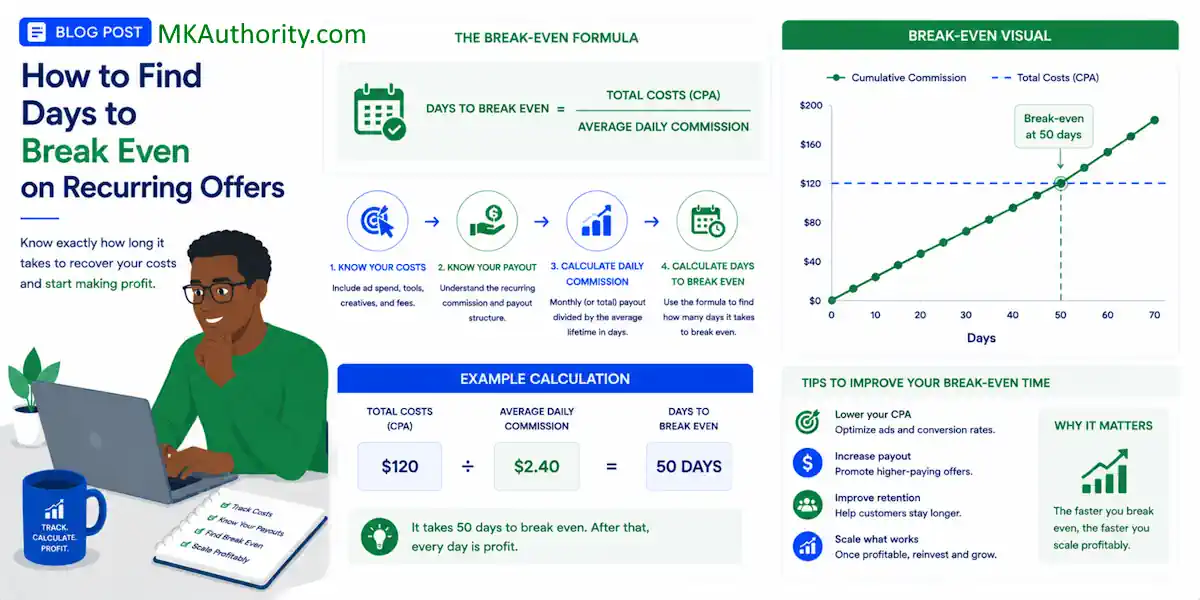

You can sell a subscription all day long and still be upside down for weeks. That is why days to break even matters. If you are buying traffic, paying affiliates, or launching a membership, you need to understand your startup costs and how long your cash is out before it comes back to your account.
The good news is that this number is not hard to calculate. Once you determine your customer acquisition cost and what one subscriber produces per day, the data becomes clear. Incorporating these metrics into your recurring revenue business plan is the most effective way to gain clarity and ensure your growth remains sustainable.
Let us make the math easy.
Key Takeaways
- Your break-even point occurs when customer revenue or customer margin pays back the amount spent to acquire that customer.
- While revenue payback is faster to calculate, focusing on contribution margin provides a more accurate metric for decision-making when delivery costs and transaction fees are involved.
- For monthly offers, most marketers use a 30-day window to convert monthly revenue or margin into a daily number.
- If you collect money upfront, subtract that amount before you calculate the remaining recurring payback period.
- Free trials, refunds, failed payments, and churn can push your true break-even day later than your initial estimate.
The plain-English formula

Here is the easy version. Take what it costs to get one customer and divide that by what the customer gives you per day. The answer is your estimated break-even time, also known as your break-even point.
For a perspective based on total revenue, use this formula:
Break-even days = customer acquisition cost / revenue per day
If your offer has a sales price per unit of $39 per month, your daily revenue is $39 divided by 30, or $1.30. If your cost to acquire that customer is $78, then $78 divided by $1.30 equals 60. Your break-even point is 60 days.
Now, if the customer pays something upfront on day 0, subtract that first. Say your ad cost is $90 and the first payment is $30. Your remaining amount to recover is $60, not $90.
There is also an exact cash method, which works well when you want to model real billing dates. Here is a quick example for a $49 monthly membership with a $120 acquisition cost:
| Day | Cash collected | Running total |
|---|---|---|
| 0 | $49 | $49 |
| 30 | $49 | $98 |
| 60 | $49 | $147 |
Using real billing dates, cash payback happens on day 60. Use this running-total method when you want to generate an accurate cash flow forecast for your business. Use the daily formula when you want a fast planning estimate.
Revenue break-even vs contribution margin
Revenue break-even is the simple version of this calculation. It asks, “When does top-line customer revenue equal what I spent to get that customer?” This approach works when direct delivery costs are negligible, like a low-touch newsletter, a basic membership, or a simple digital library.
However, keep in mind that revenue break-even ignores both fixed costs and variable costs, providing only a high-level view of your cash flow.
Contribution margin break-even is the more precise version for most paid traffic decisions. By calculating the contribution margin, you can accurately identify the gross profit generated per customer. This method asks, “When does the money left after direct costs pay back acquisition?”
To reach your true break-even point, you must account for total costs by subtracting payment fees, support costs, software seats, fulfillment, coaching time, and variable commissions from your revenue.
Revenue payback shows when cash starts coming back. Margin payback shows when the offer starts paying for itself.
The formula is:
Break-even days = customer acquisition cost / contribution margin per day
And contribution margin per day is:
(monthly price – monthly variable costs – payment fees) / 30
Use revenue payback for a quick first pass. Use margin payback before you raise budgets, add affiliates, or scale a new traffic source.
What counts in your inputs

Bad inputs lead to polished math but poor business decisions. To get the most accurate results, you must ensure your data is precise.
For acquisition cost, include ad spend, affiliate payouts, sales commissions triggered by a sale, and any bonuses or setup fees required to win the customer. These represent your primary operating expenses and fixed costs associated with growth. For revenue, always use the net amount you actually collect after accounting for discounts and expected refunds.
For contribution margin, subtract your variable costs, which are the expenses that increase when a new customer joins. These typically include Stripe fees, onboarding labor, customer support, shipping, bonus software access, or a coach’s time.
It is important to note that these calculations can fluctuate based on your production level or the total scale of your membership service.
If the offer starts with a 14-day trial, be sure to add those 14 days before any revenue begins.
If the offer bills on a quarterly or yearly basis, divide your revenue by 90 or 365 days instead of 30 to maintain consistency in your reporting.
Worked examples with realistic numbers
Let’s make this real.
Example 1, revenue basis
Say you run a $39 per month community and your ad cost to acquire one of the units sold is $78.
Monthly revenue is $39. Daily revenue is $39 divided by 30, which is $1.30. Then do the last step: $78 divided by $1.30 equals 60.
Your estimated payback is 60 days.
That lines up well with the billing cycle too. If billing starts right away, two monthly payments recover the acquisition cost.
Example 2, contribution margin basis
Now say you sell a $59 per month training membership. Your acquisition cost is $110. Payment processing is 3 percent, and member support plus software adds $8 per month.
First, find the monthly costs. Processing on $59 is $1.77. Add the $8 support cost, and total variable cost is $9.77.
Next, find monthly contribution margin. $59 minus $9.77 equals $49.23.
Now turn that into a daily number. $49.23 divided by 30 equals $1.64.
Last step, divide acquisition cost by daily contribution margin. $110 divided by $1.64 equals 67.07. Round up, and your payback time is 68 days. This result gives you a clear picture of the true profit margin for the offer once you account for those operational expenses.
If you want clean reporting while you run these numbers, tracking matters. The top affiliate link tracking software can help you spot which traffic sources are bringing in buyers who recover ad spend faster. Using this data allows you to build a more accurate sales forecast and monitor how changes in sales volume impact your recovery time.
How to reduce your break-even time
Once you have completed your break-even analysis, the next move is obvious. You need to shorten that window. When you reduce the time it takes to recover your acquisition costs, you free up vital working capital that can be reinvested into other growth initiatives or new customer acquisition campaigns.
To improve your offer, consider these strategic adjustments:
- Add more cash at the front end with an order bump, a one-time setup fee, or a low-friction upsell.
- Improve retention so customers stay well past the point where the offer pays you back.
- Cut variable costs that pile up every month, such as high support loads, performance bonuses, and unnecessary software seat access.
- Lower your customer acquisition cost with better ad creatives, stronger pre-sell pages, and tighter audience targeting.
- Review your free-trial terms, because every extra day in a trial delays your recovery period.
If you are currently selling services rather than subscriptions, remember that tracking your billable hours is the direct equivalent of tracking your daily revenue. By optimizing these hours, you can achieve the same efficiency in your cash flow.
Sometimes the fastest win is not cheaper traffic, but better retention. If a member stays for just one more billing cycle, your days to break even can drop significantly.
One final reality check is essential. If your average customer consistently cancels before your break-even day, the core model needs work. Increasing your volume will not fix an offer that is fundamentally unprofitable.
Frequently Asked Questions
Why is it important to calculate break-even days instead of just tracking total profit?
Calculating break-even days specifically helps you understand your cash flow liquidity. Knowing exactly how long your capital is tied up in a customer allows you to manage your budget and reinvest funds more aggressively into new growth initiatives.
How does churn affect my break-even calculation?
Churn is a significant variable that can push your actual break-even point further out than your initial estimate. If a high percentage of your customers cancel before they reach the break-even day, your acquisition cost will never be recovered, signaling that your current offer model may be unsustainable.
Should I use revenue or contribution margin for my calculations?
Use revenue break-even for a quick, high-level snapshot when your costs are minimal. For precise decision-making, such as scaling paid traffic or adding affiliates, always use contribution margin to account for hidden costs like payment processing fees and support labor.
What can I do if my break-even time is too long?
To shorten your break-even window, you should focus on increasing upfront cash through order bumps or setup fees. Additionally, lowering your acquisition costs through better creative or reducing monthly variable service costs will help you recover your investment faster.
Conclusion
When you calculate your days to break even, you stop guessing and start seeing your offer for what it is. While revenue payback provides a quick snapshot, identifying your precise break-even point offers a much clearer view of your profitability. Remember that reducing total costs is just as important as increasing revenue when trying to shorten this timeframe.
Contribution margin ultimately provides the most accurate assessment of your success.
If you run subscriptions, memberships, or continuity offers, keep this metric close. Performing a regular break-even analysis is essential for long-term subscription health and sustainable scaling. The faster you recover your acquisition cost, the easier it becomes to grow your business without choking your cash flow.