 Malcolm Keith 2026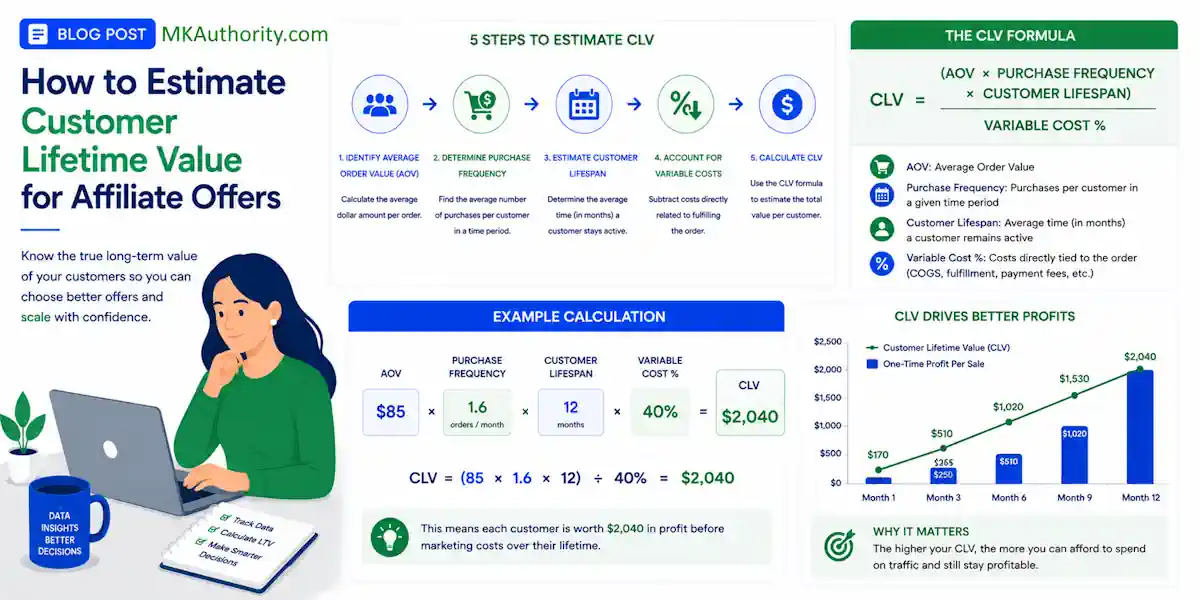

One offer pays $80 today. Another pays $28 a month for several months. Which one is better? You cannot answer that from the payout line alone. Instead, you need to calculate the customer lifetime value to understand the true profitability of your marketing efforts.
Customer Lifetime Value (LTV or CLV) is the total projected revenue or net profit a business expects from a single customer over the entire duration of their relationship. It is a vital metric that helps companies optimize marketing budgets, improve retention, and evaluate sustainable growth against Customer Acquisition Costs (CAC)
If you buy traffic or spend time building content, calculating customer lifetime value is the step that keeps you out of weak offers. It shows what one referred buyer is probably worth after accounting for refunds, upsells, rebills, and tracking limits.
Once you determine this LTV, offer selection becomes much easier, and your budget decisions stop feeling like guesses.
Key Takeaways on customer lifetime value
- A strong affiliate offer is not the one with the biggest front-end payout; it is the one with the best expected customer lifetime value for every referred user.
- Use simple math: commission from first sale + average upsells + average recurring payouts, then reduce it for refunds and tracking loss.
- If a merchant hides retention data, build low, base, and high scenarios with conservative assumptions.
- Turn your estimate into action by calculating EPC and a safe max CPC for each traffic source.
- Traffic quality matters a lot, because low-intent buyers often refund more, churn faster, and kill your profitability.
- Always monitor your customer acquisition cost to ensure your spending remains efficient compared to the long-term revenue generated by your referrals.
Why customer lifetime value beats flashy payouts
A lot of affiliates choose offers the same way shoppers grab candy at the checkout line. They make a fast assessment and a quick decision, which is a major mistake.

The commission number on the sales page is only the front of the box. What actually matters is what happens during the rest of the customer journey.
Does the buyer request a refund?
Do they take the upsell?
Do they stay on the subscription?
Does the cookie even hold long enough for you to get credit?
A front-end payout can look amazing and still lose you money.
Let’s say Offer A pays $90 once, but the refund rate is high and the average buyer never buys again. Offer B pays $40 up front, yet the same buyer usually takes a $60 bump, then stays on a $29 monthly add-on for four months. Offer B can beat Offer A by a mile when you look at long-term profitability.
This is why experienced media buyers think in expected value, not hype. They want to know the true customer lifetime value, how much one click is worth, and how much they can afford as a customer acquisition cost before profit disappears. That same logic applies if you are building a blog, an email list, a YouTube channel, or running paid ads.
Avinash Kaushik’s LTV analysis makes this point well: your marketing spend only makes sense when you know exactly what a customer is worth over time. For affiliate marketers, that means your estimate of customer lifetime value should sit right next to conversion rate and EPC whenever you compare different offers.
The simple formula, plus two offer examples
Keep the math straightforward. You do not need a finance degree to calculate your returns. Using a consistent customer value formula helps you identify which promotions are actually worth your time and ad spend.
Expected affiliate value per referred customer is:
(front-end commission + average upsell commission + average recurring commission) x (1 – refund rate) x tracking credit rate
If you want value per click, take that result and multiply it by your conversion rate.
Post Affiliate Pro’s lifetime value overview uses the same core building blocks, including average order value, repeat purchases, and customer lifespan. For affiliate marketing, you simply translate those metrics into commission dollars to determine your actual customer lifetime value.
Here is a one-time commission example.
A course pays 40% on a $120 front-end product. That gives you $48. Through effective upselling and cross-selling, 25% of buyers also take a $60 add-on that pays 30%, or $18. Since only 25% take it, your average upsell commission per buyer is $4.50.
So your gross expected commission is $52.50 per referred customer.
Now reduce it.
If refunds run 8%, multiply by 0.92.
That brings you to $48.30.
If the offer has a short cookie, or buyers often come back later on another device, you may only get credit for 85% of the buyers you influenced. Multiply by 0.85, and your adjusted value lands at $41.06 per customer.
So, if your page converts at 2.5%, your estimated EPC is 0.025 x $41.06 = $1.03.
If your traffic costs $0.70 per click, you still have room.
If it costs $1.20, the offer probably does not work on that source.
Now consider a subscription example.
A software offer pays 30% recurring on a $40 monthly plan.
That is $12 per paid month. If monthly churn is 20%, a quick estimate for average customer lifespan is 1 divided by 0.20, which gives you 5 months. Factoring in repeat purchases over that duration, your gross recurring commission is $12 x 5 = $60.
Now take off 10% for refunds, chargebacks, and failed payments.
That leaves $54.
Then apply a 90% tracking credit rate because of cookie limits and cross-device drop-off. Your adjusted customer lifetime value becomes $48.60 per customer.
If this offer converts at 1.8%, EPC is about $0.87. This LTV result shows lower initial conversion than the course, but it remains a solid choice if your traffic is cheap and the buyers stick around for the long haul.
How to estimate when the merchant won’t share retention
This happens all the time. A merchant provides a payout figure, perhaps an EPC or a polished sales page, but they withhold the internal metrics you actually need. You are left without a clear retention rate, churn rate, or refund data. To maintain an accurate understanding of customer lifetime value, you must build a range and remain conservative.
Start by gathering public clues.

Examine the offer page to see if the product utilizes a trial, a monthly plan, or annual billing. Check the affiliate terms and search for authentic customer reviews. While you might be accustomed to calculating historical clv based on known sales data, when launching a new offer, you must pivot to predictive clv.
Think of this as estimating future performance based on industry benchmarks. The core components of customer lifetime value remain consistent: value per order, average purchase frequency, and total lifespan.
For recurring offers, estimating the number of paid months is the biggest challenge. This is where creating low, base, and high scenarios becomes essential. Here is a simple range for a $40 monthly offer paying 30 percent, or $12 per month.
| Scenario | Avg. paid months | Churn rate | Retention rate | Expected commission/customer |
|---|---|---|---|---|
| Low | 3 | 20% | 80% | $25.92 |
| Base | 5 | 12% | 88% | $50.22 |
| High | 8 | 5% | 95% | $86.64 |
The takeaway is simple. If an offer only works in your high case scenario, it is risky. If it remains profitable in your low or base case, you are looking at a much more reliable opportunity.
For one-time offers, apply the same logic to the upsell take rate and refund rate. If you estimate that 30 percent of buyers may purchase an upsell, run your calculations at 15, 25, and 30 percent. If you have no data on the refund rate, always assume a figure slightly tougher than your best guess. Using conservative math helps keep your business safer.
A spreadsheet you can copy for any affiliate offer
This part is super simple, and it saves a lot of wasted spend. By using a structured model for your revenue forecasting, you can stop guessing and start scaling based on real data.
Set up one row per offer, and one tab per traffic source if you want clean comparisons. Then fill these columns in order:
- Offer name and network
- Front-end commission
- Average upsell commission per buyer
- Recurring commission per paid month
- Estimated paid months
- Refund or chargeback rate
- Tracking credit rate
- Conversion rate
- Expected commission per customer
- Estimated EPC
- Safe max CPC
Your spreadsheet formulas stay plain.
Expected commission per customer = (front-end + upsells + recurring total) x (1 – refund rate) x tracking credit rate
Estimated EPC = conversion rate x expected commission per customer
Safe max CPC = EPC x target margin buffer
If you want a 30% margin buffer to maintain your gross margin, multiply EPC by 0.70. So if your EPC is $1.00, your safe max CPC is $0.70. This ensures your profitability remains stable even when performance fluctuates. To truly dial in your media buying, monitor your clv to cac ratio to ensure your customer lifetime value significantly exceeds your acquisition costs.

Tracking matters here more than people think.
If you aren’t using sub-IDs, placement IDs, and clean click data, you are guessing. These essential tools for tracking clicks help you see which source, ad, or page is sending the buyers who actually stay and spend. By calculating the actual customer lifetime value of each segment, you can optimize your spend with confidence.
Keep an eye on your ltv trends over time to identify which traffic sources provide the highest quality leads.
This is where the spreadsheet becomes more than math. It becomes a filter. Weak offers get removed fast. Strong offers get more budget. Simple, clear, profitable.
What changes CLV in the real world
This is where many affiliates trip up. The spreadsheet says one thing, but real traffic tells a different story. Understanding true customer lifetime value requires looking beyond the initial payout and accounting for the variables that dictate long-term success.
Refund rates can wreck a good-looking front end, while strategic upsells often rescue a low initial commission. Recurring billing churn can turn a promising monthly income offer into a one-month wonder, and limited cookie duration can cut your credited sales even when your content did the heavy lifting.
Traffic source makes a significant difference as well. Effective customer segmentation helps you realize that buyers from search traffic often behave differently than those from cold social, push, native, or incentive-heavy funnels. High-intent visitors typically convert cleaner, refund less, and stay longer. By utilizing customer segmentation, you can identify which channels provide the highest profitability.
Customer quality matters just as much as traffic volume.
Coupon hunters and bonus seekers can inflate your front-end numbers while crushing your total customer lifetime value. Conversely, a buyer who arrives through a review article or a solid email sequence often enjoys a better customer experience, which leads to higher spending and longer retention.
To improve these results, focus on the customer experience from the moment they land on the offer page. A streamlined onboarding process significantly boosts early customer satisfaction, while a well-structured loyalty program encourages repeat purchases.
Monitoring your net promoter score can provide early warnings about retention issues, and integrating predictive analytics allows you to forecast future earnings with greater accuracy. Remember, the net present value of your affiliate marketing efforts relies on long-term sustainability rather than quick wins.
Do not rely on network EPC alone. EPC blends many affiliates, traffic types, and skill levels. It is a clue, not an answer. Your estimate of customer lifetime value should always be tied to your specific audience, your unique funnel, and your traffic source.
When your metrics indicate that the customer experience is slipping, or when you notice lower customer satisfaction scores, lower your expected lifetime value projections immediately. Keeping your budget grounded in reality is the best way to protect your long-term margins.
Frequently Asked Questions On Customer Lifetime Value
How often should I update my customer lifetime value estimates?
You should update your LTV calculations at least once a month or whenever you notice a significant shift in traffic quality or offer performance. Periodic reviews ensure your budget remains aligned with real-world conversion trends and evolving retention rates.
Can I use the network’s provided EPC instead of calculating my own?
While network EPCs offer a general baseline, they often aggregate data from various traffic sources and skill levels that differ from your own. Calculating your own LTV provides a more accurate reflection of how your specific audience interacts with the offer.
What if I am just starting out and have no historical data?
Use industry benchmarks and conservative estimates to build your initial models. By creating low, base, and high scenarios, you can identify which offers remain profitable under less-than-ideal conditions and avoid high-risk campaigns.
Conclusion on customer lifetime value
That first question, $80 today or $28 a month, stops being a guessing game once you run the numbers. Calculating customer lifetime value gives you a superior way to judge affiliate offers, bid on traffic, and protect your time.
You do not need perfect merchant data to get started. You need solid assumptions, a realistic range, and a spreadsheet you trust. By prioritizing your LTV calculations over raw commissions, you shift your strategy from chasing quick sales to building a sustainable business model.
Remember that the offer with the biggest payout is not always the winner. The one with the best LTV usually is. Mastering customer lifetime value allows you to stop guessing and start scaling with confidence.