 Malcolm Keith 2026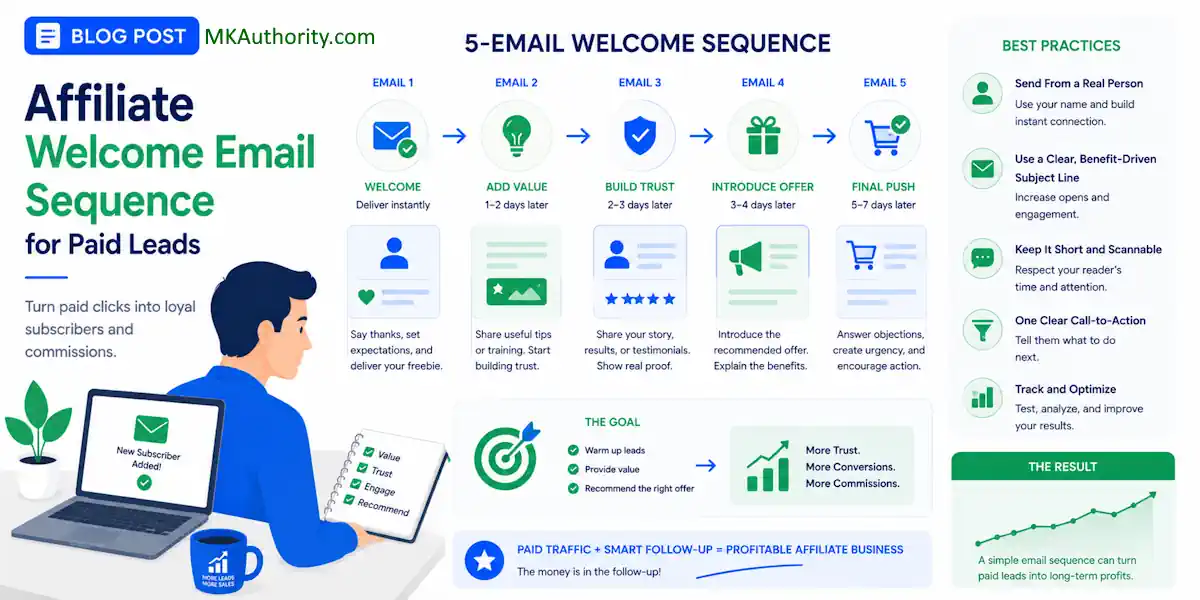

A paid lead isn’t a warm handshake. It is more like a raised eyebrow.Someone clicked, opted in, and gave you a shot. That does not mean they trust you yet. A strong affiliate welcome email sequence closes that gap fast, without rushing the sale or sounding like a hype machine for your email list.
If you buy traffic for affiliate offers, business opportunities, or home-based income products, your first few emails do most of the heavy lifting. This welcome series is where the real work starts as you begin to build a relationship with these new subscribers.
Key Takeaways About An Affiliate Welcome Email Sequence
- Create Message Match: Ensure your first email creates a seamless transition from your ad and landing page rather than jumping immediately to a hard pitch.
- Prioritize Trust Over Hype: Build authority by sharing honest lessons and addressing common industry mistakes instead of relying on unrealistic income fantasies.
- Use a Structured Hand-off: Follow a multi-day sequence—delivering the promised asset, providing value, setting buying criteria, and addressing objections—before introducing the core offer.
- Focus on Single-Goal Emails: Keep each email focused on one specific job to avoid overwhelming the subscriber and to maintain high engagement levels.

Why paid leads need a different kind of welcome
Organic subscribers usually know you a little. Paid leads often don’t. They came from an ad, a quiz, a bridge page, or a lead magnet. They’re curious, but cautious.
That changes the job of your welcome sequence, which serves as the essential onboarding process for your new audience.
With new paid leads, the first goal isn’t to pitch harder. It’s to create message match. The email should feel like the natural next step in the customer journey from the ad they clicked and the page where they opted in.
If your ad promised a simple traffic lesson and the first email jumps straight to buy now, you lose people before they even see your offer.
You must ensure your value proposition remains consistent from the first click to the inbox to keep them engaged.
Your first email doesn’t need to close the sale. It needs to make the lead glad they clicked.
A good affiliate welcome email sequence does four things in order:
- It confirms they made the right choice.
- It delivers the thing they expected.
- It shows them how you think.
- It moves them toward the core offer with context.
That order matters. Paid leads don’t like sharp turns. They want a clean path.
This is even more important in affiliate marketing because you’re often borrowing trust. You’re asking a stranger to consider a product, program, or business system you don’t own. That means your emails need to sound grounded.
Clear claims.
Plain benefits.
No income fantasy.
No magic shortcuts.
Just a believable next step.
Build trust before you hand off to the offer
The best sequence starts before you write a single subject line. You need a simple plan for the first five to seven days focused on intentional trust building.
Think in stages.
- Email one is the receipt and reset.
- Email two adds a useful idea.
- Email three introduces the buying lens.
- Email four handles friction.
- Email five makes the handoff.
That structure keeps your emails from feeling random.
For affiliates, trust usually comes from three things. First, you understand the lead’s problem. Second, you can explain the path in simple terms. Third, you don’t promise what the offer can’t deliver.
That means your welcome emails should include social proof, not giant claims. Mention your experience. Share one lesson from testing traffic. Explain a mistake most beginners make. Show them you know the terrain as you guide them toward your chosen affiliate program.
It also helps to set expectations early. Tell subscribers how often you will email. Tell them what kind of content they will get. Ask them to add your address to their’ allowlist’ or move your email to the primary tab. Those small moves improve both trust and deliverability.
If your follow-up system still feels patchy, the Profit Fundamentals email marketing course is a useful primer on list building, email marketing automation, and creating effective automation workflows for affiliate follow-up.
A sample affiliate welcome email sequence for new paid leads
Here is a simple affiliate welcome email sequence you can adapt for most affiliate funnels. It works well for traffic, training, software, and business-opportunity style offers. Use this as a working model, not a script to copy word for word.
| Send timing | Subject line ideas | Core message points | Call to action | |
|---|---|---|---|---|
| 1 | Immediately | “You’re in, start here” / “Your access is inside” | Deliver the promised asset, restate the problem they want solved, set expectations for the next few emails | “Grab your guide here” |
| 2 | 1 day later | “Most new affiliates miss this” / “Before you buy more traffic” | Teach one idea, call out a common mistake, show your approach in plain language | “Watch the short lesson” |
| 3 | 2 days later | “What a good system looks like” / “How I judge an offer now” | Introduce the criteria behind your recommended offer, pre-frame the product without hard selling | “See the system I use” |
| 4 | 4 days later | “Can this work on a small budget?” / “A fair question to ask first” | Handle objections, set realistic expectations, explain who the offer fits and who it doesn’t | “Take a closer look here” |
| 5 | 6 days later | “Ready for the next step?” / “If you want help, start here” | Make the offer handoff, recap the benefit, keep the tone calm and direct | “Get started here” |
A few things make this sequence work.
Email one should feel like a continuation, not a reset. Match the language from the ad and opt-in page. If the lead signed up for a report on affiliate traffic, use this space to deliver the asset and mention any exclusive offers available to them. Do not open with your life story.
Email two is where you earn attention. Teach something small but useful. One sharp lesson beats five fluffy tips. A subscriber should think that you truly understand their needs.
Email three is your bridge. This is where many affiliates go wrong. They drop the offer too hard and too early. Instead, explain the standard you use to judge tools, programs, or training. Then show how the offer meets that standard.
Email four is where trust grows. Handle objections without getting defensive. Budget, time, tech skills, and past disappointments come up all the time. Say the quiet part out loud.
Email five is the handoff for your product promotion. It is not about pressure or countdown drama. Just provide a clean invitation to take the next step.
Writing emails that warm leads and move the click
Every email in the sequence needs one job. One. The minute an email tries to teach, pitch, prove, inspire, and close all at once, it becomes difficult to nurture leads effectively.
Keep the body simple. Start with a hook that matches the reader’s problem. Move into one core point. End with a next step that feels natural.
A few lines that work well in an affiliate welcome series include:
- “Here’s the mistake that cost me the most time.”
- “This is what I wish someone had told me sooner.”
- “If you’re comparing options, use this filter first.”
- “You don’t need more tools yet, you need a better sequence.”
Focusing on these hooks is a great way to boost your open rates from the very first interaction.
CTAs should also match the temperature of the lead. Early emails need lower-friction asks. Think “watch this,” “read this,” or “see how it works.” Later emails can ask for the bigger move, like joining a program, starting a trial, or reviewing a product page.
By aligning the friction of the call to action with the reader’s intent, you can optimize your conversion rates and significantly improve your click-through rate over time.
The other piece is tone. Don’t sound like you’re auditioning to be an expert or coach. New paid leads can smell borrowed confidence. Write like a marketer who tests things, notices patterns, and respects the reader’s time.
By leaning into your authentic brand voice and sharing your unique brand story, you will build a stronger connection with your audience than any generic script ever could.
If you’re still building the backend of your funnel, this 30-day affiliate marketing bootcamp can help tie together traffic, branding, and email follow-up.
Deliverability and compliance still matter, even with a great affiliate welcome email sequence
A smart sequence won’t help if your emails land in spam or break basic rules.
Start with the setup. Use a real sending domain, not a random free address. Authenticate it with SPF, DKIM, and DMARC if your platform supports it. Keep the emails sent to new subscribers mostly text-based. Heavy images, spammy wording, and too many links can hurt placement.
Then watch the basics that people skip:
- Only email people who actually opted in.
- Use subject lines that match the message.
- Include an easy unsubscribe link.
- Honor opt-outs fast.
- Avoid fake scarcity and unsupported earnings claims.
- Always include a clear FTC disclosure.
- Follow CAN-SPAM and any privacy rules that apply to your audience.
Affiliate marketers need extra care here. If you are promoting income-related or business-opportunity offers, do not imply results are automatic. Ensure your promotional materials remain honest and transparent. If there are costs, say so. If the offer is not for everyone, be clear about that as well.
Compliance is not just about staying out of trouble. It helps conversion. Clear, honest messaging attracts better buyers and filters out people who were never a fit.
Track complaints and unsubscribes by traffic source. A lead source that opts in well but complains later is telling you something. Usually, the ad promise was off, the landing page overreached, or the first email came in too hot.
Proper segmentation of your data allows you to optimize your sales funnel and maintain a healthy reputation within your affiliate program.
Frequently Asked Questions
How soon should I send my first email?
The first email should be sent immediately after the lead opts in. This delivers the value they expected while they are still thinking about the ad they just clicked.
Should I promote my affiliate offer in the first email?
No, the first email should focus on delivering the promised lead magnet and confirming the subscriber made the right choice. Introducing the offer too early can feel jarring and damage the trust you are trying to build.
How many emails should be in an affiliate welcome email sequence?
A sequence of five emails over the course of a week is generally optimal. This timeframe provides enough space to deliver value, handle objections, and introduce your offer without overwhelming the subscriber.
What if I don’t have results to share as social proof?
You don’t need massive income results to build trust. You can share insights from your testing process, explain common mistakes you’ve observed, or provide a clear, honest breakdown of why you personally use the product you are recommending.
Conclusion
A successful affiliate welcome series is more than just a pile of follow-ups. It serves as a vital bridge from curiosity to genuine trust, playing a central role in your broader sales funnel.
When your welcome series matches the initial click, teaches something useful, and makes a calm handoff to the offer, your new subscribers warm up faster and convert with less resistance. This trust building is the real win; it is not about writing louder copy, but rather about refining your timing and creating a cleaner message path.
By optimizing your onboarding process and maintaining the health of your affiliate welcome email sequence list, you ensure that every participant in your affiliate program receives a professional introduction that drives long-term results.


