 Malcolm Keith 2026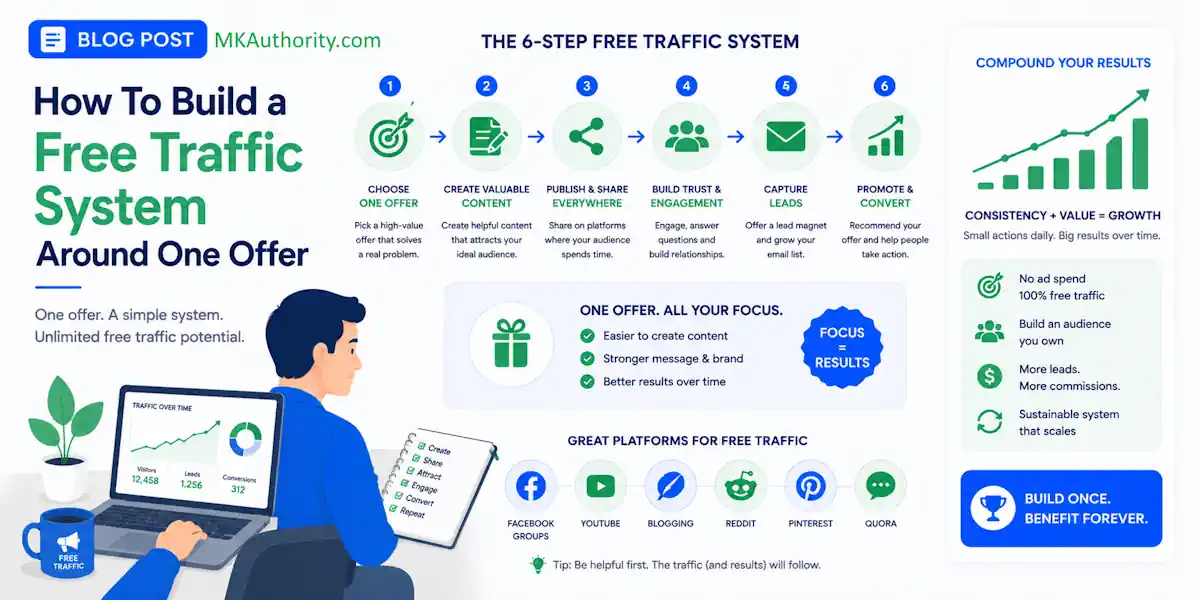

Most people do not need more traffic ideas. They need one offer, one message, and a system they can keep running next week to generate consistent website traffic. I like the idea of creating a free traffic system that has total focus on just one offer.
I do have different offers – and I do have focussed traffic on each of them. This blog, for example, is a free traffic system that creates generic traffic around tools and tips. Let’s dig deeper into creating this free traffic system.
If your content points to a different product every few days, nothing stacks. Search does not stack, trust does not stack, and your audience never truly understands your online marketing strategy.
A free traffic system works when every post, email, and conversation pushes the same simple promise.
That is where the momentum starts.
Key Takeaways On Building A Free Traffic System
- Focus on one offer: Promoting a single product allows your content to stack, building trust and clarity that is impossible when you spread your attention across multiple disparate items.
- Build a central home base: Avoid relying solely on rented social media space by driving all your traffic to a dedicated landing or review page on your own domain that guides visitors through the solution.
- Create a content loop: Use a coordinated mix of search, social media, email, and community engagement to feed traffic into your system, ensuring each channel serves a specific purpose in the conversion funnel.
- Standardize your workflow: Instead of seeking endless new ideas, take one core concept each week and repurpose it across various formats to maintain consistent output without burnout.
Why one offer beats ten
More offers feel safer, but that is rarely the case.
When you promote ten things at once, you split your attention ten ways. Your content becomes vague, your calls to action weaken, and your audience receives mixed signals.
One offer fixes that. It is a fundamental shift in your digital marketing strategy.
- You get one core problem to address.
- You gain a specific target audience to attract.
- You have one result to repeat in your content.
That repetition matters more than most people think. It turns random posts into a cohesive body of work.
Say you are promoting a beginner-friendly funnel builder, a training program, or a high-value health product. The offer itself can vary, but the rule stays the same. It needs to solve a clear problem for one specific group of people.

This is why free traffic often looks slow at first. It is not weak; it is cumulative. A blog post can climb the search engine rankings, a YouTube video can keep getting found by new viewers, and an email sequence can keep warming people up.
Each of these efforts helps you drive traffic to your business months after you hit publish.
Paid ads can speed things up, but organic traffic gives you an asset base. If you are weighing both paths, this breakdown of free vs paid traffic for affiliate marketing lays out the tradeoff well.
If a stranger cannot tell what you recommend in 10 seconds, your traffic will not compound.
One offer also makes content creation easier. You stop waking up wondering what to post. The answer is always tied to the same outcome. It is a different angle, but it leads to the same destination.
That does not make your business small. It makes it clear.
And clear converts.
Pick an offer that can carry months of content
Not every product deserves a full traffic system.
- Some offers are too narrow.
- Some solve a problem nobody is actively trying to fix.
- Some have weak sales pages, weak support, or shaky trust.
If the offer cannot hold attention, your content will not save it. A strong one-off offer has a few things going for it.
- It solves an ongoing problem, not a one-day curiosity.
- It fits naturally into daily business life or a regular routine.
- It gives you many content angles, not one tired pitch.
- It pays enough, or repeats enough, to justify your time.
For solopreneurs, recurring offers are hard to beat. Software, memberships, subscriptions, and high-quality training programs often provide the best cost-efficiency for your marketing efforts. These models not only build momentum but also allow you to attract dedicated buyer traffic that is ready to solve a specific pain point.
When your content targets the right audience, you will naturally increase conversions by addressing the unique challenges your users face. That does not mean physical products are out. A water filter, supplement, or home business tool can still work if the problem is clear and the audience is active.
Here is the simple test.
Can you create 30 useful pieces of content around this offer without sounding like a broken record? If the answer is no, keep looking.
You also want first-hand experience. Use the tool. Take the course. Try the product if you can. In 2026, surface-level content gets skimmed and forgotten.
- What holds attention now is lived detail.
- What surprised you.
- What went wrong.
- What got easier.
- What you wish you knew first.
A quick scan of this 2026 roundup of free traffic sources shows the same pattern across channels. Content wins when it speaks to a real problem and gives a real point of view.
Pick something you can talk about for six months without forcing it. That one choice makes every traffic step easier.
Build a home base before you chase views
You need a permanent destination where all your website traffic goes.
Do not rely solely on your Instagram profile or a random link-in-bio page. You need your own home base. For most people, that means a blog post, review page, comparison page, or landing page hosted on your own domain. One page can do a lot of work if it is built around the right intent.
When a visitor arrives, they want help, proof, and a next step.
Give them all three through a clean, user-friendly interface that guides them toward the solution.
A strong page usually includes:
- A plain headline that says who it is for.
- A short opening that names the problem.
- Your experience or reason for recommending it.
- A few benefits in plain English.
- Common objections and answers.
- One main call to action.
- A simple disclosure if you are an affiliate.
That is enough. You do not need a 5,000-word sales essay.
Think of this page as the dock where every boat returns. Your short-form videos, blog posts, emails, and community comments all point back here. Some people will opt in to your list first. Others will click straight through. Both are fine.
If the offer allows it, add a lead magnet that matches the same problem. A checklist, short guide, template, or mini-course works well. Keep it tight. If your offer helps people get leads, offer a simple lead-gen checklist. If your offer helps them launch a funnel, offer a one-page funnel map.
Owning the page matters because platforms shift constantly. One week Facebook groups send traffic, and the next week they do not. Search trends change and short-form platforms get crowded. However, your site is still your site.
By building content on your own domain, you also improve your long-term website ranking, making it easier for new users to find you organically over time.
People often talk about traffic like it is a faucet. It is not. It is plumbing. The page structure matters, or the flow leaks out before it reaches the offer.
Use four free traffic channels that feed each other
A good free traffic system does not try to win everywhere. It picks a few channels that support each other.
This simple mix works well for most creators, affiliate marketers, and small business owners:
| Channel | Main job | Best format | Next step |
|---|---|---|---|
| Search content | Capture intent | Blog posts, reviews, comparisons | Visit your hub page |
| Social media marketing | Create discovery | Reels, Shorts, TikToks | Read, watch, or join your list |
| Build trust | Welcome series, quick tips, stories | Click to the offer | |
| Communities | Start conversations | Helpful replies and discussion posts | Move people to your content |
Search is where people raise their hand. They already want help. That is why articles like reviews, alternatives, tutorials, and “how I use it” posts keep working.
Social media marketing is where you get seen.
The job here is not to close the sale. The job is to spark interest and generate traffic through discovery. A 30-second video can open the loop, while your page or email closes it later.
Email is the bridge most beginners skip. It is a big mistake. You may only get one clean visit from social channels, but an email list gives you more chances to educate without chasing people around the internet.
Communities still work in 2026, but only if you act like a person. Reddit, Facebook groups, niche forums, and comment sections can send strong traffic. Show up to answer, not to spray links. By engaging authentically, you improve your traffic flow and move users toward your hub naturally.
An overview of affiliate traffic sources is useful if you want a broader look at where organic attention still lives.
If you want more old-school and modern ideas in one place, this list of best free traffic sources for affiliate marketing is worth a look.
The magic is in the loop. Search content gives you depth, social media gives you reach, and email gives you follow-up. Communities give you real language straight from your market. When these channels work in harmony, you find the most sustainable way to get traffic for free.
That is a system, not a hustle.
Turn one idea into a week’s worth of content
Here is where most people make this process harder than it needs to be.
You do not need seven fresh ideas every week. You only need one useful idea, stretched across the right formats to achieve automated efficiency in your workflow.
Let’s say your one offer is an email marketing platform for beginners.

Your core topic for the week is how to get leads without paid ads.
That single topic can become:
- A blog post on your site that answers the full question.
- Three short videos, each pulling one point from the post.
- One email that shares your own lead mistake and links back to the post.
- Two community replies based on questions people already ask.
- A simple lead magnet connected to the same topic.
Now every piece supports the others.
Your blog post gives search depth, your short videos give reach, your email adds trust, and your community replies put you in front of active conversations. Everything points back to the same page, and that page points to the same offer. By structuring your output this way, you create autopilot traffic that feeds your business without requiring you to reinvent the wheel every single day.
That is how content starts acting like a system instead of a random pile of posts.
If you want to see how another marketer frames this style of content engine, this free traffic affiliate marketing walkthrough can spark ideas.
The key is angle variety. Do not post the same claim in five places. Instead, change the lens for each platform.
One piece can focus on mistakes, another can compare tools, another can show your setup, and another can answer a beginner question. Same offer, different doorway.
That keeps your content fresh and relevant without breaking your focus.
A weekly workflow you can keep doing
The best traffic plan is the one you actually stick with. Effective traffic management relies on consistency, so keep your workflow light enough to run during your busiest seasons. If you are juggling a job, clients, family, or other business ventures, this approach helps you reduce congestion in your schedule and prevents burnout.
Think of your weekly rhythm as a traffic control plan:
- On Monday, collect questions. Use Google autocomplete, YouTube suggestions, comments, emails, and community threads. Pick one topic tied to your offer.
- On Tuesday, build one core asset. Write a blog post, record a long video, or map out a strong review page.
- On Wednesday, slice that core asset into short-form clips, quote graphics, email ideas, or short text posts.
- On Thursday, publish and engage. Answer questions in communities and reply to comments. Update your page if people keep asking the same thing.
- On Friday, review what moved people forward. Look at page visits, opt-ins, clicks, and replies. Carry the winner into next week.
That is it. There is no need for a giant content calendar or a ten-platform circus.
Most solopreneurs can handle three 60 to 90-minute work blocks a week. If you have more time, focus on improving quality rather than multiplying offers.
You can even experiment with basic traffic software to automate scheduling or analytics, which helps you stay organized without manual overhead.
One warning, however. Don’t spend the whole week researching, as research is often fear wearing glasses. Avoid any self-imposed lane closure that stops you from publishing the page, posting the clip, or sending the email. Your progress depends on consistent movement.
Over time, your weekly work turns into a library. Ten good articles become thirty, thirty shorts become ninety, and a short email sequence becomes a quiet sales rep working every day.
And once this free system is producing clicks and sales, paid ads can amplify what already works. If you reach that stage, these best paid traffic sources for affiliates can help you scale without guessing.
Measure the few numbers that matter
Traffic feels exciting. Sales feel clearer.
If your numbers do not lead you toward sales, they can waste a lot of energy. You do not need a complex dashboard to stay on track. While some advanced solopreneurs integrate traffic APIs to automate their data collection, you can start by monitoring these four essential metrics:
Hub page visits. This tells you whether your content is driving people to your main page.
Email opt-ins. This shows whether your page promise is strong enough to earn a second touch.
Offer clicks. This tells you whether people trust your recommendation enough to check it out.
Content output. This sounds simple, but it matters. No system works if you stop feeding it.
Views matter less than people think. A short video with 500 views and 20 site visits can beat one with 20,000 views and no action. The same goes for blog traffic. A small article with buyer intent can outperform a broad one that pulls empty clicks. Monitoring your real-time traffic allows you to see these patterns as they happen, helping you refine your approach without getting lost in vanity metrics.
Look for friction points.
Content gets attention but no page visits, your call to action is weak.
If page visits happen but no opt-ins, your page promise is off.
If opt-ins happen but no offer clicks, your bridge email or offer positioning needs work.
Review results every 30 days, not every six hours. Free traffic moves like planting, not like flipping a switch. Small signs matter. A rise in search impressions. More replies on your emails. Better watch time on videos. Those signals often show up before sales do.
Stay patient, but stay honest. If a topic keeps pulling attention, make more around it. If a format keeps dying, trim it.
Frequently Asked Questions
Can I promote more than one offer if they are related?
It is generally better to start with one to build momentum. Once you have a proven system that generates consistent traffic, you can introduce a second offer, but only if it serves the same audience and solves a related problem.
How long does it take for a free traffic system to work?
Free traffic is cumulative rather than immediate, so expect to invest several months of consistent effort before seeing significant compounding results. Focus on the quality of your content and your hub page structure rather than daily traffic spikes.
Do I really need an email list for a free traffic system?
Yes, an email list is the most important bridge in your system because it allows you to nurture leads who aren’t ready to buy on their first visit. Social media algorithms can limit your reach, but an email list gives you direct, reliable access to your audience.
How do I know if my offer is the right one?
A strong offer should solve a persistent, ongoing problem rather than a one-day curiosity. Test it by trying to outline 30 different content angles; if you struggle to come up with topics, the offer likely lacks the depth needed to sustain a long-term traffic system.
Final thoughts on creating a free traffic system
A free traffic system around one offer isn’t fancy. That is exactly why it works.
By focusing your digital marketing efforts on one problem, one offer, one home base, and one weekly rhythm, you create a foundation that stands the test of time. You simply need to keep showing up long enough for the pieces to connect.
The win isn’t creating more content. The win is compounding attention. When search, short-form, email, and community posts all point to the same promise, strangers stop seeing scattered activity and start seeing a business.