 Malcolm Keith 2026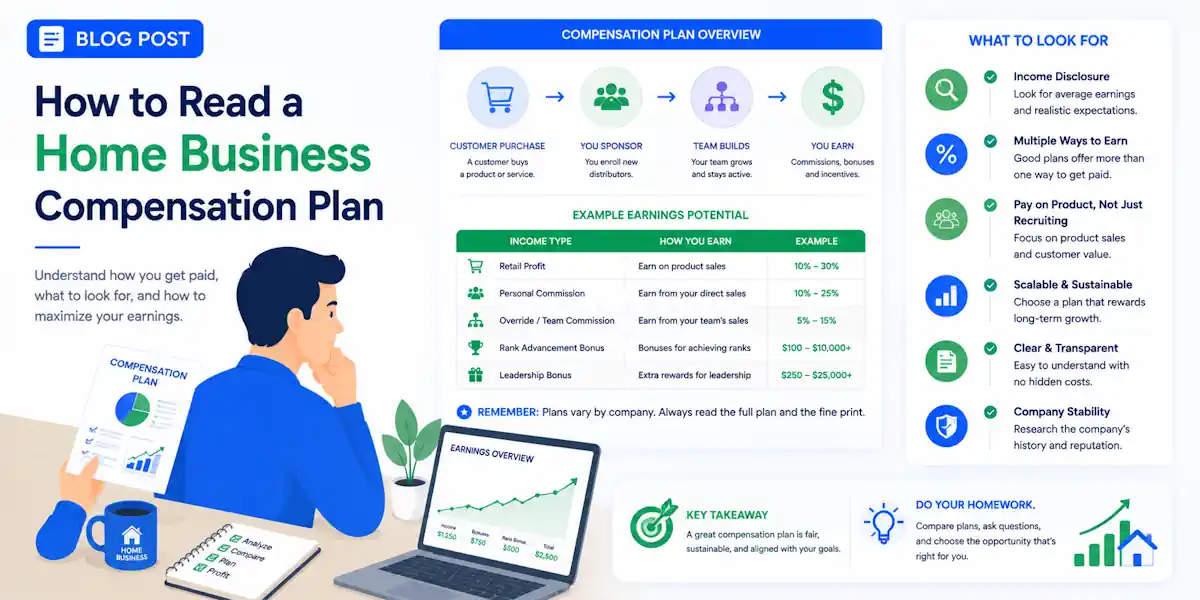

A home business compensation plan can look simple on the first page and confusing by page three. That is where many people get trapped. While the headline often sounds exciting, the actual rules frequently hide in the fine print.
Compensation plans dictate how you earn money through a direct sales, network marketing, or franchise opportunity. It outlines the specific rules, tiers, and percentages for earning commissions on retail product sales and building a team of distributors.
If you are looking at a home business compensation plan, do not read it like a marketing promotion. Instead, read it like a formal payment contract. Treat the document as a foundational business plan that defines your earning potential.
Your primary goal is to figure out what gets paid, what keeps you qualified, and what can quietly reduce your commissions.
Because pay transparency is often lacking in these documents, you must be diligent. Once you know where the money starts and where it gets blocked, the entire structure becomes much easier to evaluate and judge.
Key Takeaways on looking at a home business compensation plan
- Treat compensation documents as formal business contracts rather than marketing materials to clearly understand your earning potential and operational requirements.
- Focus on identifying the specific triggers for commissions, such as retail sales or team volume, to determine if the plan’s goals align with your daily business activities.
- Prioritize reading the fine print regarding qualification rules, such as monthly active status and rank maintenance, before getting distracted by advertised bonuses or top-tier earning figures.
- Analyze the underlying structure and limitations of the plan, including earnings caps and breakage, to distinguish between realistic income possibilities and theoretical maximums.
What a compensation plan is really showing you

At its core, any sales compensation plan serves as a map of how money moves through a business. This document is not merely about how people hope earnings will materialize or how a polished webinar explains them; it is the official breakdown of how the company distributes funds.
Start by identifying the main payout buckets. Most plans include a mix of variable compensation such as retail profit, personal referral bonuses, team commissions, rank bonuses, and matching bonuses.
A plan may list ten ways to earn, but that does not mean all ten are realistic for a new person just starting out.
Here is the first question to ask: What action creates the commission? Is it a customer sale, a personal signup, team volume, or a specific rank requirement? These triggers are designed to align your daily activities with the company’s broader organizational goals.
If you cannot trace the specific trigger required for a payout, you cannot accurately judge the plan’s viability.
A good way to read a home business compensation plan document is to follow one commission type at a time.
For example, if the plan offers short-term bonuses like a fast-start reward, find out who must buy what, when the purchase must happen, and whether future refunds claw that commission back. Once you grasp that, move to the next bonus category.
If you cannot explain how one bonus works in plain English, you probably do not understand it yet.
You will also want to spot the underlying structure. Some plans are unilevel, some are binary, and others use a matrix. If the company uses a fixed-width model, this explanation of matrix commission structures can help you read the layout faster.
Do not get distracted by the biggest number on the page. A plan that says “earn up to” may require rank, volume, and team conditions that most people never reach. The document is telling you more than what is possible. It is clearly defining exactly what has to happen before you receive a payout.
The terms that usually cause the most confusion
Most compensation plans rely on industry shorthand. Once you understand the language, the document stops feeling like a confusing puzzle. It is important to remember that these are commission-only roles. Unlike a traditional job, you will not receive a base salary, so understanding how your efforts translate into income is vital.
This quick table covers the terms that show up again and again.
| Term | Plain meaning | Simple example |
|---|---|---|
| PV | Personal volume, usually your own purchases or direct customer sales tied to you | You need 100 PV this month to stay active |
| GV | Group volume, volume from your team or organization | Your team produces 2,000 GV this month |
| Active status | The minimum you must do to qualify for commissions | Buy or sell enough to stay eligible |
| Frontline | The people you personally enroll or sponsor | You sign up three people, they are your frontline |
| Downline | Everyone below you in the organization | Your frontline plus the people they bring in |
| Compression | A rule that can skip inactive members and move volume or payout upward | An inactive account is bypassed for commission purposes |
| Payout percentage | The share of company sales allocated to the compensation plan | The company says 40 percent of volume funds commissions |
| Caps and breakage | Caps limit earnings, breakage is unpaid commission the company keeps when rules aren’t met | You qualify for more, but a monthly cap stops the payout |
These terms are not inherently negative, but the way they are applied matters.
A plan might advertise specific commission rates, yet half the product catalog might not count toward your total volume. Similarly, a tiered commission structure can sound lucrative, but you must check if only certain legs, customers, or product packs qualify for the higher levels.
Look closely for accelerators and decelerators within the fine print. Accelerators can help you reach higher earnings faster as you hit specific milestones, while decelerators, such as strict volume requirements or earnings caps, can slow your progress significantly.
Compression is another key area to investigate.
While it can help active members when inactive accounts are skipped, it might only apply to specific bonuses. You need the exact rule, not the marketing version.
The payout percentage is another spot where readers get fooled. If a company claims it pays out 50 percent, that does not mean you receive 50 percent of your total sales. It means the company allocates that portion across the entire field, subject to all rules, ranks, and caps.
Finally, consider breakage. This is the money that remains unpaid because people missed a requirement, hit a cap, or had volume that did not qualify. High breakage can make a plan look generous on paper while remaining quite stingy in actual practice.
Are you open to generating some extra ‘side hustle’ income?
The Home Business Academy™ Compensation Plan
And Affiliate Program May Be Just What You’re Looking For
FIND OUT MORE
Read the qualification rules before you read the bonus chart
This is where a lot of people get burned. They study the commission examples, then skim right past the conditions. Treating your venture like a legitimate small business requires you to look beyond the flashy numbers and understand how your daily activities translate into results.
Look for the monthly minimums first. Do you have to place a personal order? Can customer sales count instead? Does active status require a dollar amount, a point amount, or a set number of customers? Because there is no guaranteed base salary in this model, your ability to meet your revenue goals depends entirely on these specific criteria.
Small wording changes matter here, as they directly impact your quota attainment each month.
Then check what unlocks team commissions. Some plans let you earn on group volume right away. Others require two or three personally enrolled active people first. Some need one person on each side. Some require a customer count before any residual income starts.
Ask these questions as you read:
- What exactly makes me active each month?
- Can retail customer sales satisfy that requirement?
- Do I need personally sponsored people to unlock team pay?
- What volume counts, and what volume does not count?
- What happens if I miss a month or lose rank?
Rank maintenance deserves extra attention. Hitting a rank once is one thing; holding it every month is another. A plan may advertise a strong bonus at a certain rank, but if that rank needs high monthly group volume, balanced legs, and a minimum number of active frontline members, it may be hard to keep.
Much like the importance of employee retention in a traditional company, maintaining the stability of your downline is essential for consistent earnings.
You should also look at how much the plan depends on recruitment.
If most income paths only open after personally enrolling people, that is a major point to weigh. A healthier plan usually has a clear retail path, not only a recruiting path, to ensure your total rewards are sustainable.
This is also the moment to read the income disclosure statement. Not the slide deck, not the webinar summary, not the income story from one top earner. The disclosure shows what participants actually earned, how many earned at each level, and often how many earned little or nothing before expenses.
When plans get too complicated, people stop trusting what they are reading. That is one reason simplified pay plans reduce customer churn. Confusion does not help the company, and it does not help you either.
The red flags that deserve a second look
A flashy payout number is rarely the whole story. If a plan claims it pays up to 80 percent, stop and ask exactly who receives those funds, under what conditions, and how often. To verify if these promises are realistic, compare them against industry market data to see if the earning potential aligns with standard performance expectations for a small business.
Watch for heavy use of rank-based language without clear entry-level examples. Be wary of bonuses that sound large but depend on deep team activity beyond your direct control.
Keep an eye out for complex commission types that only appear after multiple layers of qualification, or corporate terms like SPIFs (Sales Performance Incentive Funds) and MBOs (Management by Objectives) that may signal temporary incentives rather than sustainable pay.
Additionally, consider that unlike a traditional corporate job, you lack a formal benefits package, which should be factored into your evaluation of the total compensation.
Pay attention to earnings caps. Some plans limit weekly pay, monthly match bonuses, or commissions per leg. That is not always a deal-breaker, but it changes the math significantly, potentially turning a strong month into a much smaller check than you expected.
Look closely at product and customer requirements as well.
If the plan mostly rewards high startup costs associated with enrollment packs, internal inventory purchases, or mandatory monthly autoship programs, you need to determine if real customer demand is actually driving the revenue. A simple test helps: would this plan still make sense if nobody recruited for 30 days and only customers bought products?
Refund rules matter as well. While it is normal for commissions to be clawed back following returns or chargebacks, you need to understand the timing. A bonus received today can easily disappear next month.
Compensation plans vary by company and are often revised. Always review the official documents and the current income disclosure statement before making a decision. If the company cannot provide both clearly, that is a warning sign that requires further investigation.
Frequently Asked Questions
What is the difference between PV and GV?
PV stands for Personal Volume, which represents the sales or purchases tied directly to your own account. GV stands for Group Volume, which represents the total sales volume generated by your entire team or organization.
Why does the “payout percentage” not represent my actual income?
The payout percentage is the total portion of company revenue allocated to all commissions across the entire organization. It does not mean you personally receive that percentage of your sales, as the money is distributed according to complex rules, rank requirements, and caps.
How can I tell if a compensation plan is legitimate?
A legitimate plan should prioritize revenue driven by actual customer demand rather than just recruitment fees or inventory loading. You should always review the official income disclosure statement to see what the average participant actually earns before expenses.
Final thoughts
The best way to read a compensation plan is to slow it down. Strip away the excitement and ask plain questions: what starts a commission, what keeps you qualified, and what can stop the payout.
A solid home business compensation plan should make sense without mental gymnastics. Unlike a traditional job with a fixed base salary, this model relies on performance-based pay. It is important to realize that there is no guaranteed salary structure; instead, you are operating a home-based business where your earnings are tied directly to your results.
While top leaders might mirror an executive compensation model, your focus should remain on building a foundation that supports long-term incentives.
If you can explain the rules, the terms, and the limits of the home business compensation plan in plain English, you are in a much better position to judge whether the opportunity is realistic and sustainable for your financial future.