 Malcolm Keith 2026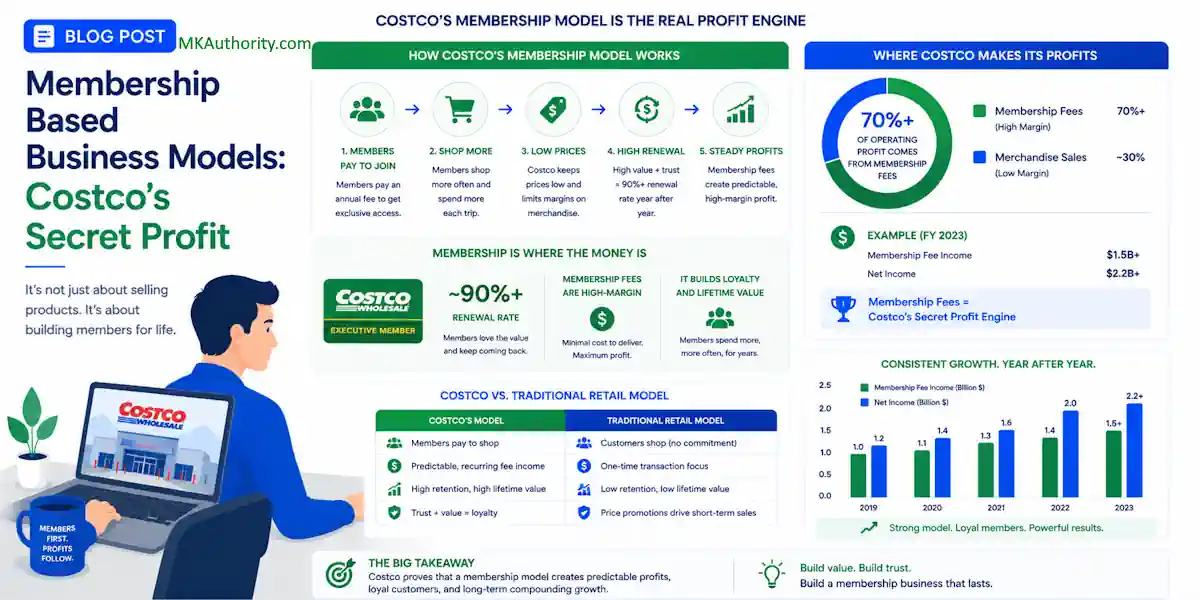

A fellow member in the Home Business Academy put up a post he was reading about membership based business models. The content, while focused on Costco, reminded me of a couple of online businesses I promote which have a subscription. I pay either a monthly or yearly subscription to get access to quality products for a significant money saving.
It is solid food for thought if you care about membership based business models and the power of a subscription business model.
For instance, I use LiveGood which offers two primary membership plans to unlock wholesale pricing on their top quality wellness products:
Monthly Plan: $9.95 per month
Yearly Plan: $99.95 per year (saves 20% compared to monthly)
These memberships grant access to discounted, wholesale prices across their entire product catalog, with savings of up to 75%.
I also use all of the memberships available in the Home Business Academy because of the huge amount of training and tools I get for a fraction of the price it would cost me to get them separately.
For CostCo, the membership based business model IS the business
Costco loses money on its hot dogs. It loses money on its rotisserie chickens. Barely breaks even on most of what it sells in the warehouse. It has more than 130 million members paying $65 to $130 a year, and its renewal rate is around 93%.
The losses are part of the plan. Membership is the business.
Costco’s CEO said it plainly, “The most important item we sell is the membership card. Everything we do supports that transaction.”
- Not the $1.50 hot dog.
- Not the $5 rotisserie chicken.
- Not the giant pack of toilet paper.
The membership card
Key Takeaways On Membership Based Business Models
- When analyzing membership based business models, it is clear that recurring revenue is the lifeblood of the company.
- Costco succeeds by using a subscription business model to prioritize member value over retail markups.
- By focusing on customer retention through high-value loss leaders, these membership based business models create predictable revenue streams that outperform traditional retail.
- Ultimately, the membership business model thrives when the recurring benefit outweighs the cost of the subscription.
Last year, Costco brought in over $254 billion in revenue. Membership fees were less than 2% of that total. Even so, those fees made up about two-thirds of the company’s total profit. In this subscription business model, these recurring payments ensure the company remains profitable regardless of fluctuations in product sales.
In several recent years, Costco would have shown a net loss without those recurring revenue streams.
Take away the membership card and the whole thing falls apart.
That is not a normal retailer. Jt is a membership company that uses a warehouse full of bargains as the reason people keep paying dues. That is why membership based business models work so well when the offer is strong and the value is obvious. It is a masterclass in driving customer retention while keeping the churn rate exceptionally low.
Back in 1954, an 18-year-old kid in San Diego got hired as a grocery bagger at a discount store called FedMart.
His name was Jim Sinegal.
FedMart was run by Sol Price, a man with a sharp idea about retail. Sell quality products at the lowest possible prices. Pay workers better than the rest of the industry. Treat customers with honesty. His pricing strategies and clear value proposition focused on volume, not big markups.
Sinegal was hooked. He watched everything Price did, how he priced items, how he dealt with suppliers, how he ran the business, how he treated people.
Over the next 25 years, Sinegal moved up from bagger to executive vice president. He later left FedMart to follow Price to his next venture, a membership-based warehouse store called Price Club.
Price Club was the first of its kind. You paid a fee to get in the door.
Once you were inside, everything was priced just above wholesale. The idea was simple. Pay the membership fee, then save more than that on the stuff you buy all year long. This early form of a subscription business model proved that a predictable revenue stream could sustain massive growth.
It worked. By the early 1980s, Price Club had 10 locations and was doing more than $366 million in sales.
Still, Sinegal wanted to build his own version. He wanted to take what he learned from Sol Price and scale it across the country.
In 1983, Sinegal and Seattle retailer Jeff Brotman co-founded Costco Wholesale Corporation. The first warehouse opened in Seattle on September 15, 1983.
The launch was nothing special. But the model worked. Within months, they opened a second location in Portland and a third in Spokane. By December 1985, Costco went public at $10 per share with 17 warehouses.
From day one, Sinegal ran the company by rules that made Wall Street uneasy.
He capped markups at 12% to 15%. Most retailers mark items up 25% to 50%, or more. Costco left money on the table on purpose, on every product it sold, effectively prioritizing customer experience over immediate margins.
He paid employees far better than the industry norm. More than 90% of Costco workers qualified for employer-sponsored health insurance, compared to the retail industry average of just under 60%.
He answered his own phone. His office had a secondhand desk. He held his own salary to $350,000 a year while rival CEOs were taking home tens of millions.
Analysts hated it. They said he was leaving profit in the aisle.
He said he was building a company that would still be here 50 years later.
Then came the decision that shaped the whole business!
Sinegal knew the warehouse full of cheap products was not the real business. It was the hook.
The membership card was the business.
Every item in a Costco warehouse is priced as close to cost as possible. The company makes very little on the products themselves. The merchandise is there to prove your membership is worth renewing, similar to how a SaaS company uses features to reduce churn.
And it works.
Costco’s membership renewal rate is over 90%. In the US and Canada, it’s around 93%. That is not the kind of subscription people forget about. That is the kind of subscription people want to keep.
More than 130 million people around the world pay Costco for the right to shop there
The standard membership is $65 a year. The executive membership is $130. This tiered pricing model ensures that those with higher demand pay more, maximizing the customer lifetime value. Those recurring payments go almost straight to the bottom line because there is very little cost to collect them.
In fiscal year 2024, Costco brought in $4.8 billion in membership fees. That $4.8 billion was nearly two-thirds of the company’s total net income of $7.37 billion.
The other $249.6 billion in product sales barely changed the profit picture. That is because it is not supposed to. The products exist to justify the membership. Not the other way around.
Costco is not selling cheap stuff. It is selling the right to buy cheap stuff. The card is the product.
And then there’s the hot dog..
In 1985, Costco started selling a quarter-pound hot dog and a 20-ounce soda for $1.50.
Forty years later, the price is still $1.50.
Everything else has gone up. Gas. Rent. Groceries. Healthcare. A McDonald’s combo costs about three times that.
Costco’s hot dog hasn’t moved a penny.
Not because it makes financial sense.
It doesn’t. The company was losing money on every hot dog it sold.
When CEO Craig Jelinek asked founder Jim Sinegal about raising the price, Sinegal gave the most famous answer in retail history.
“If you raise the effing hot dog, I will kill you. Figure it out.”
So they figured it out. Costco built its own hot dog plants, one in Los Angeles and one in Chicago. They switched from Hebrew National to their own Kirkland Signature brand. They took control of the supply chain, cut out the middleman’s margin, and found a way to keep the price at $1.50 while making the numbers work.
Costco now sells close to 200 million hot dogs a year, all at $1.50 each.
The hot dog is not just a menu item. It is a message.
A brilliant example of customer engagement that reinforces brand loyalty. It tells every member walking out the door:
- that this company will fight to keep prices low
- the savings are real
- reminds them why the membership matters
When asked if the price would ever rise, former CFO Richard Galanti called it “sacrosanct” and said the $1.50 hot dog would last “forever.”
The $5 rotisserie chicken works the same way. Costco reportedly loses money on every chicken. It sells nearly 140 million of them each year. It even built its own poultry processing plant in Nebraska so it could hold the price at $5 after competitors raised theirs.
The hot dog and the chicken are not the business. They are retention tools. Every time someone grabs that $1.50 hot dog on the way out, they are getting reminded why they pay the annual fee. It is a physical manifestation of their commitment to the subscription economy.
In 1993, Costco merged with Sol Price’s Price Club.
In 1997, the combined company took the Costco Wholesale name. Jim Sinegal’s path from grocery bagger to CEO was complete.
Today, Costco runs more than 900 warehouses around the world. Annual revenue is over $275 billion. It is the third-largest retailer in the world.
Its private label brand, Kirkland Signature, brings in about $86 billion a year on its own. That one store brand does more sales than most Fortune 500 companies.
Membership renewal rates have stayed above 90% for years. This stability is the hallmark of an effective subscription business model, providing a predictable revenue stream that investors love. By leveraging customer data to optimize their offerings, Costco maintains a superior customer experience compared to standard retailers.
An investor who put $10,000 into Costco stock in 1992 would have seen it grow to more than $43,000 just 10 years later. Since the company went public in 1985, the stock has climbed roughly 19,000%.
All from a company that intentionally makes very little on what it sells.
A grocery bagger learned from Sol Price, built a business that charges people a fee to walk through the door, sells products near cost to keep them coming back, and gets two-thirds of its profit from a little plastic card.
The warehouse is not the business.
The products are not the business.
The $1.50 hot dog sure isn’t the business.
The membership card is the business.
Everything else is there to make that card feel worth renewing.
That is not a retailer.
That is a membership based business model company that happens to have a warehouse.
It’s why membership business model structures, much like a SaaS platform or a well-oiled subscription box, get so much attention in affiliate offers and recurring income setups. The first sale matters, but the real math shows up when people keep paying.
Whether you use usage-based pricing, a freemium model, or automated billing, the goal is always the same: lowering your customer acquisition cost while scaling your monthly recurring revenue.
Does your business make money from what it sells, or from the relationship that keeps people coming back? The subscription economy proves that when you master your membership business model, you are no longer just selling a product, you are selling a long-term commitment. By focusing on subscription management and optimizing the customer experience, you build a foundation for lasting success.
Frequently Asked Questions
Why does Costco lose money on popular items like the hot dog and rotisserie chicken?
These items act as “loss leaders” that demonstrate the company’s commitment to low prices and provide immediate, tangible value to the customer. By keeping these prices artificially low, Costco reminds members why their annual dues are a worthwhile investment, which drives the high renewal rates necessary for membership based business models to succeed.
Is the membership fee really the company’s primary source of profit?
Yes, while Costco generates hundreds of billions in revenue from product sales, the profit margins on those goods are razor-thin. The annual membership fees contribute a massive portion of the company’s total net income, often accounting for roughly two-thirds of their annual profits within the subscription business model.
How does the Costco model apply to modern subscription businesses?
Costco demonstrates that the key to a successful subscription business model is building a strong value proposition that makes the recurring fee feel like a bargain. Just as a SaaS company uses features to reduce churn rate, Costco uses warehouse savings and exclusive benefits to ensure that members view their membership as an essential, high-value asset.
Conclusion On Using Membership Based Business Models
A business should consider this model if they can provide high-value, recurring benefits that make a membership fee feel like a strategic investment for the customer. You must evaluate if you can consistently deliver enough value to ensure long-term retention, as this business model prioritizes lasting customer relationships and long-term retention over one-time transaction margins.
A business should consider this model if they can offer recurring, high-value benefits that make a membership fee feel like an investment rather than a cost. You must determine if you have the ability to provide consistent value that keeps customers returning, as this model relies on
Common pitfalls in membership based business models include failing to deliver consistent, perceived value that justifies the recurring cost, which often leads to high churn rates. Companies also struggle when they underestimate the operational complexity of managing long-term customer relationships or when they neglect to balance membership benefits with the actual costs of product delivery.
Without a clear value proposition that makes the subscription feel like an investment, the model quickly loses its primary source of growth.