 Malcolm Keith 2026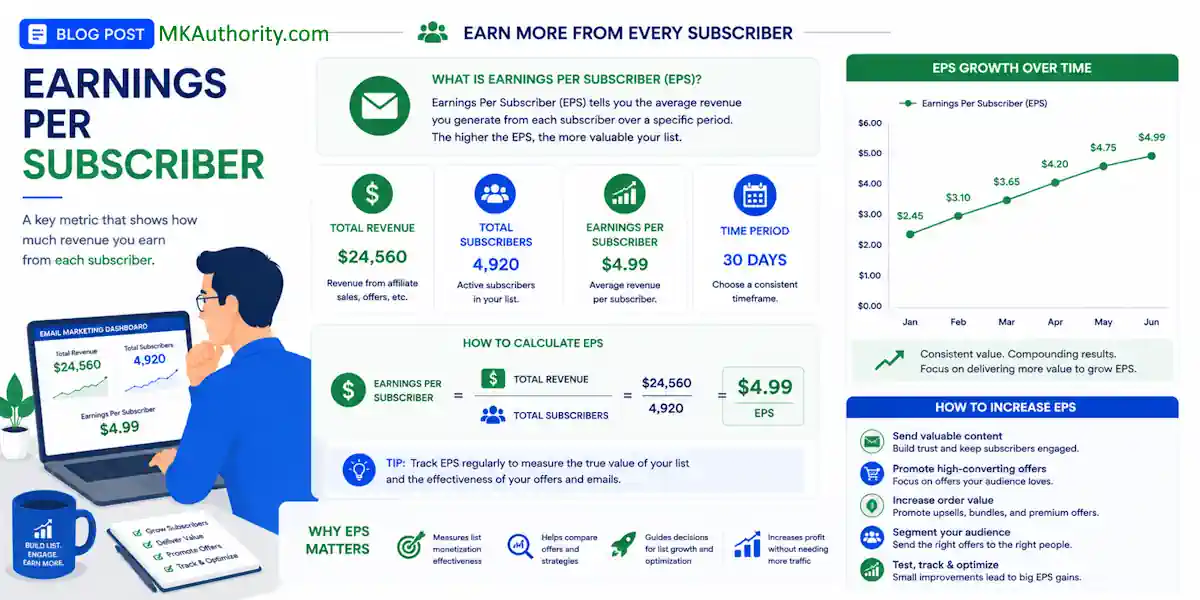

A large email list can still be a weak business. Whether you are an email marketer or one of the many modern content creators looking to monetize your audience, hitting that first 1,000 subscribers is a major milestone. However, the true value of your efforts lies in your earnings per subscriber, also sometimes discussed as RPS (revenue per subscriber).
If you run affiliate marketing campaigns and only track total commissions, you are missing the number that tells you what your list is really worth. Earnings per subscriber gives every campaign a simple money score, and that makes business decisions much easier.
Once you have this data, you can stop guessing which emails, offers, and segments are actually pulling their weight.
Key Takeaways On Earnings per Subscriber
- Measure True Value, Not List Size: A large subscriber count can mask poor performance; Earnings Per Subscriber (EPS) tells you the actual economic value of your audience by showing how much revenue each individual generates.
- Use the Right Formula: To find your EPS, divide your net earnings (after refunds and reversals) by the number of unique subscribers involved in that campaign or time period.
- Ensure Consistency: Always use unique subscribers rather than total sends to avoid inflated or inaccurate data, and be consistent with your reporting windows to make meaningful comparisons.
- Drive Smarter Business Decisions: EPS allows you to compare different segments, traffic sources, and offers, enabling you to optimize your marketing spend and identify which audience groups are the most profitable.
What earnings per subscriber actually tells you
Think of earnings per subscriber, or EPS, like revenue density. Two campaigns can both make $500, but they are not equal if one needed 1,000 subscribers and the other needed 5,000.
For many content creators, this concept is similar to how they view video views. Just as a high view count does not always guarantee high value, the size of your email list does not tell the whole story. While creators often use metrics like CPM or RPM to measure the revenue density of their video content, EPS provides a distinct perspective on the specific value of your email audience.
EPS answers a plain question: how much money did each subscriber produce?
For affiliate marketing email campaigns, that usually means taking the net affiliate revenue tied to a campaign and dividing it by the number of unique subscribers who were part of that campaign. If you are looking at a longer period, like a month or quarter, you can divide total net affiliate earnings by your average active subscriber count for that period.
EPS is a list-value metric, not a click metric.
That difference matters. Clicks tell you who got curious. Subscribers tell you what your audience is worth.
There isn’t one universal denominator for every setup, so pick the version that matches your goal and stick with it. For a single send, you might use unique subscribers who received the email. A five-email promo sequence, use unique subscribers in the sequence, not total sends. For monthly list value, use average active subscribers, not your all-time subscriber total.
The rule is simple: be consistent. If you change the denominator every time, EPS becomes noise.

The formula in plain English
Here is the campaign version most affiliate marketers need first:
Campaign EPS = Net affiliate earnings from the campaign / Unique subscribers who received the campaign
Here is the broader list-value version:
Period EPS = Net affiliate earnings during the period / Average active subscribers during the period
“Net affiliate earnings” means money after reversals, refunds, and canceled commissions. This calculation also applies beyond email marketing. You should incorporate ad revenue from your newsletters or website traffic into your total earnings. Furthermore, if you are a creator in the YouTube Partner Program, your net earnings calculation should include income from sponsorships and brand deals to get a true picture of what your audience is worth.
To calculate your earnings per subscriber without making a mess, follow these three steps:
- Pull the total net revenue tied to the specific campaign or time period, including all affiliate commissions, ad revenue, and brand partnerships.
- Clean the subscriber count so you are working with unique people, not duplicate records or total sends.
- Divide the net earnings by that total unique subscriber count.
Say you mailed 4,000 unique subscribers and earned $800 in locked-in commissions. Your EPS is $0.20. That means each subscriber on that campaign was worth 20 cents.
If you want to model future results before you send, tools like Reditus’s affiliate revenue calculator can help you test conversion assumptions. If you promote recurring offers, Refgrow’s SaaS commission calculator is useful for seeing how payout structure changes the math.
One more thing. If you sent a broadcast, then a resend to non-openers, don’t count both sends as separate subscriber groups unless your goal is revenue per send. For EPS, you usually want unique subscribers reached by the campaign.
Worked examples you can use today
Simple numbers make this click fast.
First example, a single affiliate broadcast:
You send one promo email to 5,000 unique subscribers. The offer earns $1,250 in net commissions after reversals settle. Your calculation is $1,250 / 5,000 = $0.25 EPS.
That means every subscriber on that send was worth a quarter.
Now look at a segment. You email only your 1,200 most engaged subscribers about a tighter, better-matched offer. That campaign brings in $480 net. The math is $480 / 1,200 = $0.40 EPS.
The second campaign made less total cash, but the subscriber value was much higher. That is the kind of result total revenue can hide.
This quick table shows how that looks side by side:
| Campaign | Unique subscribers | Net earnings | EPS |
|---|---|---|---|
| Full-list promo | 5,000 | $1,250 | $0.25 |
| Engaged segment promo | 1,200 | $480 | $0.40 |
| Follow-up sequence | 800 | $240 | $0.30 |
The takeaway is not to always send smaller segments, but rather that efficiency matters.
Comparing these to other channels like social media can be eye-opening. For instance, you might have a video that hits 1 million views on YouTube Shorts. While those high video views seem impressive, the engagement rate often lacks the depth of an email list.
Even with sponsorships integrated into your content, a video campaign might result in a lower EPS compared to a targeted affiliate marketing email. High video views are great for reach, but they often struggle to convert at the same rate as a curated email audience.
Let us push it one step further. Say you run a three-email campaign for 2,000 subscribers and make $600 total across all three emails. Your EPS is $600 / 2,000 = $0.30. Do not divide by 6,000 total sends unless you are measuring revenue per send or revenue per recipient across each message.
For EPS, you are measuring subscriber value across the campaign.
This is why EPS is so useful for affiliate email marketers. It turns fuzzy email performance into something you can compare, rank, and improve.

EPS vs EPC vs revenue per email recipient
These three metrics sound close, but they answer different questions. Understanding how they interact with other industry standards like CPM and RPM is essential for a complete financial view.
Here is the clean comparison.
| Metric | Formula | Best use |
|---|---|---|
| EPS | Net earnings / unique subscribers | Measuring list value, segments, and campaign efficiency |
| EPC | Net earnings / clicks | Judging offer quality, click traffic, and landing-page performance |
| Revenue per email recipient | Revenue / delivered recipients | Measuring the performance of a single email send |
| CPM | (Total Cost / Total Impressions) * 1000 | Pricing ad impressions across display and video views |
| RPM | (Total Revenue / Total Pageviews) * 1000 | Evaluating overall site or content monetization efficiency |
EPC is click-based. If 250 people click and you make $500, your EPC is $2.00. That is great for spotting strong offers or better pre-sell pages. If you already track click performance, Tune’s guide to earnings per click is a solid refresher.
Revenue per email recipient is send-based. If an email is delivered to 4,800 inboxes and generates $720, your revenue per recipient is $0.15. That metric is handy when you are testing subject lines, send times, or deliverability issues.
EPS is broader. It tells you what each subscriber contributed to the campaign or period, which makes it better for long-term list strategy. While creators focused on video content might look at reaching 1 million views to track engagement and watch time, EPS helps you understand the specific economic value of the individual fan.
It is also important to distinguish between revenue sources.
While CPM measures the cost or value per 1,000 ad impressions, this focuses on advertising inventory. When you contrast pure ad revenue with affiliate earnings or product sales, EPS acts as the ultimate filter to see which segments are actually profitable.
Sometimes EPS and revenue per recipient will be the same. That happens when you send one email to one clean audience and use delivered recipients as your subscriber count. They split apart when you run sequences, resends, cross-campaign comparisons, or period-based reporting.
Use the right tool for the question:
- Use EPC when you want to know if the click traffic monetized well.
- Use revenue per recipient when you want to judge one email send.
- Use CPM to measure the cost-effectiveness of your ad impressions and placement strategy.
- Use earnings per subscriber when you want to know the economic value of your audience.
If you are building an email-first business, EPS is the one that ties the whole thing together.
Clean the data before you trust the number
Bad inputs create fake confidence.
Start with refunds and reversals. If an affiliate network shows $900 today and $180 gets reversed next week, your real campaign earnings are $720. EPS should use the settled, net number whenever possible. This is particularly important for creators meeting monetization requirements, as you must audit your AdSense account data to account for ad revenue fluctuations that occur during monthly cycles.
Watch duplicate subscribers too. Some email platforms let the same person exist under multiple tags, lists, or imports. If your denominator includes the same person twice, EPS looks worse than it is. Deduplicate by subscriber ID or email address before you calculate.
Similarly, if you are working toward the YouTube Partner Program, you need to track your growth accurately. Reaching the threshold of 1,000 subscribers and 4,000 watch hours requires clean data, as inconsistent tracking of your audience can obscure your actual progress.
Unsubscribe timing can trip people up.
If someone received the email and unsubscribed later that day, they still count for that campaign’s EPS because they were part of the audience. For a monthly EPS calculation, though, you should use your average active subscriber count across the month. In the context of video content, watch time significantly influences the platform’s view of your reach, which in turn affects the active status and perceived value of your subscriber base.
Attribution windows matter as well. A 7-day cookie and a 30-day cookie do not produce comparable EPS numbers unless you standardize the reporting window. Different programs also reverse commissions at different rates, which is one reason to use beginner-friendly affiliate platforms that are clear about tracking, locks, and payout rules.
If you promote recurring offers, be careful not to mix short-term campaign EPS with lifetime commission dreams. Count only the revenue inside the window you’ve chosen. Anything else makes comparisons sloppy.
Using EPS to make better list and budget decisions
This metric gets interesting when you stop treating it like a report-card number.
For list growth, EPS helps you judge what a subscriber is worth. Say your 60-day earnings per subscriber is $1.10, and your paid traffic cost to acquire a subscriber is $0.80. You have room to work. If your EPS is $0.35 and you are paying $1.20 per lead, the math is waving a red flag.
That matters if you are trying to build with paid traffic, solo ads, or lead generation campaigns. A step-by-step strategy for affiliate profits works better when subscriber cost and subscriber value sit on the same page.
Your content niche plays a massive role in these calculations.
For instance, a personal finance niche often commands a much higher CPM and RPM than a general entertainment blog. Furthermore, audience location significantly impacts ad revenue, which inevitably shifts your final EPS.
When evaluating these variables, use your EPS to forecast monthly income, especially when deciding whether to invest in high-production YouTube Shorts or paid promotions to drive more video views.
Segmentation is another big one. If your buyer segment pulls $0.52 EPS and your cold segment pulls $0.09, stop blasting both the same way. By monitoring your engagement rate, you can determine which groups deserve tighter offers, faster follow-up, or higher-cost lead acquisition.
Campaign comparison also becomes much cleaner. Open rates can flatter weak offers, and total revenue can flatter huge sends, but EPS strips away both illusions. You can compare one content niche against another, one angle against another, or one traffic source against another without getting lost in list size.
Budgeting becomes more grounded. If a new subscriber is worth about $0.30 in the first 30 days and $0.95 in 90 days, you can decide how aggressively to buy leads, how long you can wait for payback, and which campaigns deserve more follow-up.
That is the real use of earnings per subscriber.
It does not just sit in a spreadsheet and look pretty.
It tells you exactly where the money is.
Frequently Asked Questions About Earnings per Subscriber
How is EPS different from Earnings Per Click (EPC)?
EPS focuses on the overall value of each subscriber on your list, while EPC measures the performance of a specific offer or landing page based on clicks. While EPC tells you if your traffic is converting well, EPS provides a broader view of how your entire list contributes to your business bottom line.
Should I include ad revenue and brand deals in my EPS calculation?
Yes, you should include all net income—including ad revenue, sponsorships, and affiliate commissions—to get an accurate picture of your audience’s value. Using the total net revenue ensures that your EPS reflects the true financial impact of your subscriber base across all your monetization streams.
How often should I calculate my earnings per subscriber?
It is best to calculate EPS both per campaign to judge specific content performance and on a monthly basis to track the long-term health of your list. Maintaining a consistent schedule helps you spot trends, such as rising or falling subscriber value, which can inform your future content and acquisition strategies.
Why does my subscriber count need to be de-duplicated?
If you count duplicate records or multiple tags for the same person, your denominator will be artificially high, making your EPS appear lower than it actually is. Deduplication ensures you are measuring the actual number of unique individuals reached, which provides an honest assessment of your marketing effectiveness.
Final thoughts On Calculating Earnings Per Subscriber
A list is not valuable simply because it is large. It is valuable when your subscribers turn into reliable earnings. For content creators, this means balancing the volatility of the YouTube algorithm with a disciplined focus on your own internal metrics.
By diversifying your revenue streams, including a healthy mix of ad revenue and affiliate income, you gain better control over your business growth. Earnings per subscriber gives you a clean way to measure that value, compare campaigns honestly, and make informed decisions on traffic, offers, and segmentation.
When the metric is calculated consistently, it becomes one of the most powerful tools in your email business.
Use this quick checklist the next time you calculate earnings per subscriber:
- Pull net affiliate earnings, not raw commissions.
- Count unique subscribers, not total sends.
- Match the denominator to the reporting period or campaign.
- Remove duplicates and account for refunds, reversals, and attribution windows.
- Compare earnings per subscriber against subscriber acquisition cost before you scale.