 Malcolm Keith 2026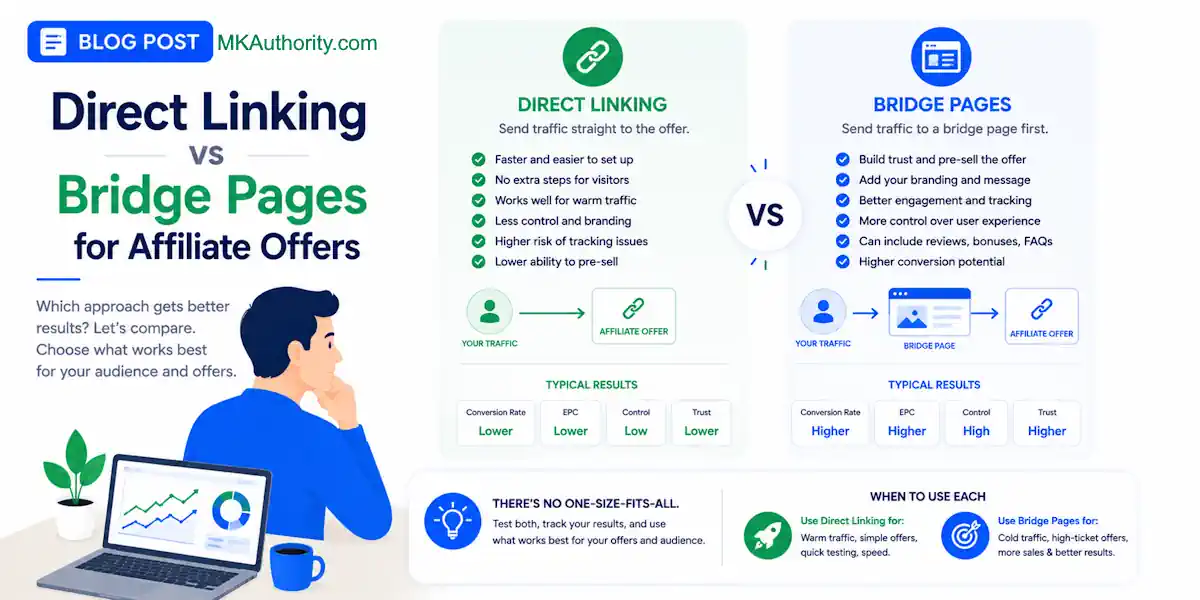

The shortest route to an affiliate offer is not always the smartest one. In the direct linking vs bridge pages debate, the real issue is control, not convenience.
If you are buying traffic, trying to keep ad accounts clean, or building something that lasts, this choice represents a critical affiliate marketing strategy that affects far more than just your click-through rate. Some offers do fine with a straight shot. Others need a page in the middle, and not a flimsy one.
Key Takeaways On Direct Linking vs Bridge Pages
- Control vs. Convenience: Direct linking offers speed and simplicity. Bridge pages provide the necessary control over the user experience and branding required for long-term sustainability.
- The Power of Pre-selling: A high-quality bridge page warms up cold traffic and filters prospects, often leading to a higher earnings per click (EPC) even if initial click-through rates are lower.
- Data Ownership: Direct linking leaves you dependent on merchant tracking, whereas owning your own landing page allows for superior data collection, retargeting, and A/B testing.
- Compliance and Safety: Modern advertising platforms, such as Google and Facebook, are increasingly hostile toward thin redirect pages; unique, value-driven pre-sell pages are essential to maintain account health.
What really changes when you add a page in the middle
A direct affiliate link sends the click from your ad, email, post, or placement straight to the merchant through your affiliate URL. There is no stop in between and no extra context from you.

An affiliate landing page adds that stop. However, people often get sloppy with terminology here. In affiliate circles, an affiliate landing page can mean a thin hand off page, a review page, a pre-sell page, or a short quiz funnel. Platforms do not treat those as the same thing.
A thin bridge page is usually weak. It often consists of a headline, a button, and a push to the merchant. A high-quality pre-sell page is different. It adds original copy, frames the problem, answers objections, and gives the click a reason to continue.
That difference changes the user journey and the overall user experience. With direct linking, the merchant owns almost everything after the click. The page design, the headline match, the trust signals, the form length, and the final close are all in their hands. You are essentially renting the traffic and hoping the merchant converts it.
With a strong pre-sell page as an intermediate step, you control the first impression.
You set expectations before the merchant sales page ever loads. That matters significantly when the offer is expensive, unfamiliar, or tied to a sensitive niche like health claims, financial products, or business opportunities.
Think of it like this: a direct link is dropping a prospect at the store entrance. A bridge page is walking them to the right shelf and telling them why that shelf matters.
That extra step can hurt if the offer is simple. It can help a lot if the offer needs trust. A quick insurance quote or email submit may not need a warm up. A recurring software tool, a coaching application, or a home business offer usually does.
Direct linking vs bridge pages, conversion rate, attribution, and how much data you actually own
Direct linking often wins on raw speed. Fewer clicks mean fewer chances to lose the visitor. If the merchant already has a polished page and the offer is low-friction, that can work well.
But more direct does not always mean more profitable. A bridge page can lower the initial click-through rates and still raise earnings per click because it filters weak traffic and warms up stronger buyers. That is why the most efficient sales funnel on paper does not always produce the best conversion rates in the tracker.
Here is the side-by-side view that matters most:
| Factor | Direct linking | Bridge or pre-sell page |
|---|---|---|
| User journey | Shortest path | One extra step |
| Presell value | None from you | You frame the offer first |
| Click-through rates | Often higher | Often lower on the first click |
| Final EPC | Strong on simple offers | Strong on trust-heavy offers |
| Tracking depth | Limited by network and merchant | Better first-party data and event tracking |
| Approval risk | Higher on paid search | Higher if thin, lower if useful |
| Long-term asset | Almost none | Page, list, angles, and remarketing data |
The big takeaway in direct linking vs bridge pages is simple:
Direct links can win the click, but a real bridge page can win the sale.
Tracking is where this gets serious. With a direct link, your visibility often stops at the outbound click unless the network supports subids and reliable server-to-server postbacks. If the merchant has poor attribution, delayed reporting, or cross-device gaps, you are flying half-blind.
With your own page, you gain superior tracking and analytics, allowing you to tag visits, pass click IDs, and compare ad-to-page message match against network conversions. By implementing A/B testing and split testing, you can optimize your angles to improve your overall conversion rates.
Whether you are running complex offers or simple lead generation campaigns, that extra layer of data provides the insight needed to scale. If you are sorting out which traffic source or ad angle is carrying the campaign, this control is invaluable. A solid tracker setup helps even more, and these top link tracking tools for affiliates are built for exactly that job.
For another practical take, CPV Lab’s direct link vs landing page comparison lands in the same place many media buyers do: the shortest path is not always the highest-EPC path.
Compliance in 2026 is where most campaigns get decided
This is where a lot of affiliates get burned. They hear bridge page and think any page between the ad and the offer is safer. It isn’t.
If your page looks like a hallway with one button, ad reviewers may treat it like a bridge page, not a real landing page.
As of 2026, paid advertising is more scrutinized than ever. Specifically, if you are running Google ads or Facebook ads, you cannot simply redirect traffic to a raw affiliate hop. Using thin affiliate pages to bypass these checks usually makes the problem worse rather than solving it.
A high quality affiliate landing page can pass where a simple redirect fails. The difference is the unique value provided to the visitor. Your page should answer questions, match the promise made in your creative, and provide relevant information tailored to your target audience before they ever click the outbound link.
If your page feels disposable or exists only to pass traffic, it will likely be flagged.
Affiliate network rules matter just as much as platform policies. Some programs allow direct linking on email or native traffic, but many require pre-approval for paid media. Furthermore, some networks strictly ban trademark bidding or specific types of paid search traffic.
If you operate in niches like supplements, finance, or biz-op, expect tighter reviews. Copying merchant claims word-for-word is a quick way to get your account suspended.
A clear affiliate disclosure also matters. It should not be buried in the footer, but placed prominently near your recommendation.
If you want examples of pages that add context instead of acting like a dead-end hallway, KeywordRush has a useful breakdown of how bridge pages for affiliate marketing are built. The broad lesson is right, even if the label gets used loosely: value first, hand-off second.

When direct linking works, and when a bridge page is the better play
Use direct linking when speed is the edge
Direct linking makes sense when the traffic is warm, the offer is simple, and the rules allow it. Email marketing is a perfect example. If your subscribers already know you, a direct affiliate link to a clean merchant page can convert without extra friction.
It also fits quick CPA actions. Think quote forms, free-trial signups, app installs, or low-commitment lead generation offers where the merchant page is already optimized for a specific conversion. In those cases, adding an extra page may introduce unnecessary drag without providing additional trust.
Direct linking can also help during early testing. If the traffic source allows it and the affiliate program doesn’t restrict it, sending a controlled amount of traffic straight to the offer can tell you if the base economics are sound. There is no point building a complex sales funnel around a product that dies on first contact.
Still, do not confuse faster to launch with safer to scale. What works in email or a simple placement often falls apart when you start driving cold traffic through paid search or social media.
Use a bridge page when trust, filtering, or ownership matters
Bridge pages win when the offer needs context. This is essential for high-converting offers like recurring software, coaching, business opportunities, and high-ticket applications where consumer skepticism is high. People rarely buy these products on blind momentum.
A high-quality affiliate landing page can do three things the merchant often will not. It can match the specific ad angle, resonate with your target audience, and pre-qualify the click. If your ad promises beginner-friendly tools, but the merchant page opens with vague corporate hype, your bridge page fixes the disconnect by speaking directly to your niche demographics.
This is also the smarter path when you want to build a sustainable asset rather than a one-off commission. Capture the email, tag the click, test hooks, and keep the traffic data. If the offer disappears next month, you still own the audience and the page.
That is the fundamental logic behind a list-building strategy, and this LeadsLeap bridge funnel tutorial shows how a bridge page funnel functions in a real-world scenario.
One realistic example: a push notification or email submit offer may convert fine with a direct link because the barrier to entry is low. However, a webinar or coaching application usually performs significantly better after a short bridge page funnel that explains who the program is for, who it is not for, and why the next click is worth making.
The page does not need to be long; it just needs to make the next click feel informed.
Frequently Asked Questions
Can I use a bridge page for every type of offer?
While you can technically use a bridge page for any offer, it is most effective for high-ticket, complex, or trust-sensitive products. For simple, low-friction offers like email submits or app installs, a bridge page may introduce unnecessary friction that reduces your conversion rate.
Why do ad platforms flag my bridge page as ‘thin’ content?
Ad platforms often flag pages that contain minimal content, lack unique value, or exist solely to redirect traffic to an affiliate offer. To avoid this, ensure your page provides original copy, addresses user objections, and adds context that complements the merchant’s landing page.
Is direct linking still a viable strategy in 2026?
Direct linking remains viable for specific scenarios, such as warm traffic from email lists or simple CPA offers where the merchant’s page is highly optimized. However, it is becoming increasingly difficult to scale using direct links on major paid ad platforms due to stricter compliance policies.
How does a bridge page improve my long-term affiliate strategy?
By using a bridge page, you can capture visitor data, build an email list, and track your own analytics independently of the affiliate network. This ensures that even if an offer is pulled or a program changes its terms, you still retain the audience and the assets you have built.
When looking at direct linking vs bridge pages, choose the path that fits the traffic
The smartest answer to the debate between direct linking and bridge pages is that it depends on the click you are paying for. Ultimately, your choice should be considered a vital affiliate marketing strategy that aligns with channel rules, offer complexity, and your specific need for data.
If the offer is simple, the traffic is warm, and the program rules allow it, direct linking can be the cleanest move. However, if the traffic is cold, the niche is sensitive, or the sale requires building trust, using a pre-sell page is the most effective way to control the user experience.
By implementing a dedicated affiliate landing page, you can better stabilize your conversion rates . This ensures you are nurturing prospects before they reach the final offer.
The shortest path can work in the short term. The better path, however, is the one you can track, get approved, and still own when the offer changes. Always prioritize long-term control and data ownership over the convenience of a quick redirect.
