 Malcolm Keith 2026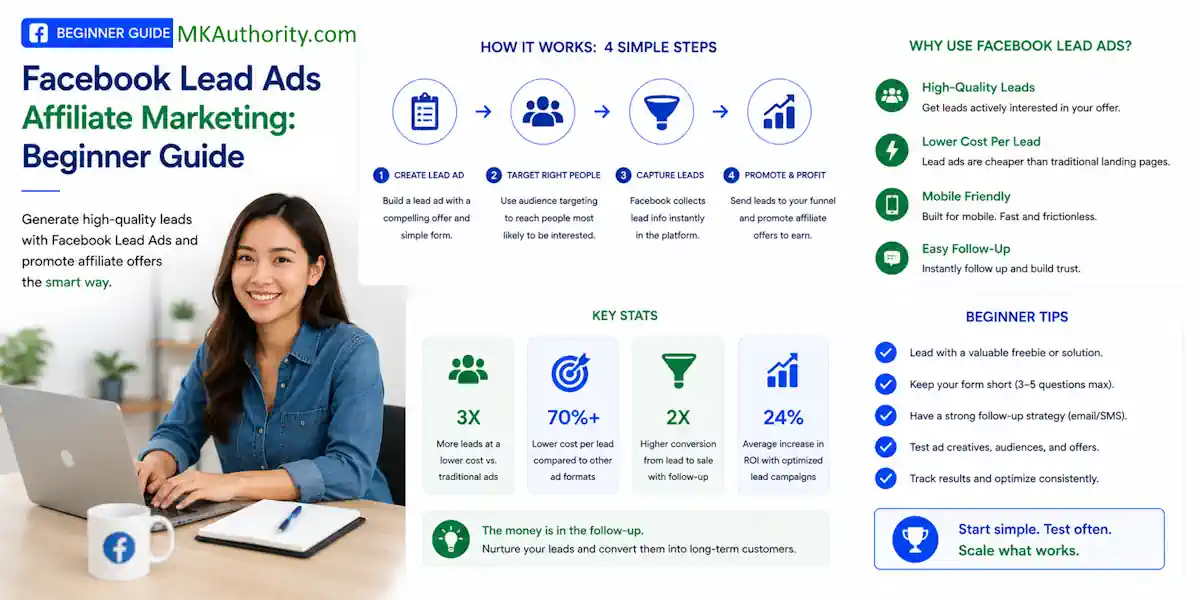

Getting traffic is one thing. Getting contact details from people who might actually want what you promote is a whole different deal. That is where Facebook lead ads affiliate marketing can be a smart starting point.
To get started, you will need an active Facebook Business Page to serve as the hub for your campaigns.
Instead of sending cold visitors straight to an affiliate offer and hoping for the best, you use lead generation to collect contact information first. This allows you to follow up, build trust, and share the right offer at the right time.
The goal is not to chase cheap leads for bragging rights.
The goal is to build a list of real people who gave you permission to hear from you.
Key Takeaways When Looking At Facebook Lead Ads Affiliate Marketing
- Facebook lead ads allow you to collect names, emails, and phone numbers directly without forcing prospects to leave the Facebook or Instagram platform.
- When starting your journey with affiliate marketing, focus on one simple offer, one audience segment, and a small test budget rather than promoting multiple products at once.
- Always verify that an affiliate program explicitly allows paid social traffic through Meta Ads before you launch your campaign.
- Clear consent, a transparent affiliate disclosure, and honest ad copy protect both your advertising account and your professional reputation.
- Your follow-up strategy is just as important as the ad itself. Remember that capturing a lead is the beginning of the conversation, not the finish line.
Why Facebook Lead Ads Work for Affiliate Marketers
A Facebook lead ad is built to make the first step easy. Someone sees your ad on Facebook or Instagram, taps it, and opens an Instant Form. This native functionality of the platform allows a user’s details to be pre-filled from their Meta profile, which means less typing and significantly less friction.
That matters because people are busy.

If you send a cold prospect to a long sales page, a slow website, or a complicated opt-in form, many will leave before you ever get a chance to help them. With a lead generation campaign, you are asking for a smaller commitment first.
Maybe you offer a free checklist for choosing a beginner affiliate program. Maybe it is a short training on getting traffic without bothering family and friends. Or maybe it is a simple guide that helps people compare email marketing tools.
The free resource should connect naturally to the affiliate offer you plan to discuss later. This is where many beginners get stuck. They promote a broad “make money online” freebie, then follow it with a random crypto offer, a weight-loss product, or a software trial. The connection feels weak because it is weak.
Think of your lead magnet like the front door of your business.
It should be designed specifically to attract your ideal buyer persona, ensuring you bring in the kind of person you can genuinely serve.
Cheap leads that never open emails, answer messages, or buy anything are not a win. A smaller list of interested people is far more valuable.
Meta Ads provides detailed guidance that explains the basic format and available lead destinations for your campaigns. For most beginners, the simplest choice is a leads campaign using an Instant Form.
You can also collect leads through your own website or messaging apps. Those options can work well, but they add more moving parts. Instant Forms make it easier to get your first campaign live and learn what your market responds to.
Pick an Affiliate Offer Before You Build the Ad
Don’t start inside Ads Manager. Start with the offer.
Affiliate marketing gets easier when you know exactly what happens after somebody joins your list. Whether you find a high-converting offer through a trusted affiliate network or a direct partnership, you need a plan.
Are they going to a webinar, a product review, a comparison page, a seven-day email sequence, or a training video that introduces a tool you use?

Get clear on that first.
A good beginner offer has a few things going for it:
- It solves a problem your audience already has.
- It has a clear sales page and real support materials.
- The price and commitment match the traffic source.
- The affiliate program permits Facebook and Instagram advertising.
- You can talk about it honestly without making wild claims.
For example, a beginner can run an ad for a free Affiliate Traffic Starter Checklist.
The form collects an email address. The thank-you screen sends the lead to a short training about building a simple funnel. The email follow-up can then introduce an email platform, landing-page builder, or training program that relates to that lesson. By choosing a product that converts well, you improve your overall ROI after factoring in your total ad spend.
That path makes sense.
A cold audience rarely wakes up wanting to buy a $2,000 business program. But they may want help starting an email list, finding an audience, or understanding how paid traffic works. Solve the first problem well, and you earn the right to present the next step.
Before spending a dollar, read the terms provided by the program. Some programs allow paid traffic but ban direct linking. Others allow Google search ads but not Meta ads. Some do not allow bidding on their brand name, and a few prohibit email promotion unless you get approval first. When you are involved in affiliate marketing, you must follow these rules strictly to avoid losing your commissions or getting banned.
Never assume. Send support a direct question if the rules are unclear.
You also need to disclose your relationship. The FTC’s disclosure guidance for social media is clear about the basic idea: people should be able to notice and understand that you may earn a commission. Put a plain disclosure on your landing page, in relevant emails, and near affiliate links.
“This email contains affiliate links. I may earn a commission at no extra cost to you.” That is simple, clear, and honest.
Set Up Your First Lead Campaign in Meta Ads Manager
Meta Ads Manager can look like a cockpit when you first open it. Don’t let it throw you off. You do not need every button to launch a clean first campaign.
Choose the Leads campaign objective when you create your campaign. Then select Instant Forms as the conversion location if you want people to submit their details inside Facebook or Instagram.
Here is a beginner-friendly campaign structure:
- Create one campaign with the Leads objective and keep the budget small while testing.
- Build one ad set around a clear target audience idea, including location, age range, and relevant interests if they fit.
- Create two or three versions of your ad creative with different hooks or visuals.
- Connect one Instant Form to all ads so you can compare the results fairly.
- Track lead quality before expanding the budget.
At the campaign level, you may see budget choices that let Meta distribute spend across ad sets. If you only have one ad set, that decision is simple. Once you test several audiences, campaign budget can be useful, but don’t overcomplicate your first test.
At the ad set level, decide who you want to reach. A broad audience can work, especially when your messaging speaks clearly to the right person. Defining your demographics and using interest targeting can also help you begin with a focused idea.
Say you promote a beginner guide about building an affiliate email list. You might test an audience interested in email marketing, online business education, landing pages, or well-known marketing tools. Keep it relevant. Do not pile 30 unrelated interests into one ad set and call it targeting.
Avoid targeting based on personal problems or sensitive traits.
Don’t write copy such as, “Are you broke?” or “Tired of your debt?” Meta’s policies restrict ads that imply knowledge of a person’s financial status, health, identity, or personal situation. Review Meta’s advertising standards before publishing.
Your ad also cannot promise easy income. Phrases like “Make $500 today” or “Quit your job in 30 days” may attract attention, but they can create policy problems and attract the wrong people anyway.
Try a more grounded angle:
Primary text:
“Want a simple way to start collecting leads for your affiliate business? Grab this free checklist and see the basic setup before spending money on traffic.”
Headline:
“Free Affiliate Traffic Checklist”
Call to action:
“Sign Up”
No wild promises or fake urgency. No pretending that a form equals an income stream. Just a useful next step.
Build an Instant Form That Filters Out Freebie Hunters

A lead form should be short, but not mindless.
If you ask for too much, completion rates can drop. If you ask for almost nothing, you may collect people who have no interest in your topic. The sweet spot is a lead form that feels easy while still qualifying the person a little.
For most beginner affiliate campaigns, ask for a first name and email address. Add a phone number only if you have a real reason to use it and clear permission to contact the person by SMS or phone.
A good lead form has four parts:
- A short intro that tells people what they will receive.
- Basic contact fields that match your follow-up plan.
- One simple qualifying question, if it improves lead quality.
- A thank-you screen that tells them what happens next.
For the qualifying question, keep it simple. You could ask, “What are you working on right now?” and offer choices such as “Starting an affiliate business,” “Building an email list,” or “Getting more website traffic.”
That answer helps you segment your leads later. It also tells you whether the ad is reaching the people you wanted. To ensure you are accurately measuring these results, you should verify your conversion tracking setup. Implementing a Facebook pixel or using the Conversion API on your thank-you page ensures that every successful registration is tracked properly within Meta Ads Manager.
Use the higher-intent form type if your leads are submitting but not engaging afterward. It adds a review step before submission. You may get fewer leads, but the leads can be more deliberate.
Your form needs a working privacy policy link. It should explain what data you collect, how you use it, and how a person can contact you. If you plan to email marketing content, say so clearly. If you plan to text leads, get explicit SMS consent and include the required disclosures for your location and messaging provider.
Do not hide the real purpose behind vague language. If the free training leads into a paid affiliate recommendation, that is fine. Just be upfront about your business and give people a useful experience first.
Test Budgets Like a Beginner Who Wants to Stay in Business
You do not need a huge budget to learn. You do need enough budget to get real data.
A reasonable starting point is often $10 to $20 per day for one ad set, depending on your niche and audience size. You can also experiment with CBO campaigns if you want Meta to distribute your budget automatically across different ad sets.
Run your campaign long enough to gather leads and see what happens after the opt-in. Stopping an ad after a few hours because it has not produced a sale tells you almost nothing.
Start with one audience and two or three ad variations. Keep your form and offer the same. That way, you can see whether the hook, image, or video is the reason one ad gets better results.
To protect your capital, set up automation rules that trigger a stop loss if an ad exceeds a certain cost per lead. This strategy prevents you from overspending on underperforming creatives while you sleep.
Use a simple scorecard like this:
| Metric | What it tells you | What to watch for |
|---|---|---|
| Cost per lead | What you pay for each opt-in | Compare it with lead quality, not by itself |
| Form completion rate | Whether people finish the Instant Form | A weak form intro or too many questions can hurt it |
| Email open rate | Whether leads recognize and trust you | Low opens can point to poor follow-up or low-quality leads |
| Link clicks | Whether people want the next step | Interest matters before a sale happens |
| Sales or trials | Whether the offer fits the audience | Give the sequence time before judging |
A $3 cost per lead is not automatically better than a $10 lead. If the $10 lead joins your training, opens emails, and buys a relevant tool later, that lead may be worth far more.
Give an ad enough time to spend a meaningful amount. Then look at the full picture.
- Are people opting in?
- Are they opening the first email?
- Are they clicking?
- Are they unsubscribing right away?
If the leads are cheap but dead, test a better promise, a tighter audience, or a higher-intent form. If leads are too expensive, test a simpler lead magnet, a stronger visual, or broader targeting.
Don’t change five things at once. That is how people burn money and learn nothing.
Follow Up Fast and With Permission
The real money side of affiliate lead ads does not happen inside the form. It happens in your follow-up.
Connect your lead form to an email platform through a native integration, a CRM integration, Zapier, Make, or another approved connector. Test the setup yourself. Submit a lead using your own email address and check that the contact arrives in the right list, tag, or automation.

For those who engaged with your content but did not finish the form, consider setting up retargeting ads to re-engage them later.
Your first email should arrive quickly. Thank the person, deliver the promised resource, and tell them what to expect next.
Then keep the next few emails useful. Teach one small thing at a time. Share why you use a tool. Point out a mistake you made. Show how the tool solves a problem. When you share your affiliate link, disclose it clearly.
A simple five-email sequence could look like this:
- Deliver the free guide and set expectations.
- Share a practical beginner tip connected to the guide.
- Explain a common mistake and a better approach.
- Recommend a related affiliate tool with an honest disclosure.
- Answer objections and invite the reader to take the next step.
Don’t hammer people with daily pitches. A list is not a vending machine. People joined because something in your ad caught their interest. Respect that interest.
If you use SMS, get permission that clearly covers marketing messages. Include opt-out instructions. Email marketing also needs a visible unsubscribe option and a valid mailing address where required. The FTC’s CAN-SPAM compliance guide is worth reading before you build your first automation.
Launch Checklist Before You Spend Money
Run through these items before you press Publish:
- Your affiliate program has confirmed that paid Facebook and Instagram traffic is allowed.
- Your lead magnet matches the offer you plan to introduce later.
- Your ad makes realistic claims and does not imply personal attributes.
- Your Instant Form includes a valid privacy policy link.
- Your consent language matches your email, SMS, or phone follow-up plan.
- Your thank-you screen delivers a clear next step.
- Your email automation has been tested with your own contact details.
- Your affiliate disclosure appears near affiliate promotions.
- You have set a daily budget you can afford to test without panic.
- You have verified that conversion tracking is active so you can measure results accurately.
- You understand that while many beginners start with personal accounts, professional marketers often use an agency ad account to ensure greater stability.
- You know which numbers you will check to optimize your affiliate marketing performance after leads begin coming in.
This checklist may not feel exciting, but it saves you from the usual beginner mess.
Broken forms, missing emails, banned traffic sources, and unclear offers can turn a good idea into wasted ad spend fast.
Frequently Asked Questions About Facebook Lead Ads Affiliate Marketing
Do I need a website to start using Facebook lead ads affiliate marketing?
No, you do not need a website to run your first campaign. By using Meta’s native Instant Forms, you can collect contact information directly on the Facebook or Instagram platform without sending users to an external landing page.
How much budget should I start with for Facebook lead ads affiliate marketing?
Most beginners find success starting with a budget between $10 and $20 per day. This allows you to collect enough data to identify which ad creative and audience segments are performing best without risking significant capital during the testing phase.
Can I promote any affiliate offer with Facebook lead ads affiliate marketing?
Not all affiliate programs allow paid traffic, so you must always check the program’s terms or ask their support team directly. Additionally, you should ensure your offer is compliant with Meta’s advertising standards, which prohibit misleading claims and aggressive promises of easy income.
How can I improve the quality of my leads?
Adding a simple qualifying question to your Instant Form is one of the most effective ways to filter out low-intent users. You can also use the ‘higher-intent’ form setting, which adds a review screen that forces users to confirm their information before they can submit the form.
Final Thoughts About Facebook Lead Ads Affiliate Marketing
Facebook lead ads give affiliate beginners a practical way to turn attention into permission based follow up. The ad gets the conversation started, but your offer, honesty, and email follow up do the heavier work.
Start small. Test one clear message, and focus on helping people before you pitch them. Once you identify a winning combination, you can look into scaling your results to increase your overall volume. That is how Facebook lead ads for affiliate marketing can become a real business asset instead of another random campaign that burns out after three days.