 Malcolm Keith 2026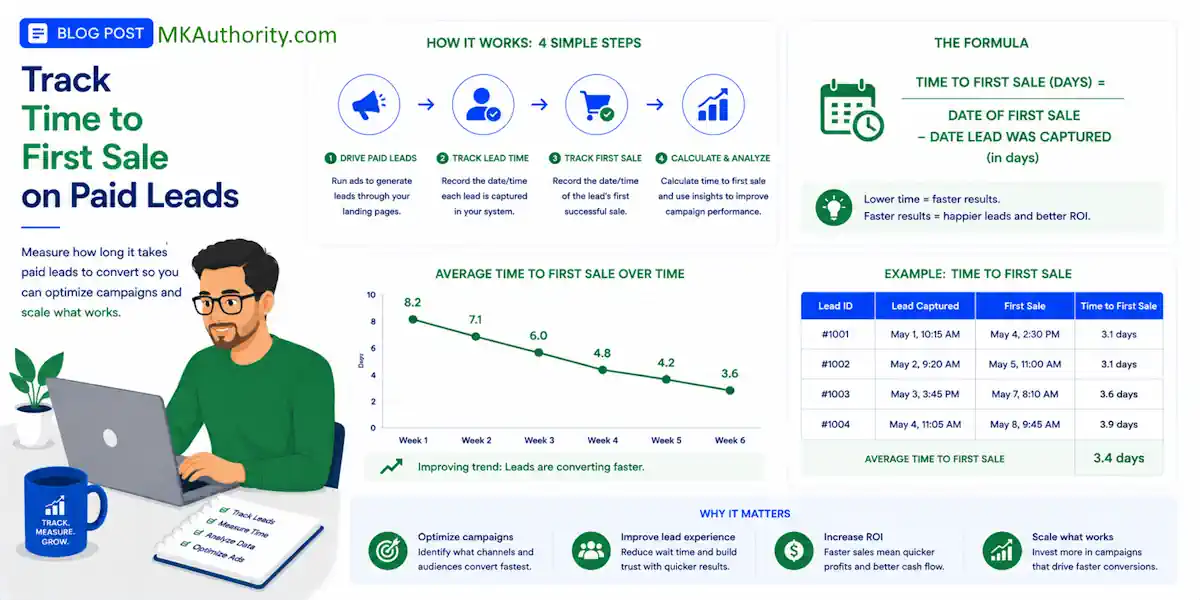


A cheap lead is not cheap if it takes forever to buy. If you are paying for Facebook leads, Google Ads calls, solo ad traffic, or any other funnel using paid ads, you need one number – time to first sale – that tells you how fast cash comes back.
That metric of your time to first sale can expose weak follow-up, slow funnels, bad lead sources, and wasted ad spend faster than almost anything else. By refining this part of your marketing strategy, you gain better clarity on your actual profitability.
Once you track your first sale the right way, your CRM stops being a contact graveyard and starts acting like a scoreboard.
Key Takeaways On Time To First Sale
- Track two locked timestamps from the start: the lead created date and the date of the first sale.
- Keep response time, appointment scheduling speed, and your time to first sale as separate metrics, or your reports will provide misleading insights.
- Report by source, campaign, and lead-created cohort so you can identify which paid lead channels convert into paying customers the fastest.
- Use the median number of days to first sale alongside the average, because a few outlier deals can easily skew the average results.
- Clean up duplicate entries, recycled leads, and offline closes before you trust the accuracy of your reporting data.
What time to first sale actually tells you
Time to first sale is simple. It measures how long it takes for a paid lead to become your first customer after they enter your system.
That sounds basic, but it answers a big money question. Are you buying leads that turn into revenue quickly, or are you feeding a pipeline that stays stuck for weeks? Much like an e-commerce store or a high-performing online store, the speed of your transaction process is critical.
If your store takes too long to convert, you lose momentum and cash flow.
If you are using various platforms to drive traffic to your offers, this metric helps you look past cost per lead. One source may bring cheaper names, but another may bring a first sale in just three days. The second one often wins, even if the leads cost more upfront.
This matters even more in home business, affiliate, coaching, and local service funnels. Some leads buy on the first click. Others need texts, calls, follow-up emails, and a booking link before they ever pull out a card. If you only track opt-ins or appointments, you can fool yourself fast.
Sometimes, ads that do not result in immediate revenue still provide value by building brand awareness, but you must distinguish that from direct acquisition.
A lot of teams already watch close rate and revenue. Good. Keep doing that. But sales speed belongs in the same conversation. Sales metrics worth tracking should tell you not only what closed, but how long it took to close.
Think of it like a stopwatch on your ad dollars. The timer starts when the lead is created. It stops when the first deal tied to that lead hits closed-won. That is the number you want on your dashboard to ensure your acquisition costs are actually paying off.
Don’t confuse it with response time or appointment speed
This is where a lot of reporting goes sideways. Teams mix three different clocks, then wonder why the numbers do not help.
Here is the clean separation:
| Metric | Starts when | Ends when | What it tells you |
|---|---|---|---|
| Lead response time | Lead is created | First rep reply or call | How fast your team reacts |
| Time to appointment | Lead is created | First booked meeting | How fast the lead moves to a conversation |
| Time to first sale | Lead is created | First closed-won sale | How fast the lead becomes revenue |
Lead response time is an activity metric. Time to appointment is a pipeline metric, while time to first sale is a revenue metric that measures how quickly a lead generates actual profit.
Why does that matter? Because each one solves a different problem.
A slow response time points to weak follow-up.
Slow appointment time can point to poor nurture, bad scripts, or low-intent leads.
Slow time to first sale can come from both of those, plus pricing, offer fit, rep skill, or a long sales cycle.
If you blend these into one number, you lose the story.
A quick example helps.
A paid lead comes in at 9:00 a.m.
A rep texts back at 9:07 a.m.
The potential customer books a call two days later.
The deal closes eight days after that.
Your response time is seven minutes.
Appointment speed is two days.
Your time to first sale is ten days.
You want all three. While a fast response can improve your overall conversion rate, it is not the same thing as tracking revenue velocity. Copper’s breakdown of sales metrics is a good reminder that speed is a factor, but it is not a replacement for clear, revenue-focused reporting.
Simple CRM setup that makes the number easy to trust
You do not need a giant tech stack to measure lead velocity. You need a few clean fields, one rule for when dates get stamped, and one report that does not keep changing the finish line.
Business owners managing their own CRM systems can handle this using HubSpot, Salesforce, or GoHighLevel. These platforms track data through custom properties, workflows, and deal-stage history. The setup is simple if you keep it tight:
- Create a Lead Created Date field. Auto-fill it when the form submits, the lead syncs from your email list, or the rep creates the contact manually.
- Create a First Response Date field. Stamp it when the first outbound call, email, or text is logged.
- Create a First Appointment Date field. Stamp it when the first appointment becomes booked or confirmed.
- Create a First Closed-Won Date field. Stamp it the first time a deal enters closed-won, which marks your first sale, then lock it so it never gets overwritten.
- Calculate your sales-speed fields. Time to first sale in days is first closed-won date minus lead created date. In a spreadsheet, hours to first sale is (Sale Timestamp – Lead Timestamp) * 24.
The biggest gotcha is overwrite logic.
If a customer buys again later, that is not the first sale. If a closed deal gets reopened, your first closed-won date should stay put. First means first. If your business uses an automated checkout process, ensure that is the specific trigger point that stamps the sale timestamp so you maintain consistent data.
Another smart move is saving source data at lead creation. Keep original source, campaign, ad set, keyword, landing page, and any UTM values. If you are buying calls, keep the tracking number too.
That gives you clean source-level reporting later instead of guesswork.
If your funnel is simple, one contact can equal one deal. If your setup has contacts and multiple opportunities, track the first sale at the opportunity level but tie it back to the original lead record. That keeps repeat business from muddying the first-sale clock.
Reporting logic for ad-driven funnels and messy real-world data
Now for the fun part, the part that shows you where your ad money is getting stuck.
The best report groups leads by the date they were created, then breaks them out by original paid source or campaign. That way, you aren’t mixing fresh leads from this week with older leads that had more time to close. Whether your traffic comes from facebook ads, instagram ads, social media outreach, influencer marketing campaigns, or even organic google search results, the reporting framework remains the same.
A practical report usually includes these columns in one view: lead-created week, source, campaign, lead count, first-sale count, conversion rate, average days to first sale, median days to first sale, and revenue. When you compare channels, median often tells the truth faster than average.
One recycled deal that closes after 120 days can throw your average way off.
This also helps with budgeting. When you know which campaigns turn into money faster, it’s easier to optimize your ad spend for better results. Fast-closing leads help cash flow, but you should also keep an eye on technical metrics like bounce rate and cart abandonment, as these can explain why specific segments take longer to reach the first sale.
Slow-closing leads may still work, but they need a different budget plan and a longer payback window.
Duplicate leads can wreck the math
Paid traffic creates duplicates all the time. A prospect opts in on mobile, then calls later. They use one email on Facebook and another on your landing page. Now what?
Set a matching rule. Email plus phone is common. If both match an existing contact, merge or flag the new record. Keep one master contact when possible, then attach new opportunities to that record. Most important, don’t let duplicate lead-created dates keep restarting the clock.
If your team buys list leads or co-reg leads, add a duplicate flag and a duplicate reason. That gives sales ops a way to filter out noise when reporting.
Attribution, recycled leads, and offline sales need house rules
Multi-touch attribution gets messy fast, so keep your first rule simple. Use original paid source for time-to-first-sale reporting, and keep last touch in a separate field. That way you can answer two different questions: where the lead came from first, and what touch happened before the sale.
Good source tracking starts before the sale ever happens. Lead tracking best practices can help if your UTM and source capture is loose right now.

Recycled leads need their own logic too. If an old lead goes cold and a rep works it again three months later, don’t overwrite the original lead date. Add a Reactivated Date instead. Then report both numbers when needed: original lead to first sale, and reactivated date to sale.
One tells you full sales cycle length. The other tells you how fast your re-engagement process works.
Offline sales need discipline. If a rep closes a lead on the phone, at a hotel meeting, or after a live presentation, the sale still needs to hit closed-won in the CRM that same day. No sticky notes. No “I’ll enter it later.” Late data entry breaks the metric because the timestamp becomes the admin date, not the real sale date.
Frequently Asked Questions
Why is the median time to first sale better than the average?
The average is easily skewed by a few long-term deals or outliers that take months to close, which can make your process look slower than it actually is. Using the median provides a more accurate picture of the typical experience for the majority of your leads.
Does time to first sale include repeat purchases from existing customers?
No, this metric should only track the time between the original lead creation and the very first closed-won deal. Any subsequent sales after the first one are considered lifetime value or repeat business, and tracking them here would dilute your acquisition data.
Can I use the same timestamp for response time and time to first sale?
Absolutely not, as these measure entirely different parts of your operation. Response time tracks your team’s reactivity to a new lead, while time to first sale tracks the overall efficiency of your revenue generation process.
What should I do if a lead is created multiple times?
Establish a strict deduplication rule based on unique identifiers like email or phone number to ensure the clock is never reset. By maintaining a master record, you prevent duplicate entries from distorting your data and keep the original lead date as the primary reference point.
Final Thoughts On Time to First Sale
The lead is not the finish line. The sale is.
When you track time to first sale the right way, paid leads stop looking like a pile of names and start showing you a clear pattern. You can see which sources buy faster, which reps move quicker, and where your funnel is dragging its feet.
While strategies like content marketing and search engine optimization provide essential long-term value, paid tracking is primarily about immediate feedback.
This differs significantly from the organic growth you might see through word of mouth, referrals from friends and family, or recommendations within online communities.
Start with locked dates, clean source fields, and one honest report. You might even consider using a specific discount code to incentivize that initial purchase and clarify your data. A month from now, you will know a lot more about your business than your cost per lead ever told you.
By mastering your time to first sale, you ensure that every dollar spent is moving you closer to that vital first sale.