 Malcolm Keith 2026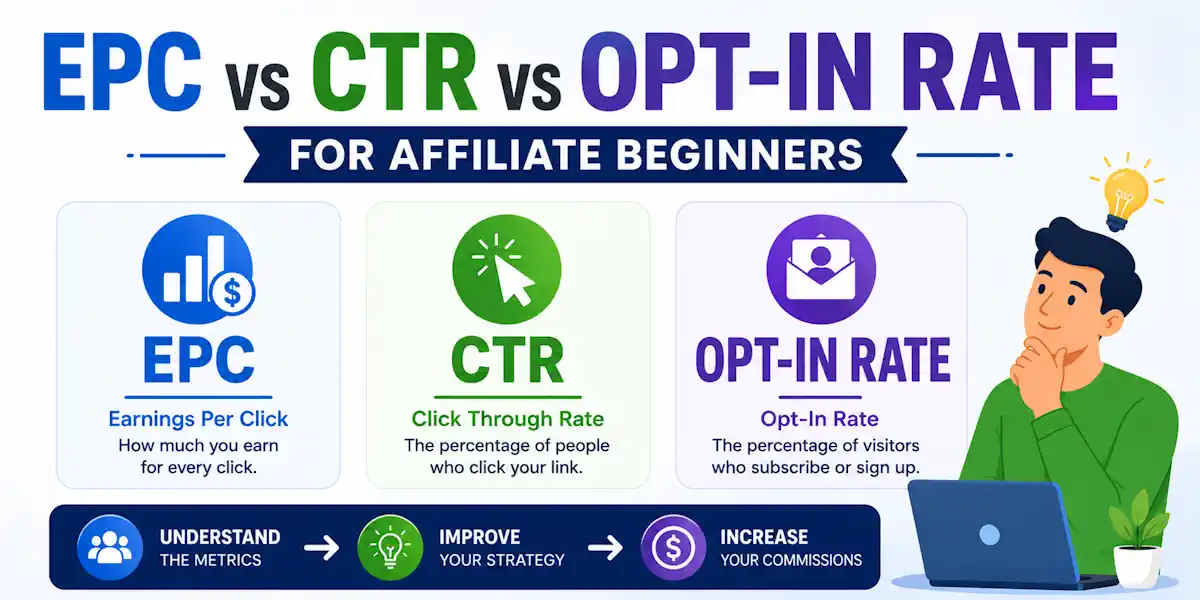

Most beginners look at one number and assume they have the full picture. They do not. Understanding your affiliate metrics only makes sense when you see how they connect to form your overall strategy.

These numbers serve as essential key performance indicators that guide your decision making.
A campaign can generate plenty of clicks and still fail to produce revenue. Another can maintain a strong EPC while stalling because the conversion rate is too low to sustain growth. That is where beginners often feel confused and get stuck in their progress.
If you want to know what to fix first, you need to understand exactly what each number is telling you about your funnel.
Key Takeaways
- Metrics tell a story as a sequence: CTR, opt-in rate, and EPC represent different stages of your funnel—attention, lead capture, and revenue generation—and should be analyzed as a connected chain rather than in isolation.
- Fix the earliest funnel failure: If you are struggling with performance, always address the weak point at the beginning of the journey, starting with CTR, then opt-in rates, and finally EPC.
- Context is essential for data: A high EPC is meaningless if your CTR is too low to sustain traffic, just as a high opt-in rate is ineffective if the resulting leads never convert to sales.
- Avoid testing too many variables: To identify exactly what is broken, change only one element of your campaign at a time and allow sufficient traffic to flow before evaluating your results.
What EPC, CTR, and opt-in rate affiliate metrics actually measure
Tracking these three numbers helps you understand the health of your affiliate marketing program. Each affiliate metric monitors a different stage of your funnel, measuring attention, lead capture, and revenue generation.
Here is a quick side-by-side view of these key performance indicators:
| Metric | What it tells you | Simple formula | Best time to prioritize |
|---|---|---|---|
| CTR | How many people clicked your affiliate links | Clicks / Impressions x 100 | When you need more traffic into the funnel |
| Opt-in rate | Your conversion rate for leads or forms | Opt-ins / Visitors x 100 | When people land on the page but do not subscribe |
| EPC | Your earnings per click on average | Earnings / Clicks | When comparing offers or checking profitability |
CTR, or click-through rate, is your first signal. It tells you whether your headline, image, or call to action is getting people curious enough to click. If 1,000 people see your post and 30 interact with your affiliate links, your click-through rate is 3%.
Opt-in rate measures how many visitors become leads. This conversion rate matters if you are sending traffic to a landing page, lead magnet, or email capture form. If 100 people land on your page and 35 join your list, your opt-in rate is 35%.
EPC, or earnings per click, is the primary indicator of your financial performance. If 50 clicks produced $75 in payouts, your EPC is $1.50. This does not mean every click resulted in a sale, but rather that each click was worth $1.50 on average based on your specific commission rate.
That average matters because it helps you compare offers from various affiliate partners. It also helps you see whether your paid traffic strategy is viable. If your EPC is $0.60 and you are paying $1.00 per click, your campaign is not profitable.
Still, none of these affiliate metrics can replace the others.
A high click-through rate cannot tell you whether the offer pays well. A high opt-in rate cannot guarantee that your subscribers will eventually buy. The EPC cannot tell you whether people hated your ad and barely clicked.
That is why smart beginners stop asking which number is best and start asking where the funnel is breaking.
How these numbers work together in an affiliate funnel
Think of your funnel like a row of doors representing the customer journey.
CTR opens the first door, while the opt-in rate opens the second.
EPC tells you what happened after people went all the way through the process.
If one door barely opens, the rest of the path does not matter much.
Here is a beginner-friendly example of how conversion tracking helps you monitor performance.
You publish a blog post or share a landing page link. That message gets seen by 1,000 people. Out of those 1,000, 40 individuals generate clicks. Your CTR is 4%.
Those 40 clicks land on your page. Out of that group, 16 join your email list. Your opt-in rate is 40%.
Later, 2 of those leads buy through your affiliate links, and you earn $60 in total attributed revenues. Because you started with 40 clicks, your EPC is $1.50.
Now the picture is clearer:
- Your message got decent attention.
- Your page converted visitors well.
- Your traffic was worth $1.50 per click.
That tells a fuller story than any single number could.
A high EPC with a weak CTR is still a traffic problem. A strong CTR with a bad opt-in rate is still a page problem.
This is also why structure matters. Random links posted in random places make it hard to read what your numbers mean. A simple funnel gives each metric a specific job, including how you evaluate your affiliate partners. If you need a better framework for that, this piece on building a structured affiliate business explains why scattered efforts tend to stall.
Once you see the chain, decisions get easier. You stop changing five things at once. You start fixing the earliest weak point.
When beginners should prioritize EPC, CTR, or opt-in rate
The short answer is this: prioritize the metric closest to the problem you are trying to solve.
If you are not getting enough visitors, start with CTR. Your offer might be fine, but your headline may be flat. Your ad image may not match the promise. Also, your call to action might be soft. Before you judge your traffic source, get enough clicks on your affiliate links to feed your funnel.
Blog post: How many affiliate campaign clicks are enough to judge an affiliate campaign success?
If you are getting traffic but very few leads, focus on opt-in rate. That usually points to a landing page issue. The headline may not match the ad. The page may ask for too much. The lead magnet may sound weak. Sometimes the page is simply cluttered and confusing.
If people are clicking and opting in but commissions are poor, it is time to look harder at EPC. This is where offer quality, follow-up emails, buyer intent, and payout levels matter most.
A common beginner mistake is chasing the highest commission rate. A bigger payout does not always mean better results for your return on investment.
Imagine two offers:
- Offer A pays a strong commission, shows a $2.20 EPC, and has a high average order value.
- Offer B pays less, shows a $1.10 EPC, and has a lower average order value.
Most beginners pick Offer A without thinking. But what if Offer A gets almost no clicks because the message feels too aggressive? What if Offer B gets far more clicks and builds a larger list because it feels easier to say yes to?
That is why EPC should be read with context.
If you are comparing offers inside an affiliate marketing program, EPC is useful. It tells you which affiliate partners tend to earn more per click. However, it does not tell you how your audience will respond to the front-end message or how it will impact the customer lifetime value over time.
For paid traffic, EPC often gets top priority once you have enough data. If your clicks cost more than they are worth, you lose money. For free traffic, CTR and opt-in rate often deserve more attention early, because you need momentum before you can judge monetization.
If you are still building your first process, following a clear system helps a lot. A simple guide on how to start generating affiliate commissions within a professional affiliate marketing program can make these numbers feel far less abstract.
How to troubleshoot low conversions without guessing
Beginners waste a lot of time fixing the wrong thing. They swap offers when the ad is the issue, they rewrite emails when the landing page is leaking, and they blame traffic when the offer is weak.
The better move is simple: fix the earliest leak first.
If your CTR is low, start at the top. Your audience is seeing the message and not clicking. That usually means your marketing materials are off. Maybe the promise is boring, the image does not stop the scroll, or the message attracts the wrong crowd. Change the headline, angle, image, or call to action before touching the rest of your campaign.
If your CTR is decent but opt-ins are low, look at the page. Does the landing page match the ad that brought the click? Does the headline make the same promise? Is the page easy to understand in five seconds? If your conversion rate is lagging, you might be offering a vague pitch instead of a clear benefit. Small page changes can move this number fast.
If CTR and opt-in rate look healthy but EPC is weak, the traffic is arriving and leads are being captured. Now the issue is usually offer fit or follow-up. The product may not match the promise that got the lead, or the audience may want information rather than a purchase. If the back end is not generating sufficient sales revenue, your email sequence may be failing to nurture the prospect properly.
Here is a realistic beginner scenario.
You run a paid campaign. Your CTR is 2.8 percent after 100 clicks, which is decent enough to work with. Your opt-in rate is only 11 percent. That tells you the traffic source may be okay, but the landing page is underperforming. In this case, your cost per acquisition is likely too high, so fixing the page beats changing the offer right away.
Now flip it.
You send 500 clicks to a page, but your CTR is only 0.4 percent. Even if your landing page converts well when people arrive, the page is not the main issue. Your message is not getting the click. Work on the front end first.
One more scenario.
Your CTR is 3.5 percent, your opt-in rate is 38 percent, and your EPC is still poor despite 200 clicks. Now the traffic and page are doing their jobs. The offer may be weak or the audience mismatched. When tracking these outcomes, do not rely solely on a last click attribution model. Understand that a healthy funnel requires every stage to contribute to your overall return on ad spend.
Don’t judge a funnel by the last number only. Check where people drop off before they ever reach the sale.
This is where many beginner-friendly affiliate metrics become useful clues instead of random dashboard noise. They tell you where to focus next and where to stop guessing.
When you are testing, keep it clean. Change one thing, give it enough traffic, and compare the results. If you change the ad, page, and offer all at once, your data will not reveal which part of your funnel actually needs improvement.
Frequently Asked Questions About Affiliate Metrics
Why is my high EPC not leading to more profit?
A high EPC is a strong signal of earning potential, but it does not account for the cost of acquiring your traffic. If your cost-per-click exceeds your earnings-per-click, you are still operating at a net loss regardless of how well the offer performs.
Should I prioritize CTR over conversion rates?
CTR should only be your primary focus if you are failing to generate enough traffic to get statistically significant data. If you already have consistent traffic but no sales, your efforts are better spent optimizing your opt-in or landing pages.
How many clicks do I need before I can trust these affiliate metrics?
While there is no fixed number, you need enough data to ensure your results aren’t due to random chance. Generally, wait for at least 100 to 200 clicks before making major adjustments to your funnel based on your EPC or conversion rates.
Can I use the same affiliate metrics for all affiliate offers?
Yes, the core metrics apply to most affiliate programs, but the target benchmarks for each will vary based on the industry and offer price point. Always compare your performance against similar offers or your own historical data rather than arbitrary industry averages.
Final thoughts about affiliate metrics
The biggest beginner mistake is not low EPC, low CTR, or low opt-in rate. It is treating one number like the entire business. Affiliate metrics work best as a chain where each link serves a specific purpose. CTR shows whether people care enough to click, opt-in rates show whether your page earns trust, and EPC shows whether your traffic generates sales revenue.
When you analyze these affiliate metrics together, the path forward becomes clear. While beginners often focus on immediate clicks, long-term success requires monitoring the activation rate and retention rate of your audience. Keeping a close eye on your churn rate and fraud rate is equally vital to ensure healthy program growth.
As you scale, you will find that incremental revenue often comes from identifying active affiliates who consistently provide value.
Ultimately, success depends on choosing a solid affiliate marketing program that aligns with your goals. When these numbers are read as a complete picture, the next move becomes obvious. Not easy, perhaps, but clear enough to guide your strategy toward sustainable results.