 Malcolm Keith 2026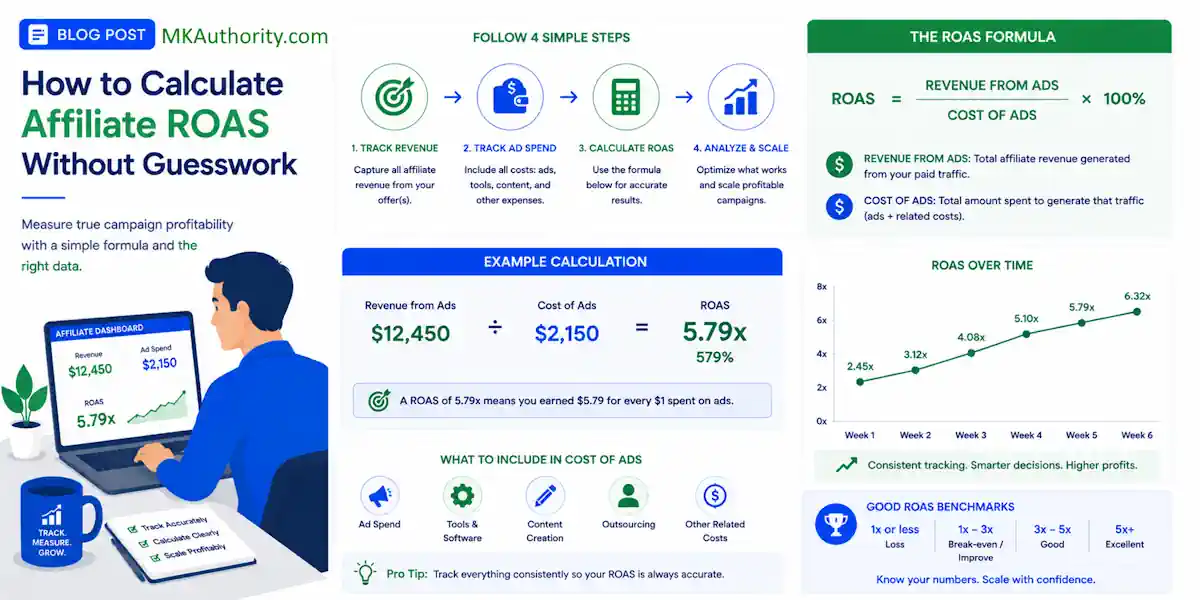

A campaign can look great on the surface and still lose money. That is why affiliate ROAS matters so much.
ROAS stands for Return on Ad Spend. It is a key digital marketing metric that measures the gross revenue generated for every dollar or pound (or your currency) you invest in an advertising campaign
If you are an affiliate, an ecommerce brand, or a professional in the industry, you need clean math, not fuzzy reports, to evaluate your affiliate marketing and performance marketing efforts.
Once you know what belongs in the formula, you can spot winners fast and shut down weak traffic before it eats your budget. Ultimately, mastering this metric is the key to understanding your true return on investment.
Key Takeaways On Affiliate ROAS
- Calculate Adjusted ROAS for Accuracy: Move beyond basic media spend by incorporating commissions, network fees, bonuses, and refunds into your total campaign cost to reveal the true return on your affiliate marketing efforts.
- Standardize Your Data: Always use net attributed revenue by backing out coupon discounts and refunds, and ensure your reporting window remains consistent across all channels to avoid flawed comparisons.
- Context Matters More Than Metrics: A high ROAS does not automatically guarantee profitability; evaluate your results against your specific margins and business model rather than relying on arbitrary industry benchmarks.
- Distinguish Between Perspectives: Understand that the brand’s ROAS and the affiliate’s ROAS are distinct metrics; the brand tracks revenue from total sales, while the affiliate tracks revenue from earned commissions.
What affiliate ROAS really tells you

ROAS stands for return on ad spend. In plain English, it shows how much revenue came back for every dollar spent on your marketing efforts.
The base formula is simple, and Wall Street Prep’s ROAS formula breakdown lines up with the version most marketers use to evaluate their affiliate marketing strategy:
Basic affiliate ROAS = Attributed revenue generated / ad spend
Adjusted affiliate ROAS = Net attributed revenue / total affiliate campaign cost
That second version is the one most managers need.
Why? Because affiliate campaigns often include more than just media spend. You may have commissions, network fees, bonuses, coupon discounts, and refunds all pulling on the final result.
It is also worth noting that the pay-per-performance nature of these campaigns helps build brand impressions, even if a specific click does not convert into an immediate sale.
ROAS is not the same as profit. A 4:1 return can still be weak if your margins are thin. On the other hand, a 2.5:1 return can be excellent if the customer buys again and your back-end is strong. That is why CDP’s ROAS benchmarks overview is useful as a reference, but not as a rule carved in stone.
The big idea is simple. Use ROAS to measure efficiency, then compare it against your margins and business model.
The numbers you need before you can calculate affiliate ROAS
Start with revenue. For most brand-side calculations, that means the total revenue generated from attributed sales within the affiliate channel. However, you must use the correct sales figures to ensure accuracy.
If your cart or analytics platform reports gross sales, subtract coupon discounts and refunds. If it already reports net sales after discounts, do not subtract the coupon value again. That one mistake can wreck your math in a hurry. Evaluating the affiliate channel alongside your other marketing channels is the only way to calculate a truly realistic customer acquisition cost.
Now look at costs. In affiliate campaigns, ad spend is not always the whole story. Your cost bucket may include commission payouts, affiliate network override fees, flat placement fees, performance bonuses, and any paid traffic the brand funded directly. Some brands also choose to factor in earned media value if their publishers are providing significant brand exposure beyond direct clicks.
This quick view keeps it clean:
| Line item | Include it? | Quick rule |
|---|---|---|
| Attributed sales | Yes | Use the sales tied to the affiliate campaign |
| Coupon discounts | Yes, if not already netted out | Never subtract twice |
| Refunds or chargebacks | Yes | Back them out of revenue |
| Affiliate commissions | Yes | Core campaign cost |
| Network fees | Yes | Include overrides and platform fees tied to the sale |
| Bonuses or tenancy fees | Yes | Count fixed and variable partner payments |
| Brand-paid ads | Yes, if the brand paid | Meta, Google, native, or other traffic sources |
If your tracking is messy, your ROAS will be messy too. That is why solid attribution matters. Good data starts with good links, subIDs, and postback tracking, and these best tracking tools for media buyers can help tighten that up.
Worked examples for real affiliate campaign setups
When the affiliate drives traffic directly to the brand
Let’s say a content publisher sends traffic to your store.
Here are the numbers for the month:
- Gross attributed sales: $15,000
- Coupon discounts: $1,200
- Refunds: $900
- Commission rates: 12 percent of net sales
- Network fee: 20 percent of commission
- Bonus payout paid to affiliate: $300
- Brand-paid ads: $0
First, calculate net attributed revenue.
$15,000 – $1,200 – $900 = $12,900
Next, calculate commission.
12 percent of $12,900 = $1,548
Now the network fee.
20 percent of $1,548 = $309.60
Total campaign cost becomes:
$1,548 + $309.60 + $300 = $2,157.60
Now the adjusted affiliate ROAS:
$12,900 / $2,157.60 = 5.98
So this campaign produced a 5.98:1 ROAS. For every $1 spent on the affiliate campaign, the brand got $5.98 in attributed net revenue.
That is the brand-side view. No brand-paid traffic was involved, so the cost stack stayed pretty lean.
When the affiliate runs paid traffic
Now flip the setup. The affiliate is buying traffic on Meta Ads or Facebook Ads and sending visitors to the offer as part of their advertising campaigns.
In that case, the affiliate and the brand may each have a different ROAS number. This is where people get crossed up.
For the affiliate’s ROAS, revenue is not total product sales. Revenue is the commission the affiliate actually earns.
Example:
- Commission earned: $3,500
- Reversed commissions from refunds: $200
- Net commission received: $3,300
- Ad spend paid by affiliate: $2,000
Affiliate-side ROAS:
$3,300 / $2,000 = 1.65
So the affiliate got back $1.65 for every $1 in ad spend.
Now look at the brand’s ROAS on the same traffic. Suppose the brand saw:
- Attributed net sales after discounts and refunds: $18,000
- Commission owed to affiliate: $3,300
- Network fee: $660
- Bonus: $0
- Brand-paid ads: $0
Brand-side ROAS:
$18,000 / ($3,300 + $660) = $18,000 / $3,960 = 4.55
Same campaign, two different ROAS views. Both are correct because the cost sits in different places.
If the cost hits your books, it belongs in your formula. If it doesn’t, leave it out.
That one rule clears up a lot of confusion.
Common mistakes that throw off affiliate ROAS
The first big mistake when analyzing your advertising campaigns is mixing gross and net revenue. If you fail to account for discounts and refunds, your ROAS will look much stronger than it actually is.
The second mistake is double-counting coupons. Many ecommerce dashboards already reflect sales after discounts are applied. Subtracting the coupon value a second time will make your campaign performance look worse than it is in reality.
Another issue is ignoring network fees and bonuses. A campaign can look healthy based on commission alone, only to fall apart once override fees and fixed partner payouts are factored into the equation.
It is also vital to consider the incrementality of your affiliate partnerships. You must determine if your partners are actually driving new, incremental sales or if they are simply claiming credit for customers who were already going to convert regardless of the affiliate touchpoint.
Your choice of attribution model also matters significantly. If one report uses a 7-day click window and another uses 30 days, your comparison will be shaky. Pick one method and stay consistent to ensure your data remains reliable.
If your team still debates the math, a simple ROAS formula guide can help everyone line up on the basics.
How to improve affiliate ROAS without chasing more clicks

Sometimes the fix is not more traffic. It is cleaner economics.
Start by separating partner types. Coupon affiliates, email affiliates, influencers, and paid media affiliates rarely perform the same way. Every publisher should have their own target, their own payout logic, and a unique conversion path that leads to a dedicated landing page when possible.
Then look at your offer. A small bump in conversion rate or average order value can change ROAS fast. Better bundles, tighter product pages, and smarter upsells often do more than another traffic test. Remember that long-term success is tied to customer lifetime value, so be sure to adjust your payout logic to reward partners who bring in high-quality, recurring customers.
Email follow-up helps too. If you capture the lead before the sale, you get another shot at revenue without paying for the click twice. For that part of the funnel, these best autoresponders for affiliate marketing are worth a look.
A few practical moves usually help the fastest:
- Cut or cap coupon use when it steals credit from full-price sales.
- Use bonus tiers only after the partner clears a profitable volume goal.
- Watch refund rates by partner, not only sales volume.
- Check tracking every time a landing page, cart, or offer URL changes.
Small fixes add up. And in paid traffic, small fixes are often the whole game.
Final thoughts on affiliate ROAS
Good affiliate ROAS math is not fancy. It is clear revenue, clear costs, and one consistent method.
Once you separate brand costs from affiliate costs, the picture gets a lot easier to read. Maintaining a healthy affiliate ROAS is truly the heart of successful affiliate marketing, as it allows you to move beyond guesswork. When you rely on accurate tracking, you can compare campaigns properly and make strategic decisions based on your actual return on investment rather than hope.
FAQ
Should I use gross sales or net sales?
Use net sales if possible. That means revenue after discounts and refunds. If your platform only shows gross sales, back those items out before you calculate.
Do affiliate commissions count as ad spend?
For a pure textbook return on ad spend, some people only use media spend. However, for a holistic view of affiliate marketing, commissions are a core component of the campaign cost and should be included in an adjusted ROAS calculation.
What is a good ROAS for affiliate campaigns?
There is no one magic number. Many marketers use 4:1 as a rough starting point, but according to a recent industry study, your specific target depends on your profit margins, refund rates, and repeat purchase behavior.
Can a campaign have strong ROAS and still lose money?
Yes. A campaign can post a solid ROAS and still be weak after product costs, shipping, support, and overhead are factored in. Because affiliate ROAS measures spend efficiency rather than full business profit, you must look at the bottom line to ensure your campaigns are truly sustainable.