 Malcolm Keith 2026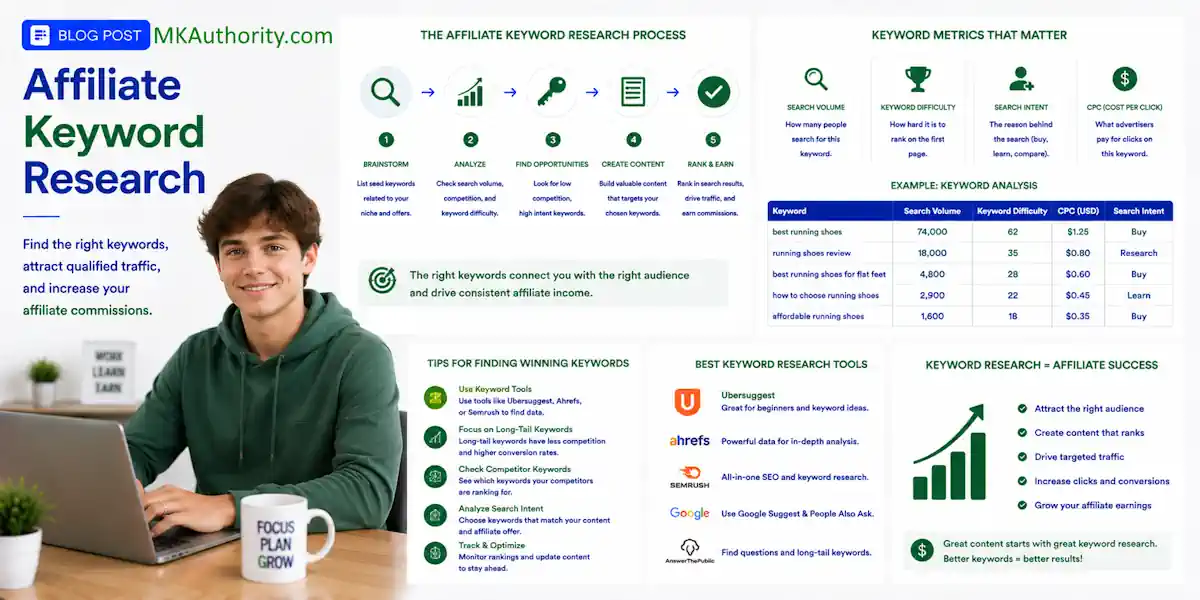

When doing affiliate keyword research the biggest keyword isn’t always the one that puts money in your account. A smaller search term from someone comparing products, checking prices, or seeking an alternative often signals buying intent and brings more qualified visitors.
That’s why research for affiliate marketing needs to go beyond traffic numbers. These visitors matter because affiliate marketing works best when people have a real problem and a clear reason to buy.
I must admit I let paid tools do the work for me automatically inside RightBlogger as they have mastered affiliate keyword research for my website and blog.
Let’s find those terms without wasting months writing pages nobody needs.
Key Takeaways When Doing Affiliate Keyword Research
- Focus on low-competition buyer terms that show commercial or transactional intent, such as reviews, comparisons, alternatives, pricing, discounts, and product-specific searches.
- Start with the offer and audience, then use seed keywords, buyer modifiers, autocomplete, forums, and keyword tools to build a focused list of realistic opportunities.
- Check the actual search results before writing. Match each keyword to the right content format, group phrases by search intent, and avoid forcing a page type Google does not currently rank.
- Connect every keyword to a useful page, a suitable affiliate offer, and realistic economics. Track clicks, sales, refunds, reversals, and cleared commissions so your strategy improves over time.
- Trust matters in affiliate content. Use firsthand evidence when possible, explain downsides honestly, disclose affiliate relationships, and give readers a clear next step.
Why Buyer Terms Beat Big Traffic Numbers
A keyword like “what is email marketing” is an example of informational keywords. It can attract plenty of curiosity traffic, which is fine if you’re building a broad education site. But turning that curiosity into a software sale can take time.
Now compare that with “best email marketing software for a small list” or “ConvertKit vs Mailchimp for beginners.” These product-specific searches show stronger buying intent and a more focused search intent. The searcher is closer to a decision, has moved past the basic question, and wants help choosing.
That is where sites built around affiliate marketing can do well.
Low-competition buyer terms often include a product, a problem, an audience, a budget, or a feature. Specific long tail keywords may not look exciting in a keyword tool, but that does not make them weak opportunities. A phrase with 80 monthly searches can still beat one with 8,000 and bring people ready to act.
Look for commercial terms and comparison keywords such as:
- “best tools,” “reviews,” “vs,” “alternatives,” “pricing,” and “discount”
- “for beginners,” “for older people,” “for remote work,” or “for small business”
- “under $50,” “monthly plan,” “no contract,” or “free trial”
- A problem-based need, such as “best backup service for photographers”
A keyword difficulty score, search volume, and cost per click are directional indicators. They are estimates, not promises. Use them to sort opportunities, but Google does not rank a page because a tool says the keyword is easy.
CPC is also a clue, not proof, since a higher CPC can show that advertisers value a search term. It does not mean your affiliate offer will convert or that you can profitably buy that click.
The real question is simple: does this search lead naturally to a helpful page and a suitable offer?

Affiliate Keyword Research: A Practical Low-Competition Workflow
Good results start with the offer and audience, not the tool. Before you collect hundreds of phrases, know what you can honestly recommend and who it is for. That focus gives your keyword strategy a useful direction.
Choose a product category where you can add something useful. Good niche selection means matching the category to your experience and the audience you want to serve in affiliate marketing.
That could be email marketing platforms, website hosting, AI writing tools, home office gear, online training, or a traffic source you have tested yourself.
Then use this simple workflow.
- Start with five to 10 seed keywords based on products, problems, and audiences. For example, “email marketing software for affiliate marketing,” “lead capture page,” “solo ad traffic,” or “AI writer for bloggers.”
- Add buyer modifiers to reveal buying intent. Try “best email marketing software for affiliate marketers,” “lead capture page builder review,” or “AI writer alternatives for beginners.” Specific audience, budget, and feature modifiers can create narrower long tail keywords.
- Use Google autocomplete, People Also Ask, related searches, and forum discussions to find the way real people phrase the problem. Search a seed term followed by a space and let Google’s suggestions do some of the work.
- Put your ideas into a spreadsheet. Add the search term, topic cluster, intent, search volume estimate, keyword difficulty, CPC estimate, likely page type, affiliate program, and notes from the search results.
- Filter for realistic opportunities. A useful starting point for a newer site might be keyword difficulty under 30, with around 50 to 500 monthly searches and clear commercial intent. Don’t treat those numbers like rules carved in stone.
- Check the search results before writing one word. Reviewing the ranking pages gives you useful competitor research and saves a lot of wasted work.
A practical research guide can give you more examples of review, comparison, and product-focused search patterns. Still, your own SERP checks matter more than copying somebody else’s filter.
Don’t build a giant random keyword list.
Group close phrases with the same search intent, using keyword mapping to assign them to one strong page. For example, “best autoresponder for affiliate marketing,” “best email tool for affiliate marketers,” and “email marketing software for affiliate beginners” may fit one buyer’s guide.
On the other hand, “AWeber vs GetResponse” targets comparison keywords and deserves its own comparison page. The person searching it already has two products in mind.
Validate Search Intent in the SERPs Before You Write
Search intent is what a person expects when they type a query. It isn’t what you hope they want.
This is where many affiliates go wrong. They see a nice keyword volume number, write a review page, and wonder why it never ranks. Google may show tutorials, official product pages, Reddit threads, YouTube videos, or local businesses instead. That mismatch is a search intent problem, not a bad keyword metric.
Open the actual search results in the country you want to reach. Then look closely at what is already winning.
Check these signals:
- Review and comparison pages on page one usually signal commercial queries.
- Product ads, shopping listings, pricing pages, and “buy” pages can point to pages for people ready to purchase.
- Tutorials and question-based articles usually need educational content first.
- Results dominated by major publishers and official brand sites can be harder to break into.
- Smaller niche blogs with useful pages can show room for a focused affiliate page and make competitor research easier.
If the top results answer “how does a VPN work,” that query is an example of informational keywords. Don’t force a “best VPN deal” page onto it, because deals call for transactional keywords. Build the helpful explainer, then guide the reader to a relevant comparison where it makes sense.
A search for “Semrush alternatives for freelancers” has a different job. It is a set of comparison keywords. The reader wants options, prices, limitations, and product differences before choosing one tool over another. That is a commercial page, not a 3,000-word beginner lesson on SEO.
A low keyword difficulty score cannot rescue a page that gives searchers the wrong answer.
Use the SERP as your content brief. A useful keyword research walkthrough for affiliates can help with idea generation, but Google is still showing you the clearest clue about page format.
Match Keyword Types to the Right Affiliate Content
Not every keyword should send people straight to an affiliate link. Content must match the search intent and the reader’s stage in the buying process.
| Keyword type | What the searcher wants | Best page format | Affiliate approach |
|---|---|---|---|
| Informational | A clear answer or explanation | Tutorial, checklist, how-to article | Help first, then mention suitable tools |
| Commercial | Help choosing between options | Buying guide, review, comparison | Explain who each option suits |
| transactional keywords | A deal, price, or place to buy | Offer page, pricing guide, deal page | Send them to the exact relevant offer |
| Navigational | A particular website or brand | Usually the official site | Do not chase it unless you add a genuine comparison angle |
Informational keywords aren’t useless. They bring new people into your site and can build trust. A page on how to start an email list can educate readers and introduce useful email tools naturally.
Commercial terms often produce stronger affiliate conversions when readers have commercial search intent and actively evaluate products. This is where product reviews, “best” lists, alternatives pages, and comparison keywords earn their keep.
Transactional keywords are closer to the finish line. But be careful. A search for a coupon, bonus, or discount needs an honest answer. Don’t promise a deal that does not exist. If an offer has no promotion, say so and show what the buyer gets instead.
Navigational keywords are usually poor targets. Somebody searching “Ahrefs login” does not need your affiliate article. They need the Ahrefs login page.
The smartest move in affiliate marketing is to build a content path. Informational pages answer early questions. Commercial pages help people compare. Transactional pages catch readers who are ready to take the next step. Together, these stages form a focused keyword strategy.
Keyword Research Tools That Work on a Budget
You do not need an expensive stack on day one. Google itself gives you plenty of clues for free.
Google Keyword Planner is useful for rough search volume, bid ranges, and cost per click estimates. You need a Google Ads account to access it, but you do not need to run a campaign for basic keyword ideas.
The Google Keyword Planner is built for advertisers and paid traffic, so its competition label is not a direct organic SEO difficulty score.
Google Trends helps you spot whether interest is seasonal or fading. Search Console becomes gold once your site has traffic because it shows the real queries that already bring search visits to your pages.
For discovery, use Google autocomplete, People Also Ask, related searches, the Ubersuggest tool, and AnswerThePublic. These are great for finding questions and long-tail angles your first seed list missed.
When you need deeper data, the Ahrefs Keyword Tool and Semrush Keyword Tool can estimate keyword difficulty. They also show ranking pages, competitor keywords, a competitor’s backlink profile, and gaps on your site for competitor research. Their databases are useful, but they do not replace judgment.
A tool cannot tell you whether the top-ranking review is thin, outdated, or written by somebody who has never used the product.
A solid affiliate keyword research overview can help you compare the main research methods for affiliate marketing. Start with the tool you can afford, then spend more time checking intent and creating better pages.
AI tools can help group a large list into topic clusters. That can save time. But read every cluster before you build pages around it. AI may group phrases that look similar but serve very different purposes.
Map Buyer Keywords to Offers and Real Numbers
A keyword is not profitable because it contains the word “best.” It is profitable when the visitor’s search intent, page, offer, and economics line up.
Take “best landing page builder for affiliate marketers.” That search needs a useful buying guide. Show the features that matter, such as templates, email integrations, split testing, tracking, mobile speed, and pricing limits. Then recommend tools based on who they fit.
Comparison keywords such as “Leadpages vs Systeme.io” need a direct comparison. Put the important differences near the top. Some transactional keywords deserve a direct offer or pricing path. Tell readers where each platform is stronger, where it is weaker, and which one you would choose for a small budget.
This is where affiliate keyword research becomes a real affiliate marketing business activity, not another content-publishing chore. Buying intent shows whether readers are ready to choose an offer.
Work backward from what a sale is worth. A simple starting formula is:
Expected payable EPC = sales conversion rate x commission per sale x (1 – refund and reversal reserve)
Say an offer pays $35 per sale. You expect 2% of visitors to buy and hold back 20% for refunds or reversals.
Your estimated payable value per click is $0.56:
0.02 x $35 x 0.80 = $0.56
That number is not an automatic cost per click bid target. It is a rough ceiling before landing-page software, email tools, tracking, creative costs, and profit.
If a click is expected to produce $0.56 in cleared commissions, paying $0.70 for that click is not a winning plan.
Organic traffic takes effort and time, but the same thinking matters when comparing it with paid traffic. A keyword that brings 300 visitors but produces no qualified clicks can be less useful than one that brings 30 visitors and generates regular commissions.
If you are getting clicks but no sales, look at the full path. This guide to fixing affiliate conversion issues can help you spot whether the problem is weak traffic, mismatched content, a poor offer, or a follow-up gap.
Create Affiliate Content People Can Trust Using Affiliate Keyword Research
Thin product reviews are everywhere. They repeat product descriptions, copy a few features, add affiliate buttons, and offer no real help. Those pages have a hard time standing out now.
Your review needs proof of effort. Use the product if you can. Show original screenshots, setup steps, test results, photos, videos, pricing details, and the parts that annoyed you. A first-hand review does not need to be perfect. It needs to be honest.
If you have not used the product, don’t pretend you have. A page built around comparison keywords can still be research-based. Explain your selection criteria, then compare official features, pricing, user limits, support options, and the kind of customer each product is built for.
A strong buyer page usually answers these questions early:
What does it cost?
Who is it for?
Who should avoid it?
Does it solve a problem?
What are the alternatives?
What happens after somebody clicks your link?
Use natural question headings because people search that way, especially on mobile and voice search. Match each heading to the reader’s search intent. Give the direct answer near the top, then support it with details. Don’t pad the page with generic filler or rely on keyword stuffing across headings, product descriptions, and buyer copy.
Your disclosure should be clear. In affiliate marketing, transparency matters because a recommendation has more weight when readers know you may earn a commission and can still see the honest downsides.
Track What Happens After the Click
Rankings and traffic are only the beginning. Track the complete affiliate marketing path, not just the clicks. A high click-through rate can look awesome, but it does not pay the bills by itself.
Track impressions, organic traffic, outbound affiliate clicks, opt-ins, sales, refunds, reversals, and cleared commissions. This shows where the funnel is breaking.
People see your page but do not click it in Google, improve the title and description.
If they click through but do not tap the affiliate link, your content may not answer the buying question.
If they click the offer but do not buy, review the offer fit, price, checkout experience, and your pre-sell page.
EPC is one of the clearest numbers to watch. Divide cleared commissions by clicks to see what each visitor was worth after results settle. Do not judge an offer by reported commissions alone. Refunds, cancellations, delayed approvals, and missed tracking can change the final number.
For paid traffic or other advertising, separate campaigns by keyword theme and match each ad to the right page. Start small, use negative keywords to block weak intent, and change one item at a time. The traffic-source guide covers why tight keyword groups and accurate tracking matter before you scale.
Build first-party data where you can. Use tagged links, event tracking, email opt-ins, and a simple spreadsheet if the affiliate dashboard is slow or incomplete. Your own numbers should refine your keyword strategy and campaign choices over time. They beat hopeful assumptions every time.
Frequently Asked Questions About Affiliate Keyword Research
What are buyer keywords in affiliate marketing?
Buyer keywords are search terms used by people who are comparing products, checking prices, looking for alternatives, or preparing to buy. Examples include “best,” “review,” “vs,” “pricing,” “discount,” and product-specific searches with audience or budget modifiers.
How do I find low-competition affiliate keywords?
Start with products, problems, and audiences that fit your niche, then add buyer modifiers to create specific long tail keywords. Use Google autocomplete, People Also Ask, related searches, forums, and keyword tools before checking the actual search results for realistic ranking opportunities.
What keyword difficulty and search volume should I target?
A newer site might begin with keywords below a difficulty score of 30 and around 50 to 500 monthly searches. These are starting points rather than fixed rules, because search intent, competition quality, content usefulness, and offer fit matter more than a tool’s estimate alone.
How can I tell whether a keyword has the right search intent?
Review the current search results and look at the pages Google ranks. Review pages and comparisons usually indicate commercial intent, while tutorials and question-based articles usually need informational content; your page should answer the same job the searcher expects.
How do I know whether an affiliate keyword can be profitable?
Match the keyword to a useful page and an offer that fits the visitor’s needs, then estimate the value of a cleared commission after conversions, refunds, and reversals. Track affiliate clicks, sales, EPC, and final commissions because traffic and reported commissions alone do not show the complete economics.
Final Thoughts On Affiliate Keyword Research
The best low-competition buyer keyword isn’t defined by pretty metrics. It’s where search intent, useful content, a suitable offer, and realistic economics meet.
Apply these principles through a focused keyword strategy, finding problems people are already trying to solve. Then use affiliate keyword research to give them a straight answer, a real comparison, and a clear next step. That is how a focused affiliate marketing business using research can turn smaller search terms into steady, qualified organic traffic.


