 Malcolm Keith 2026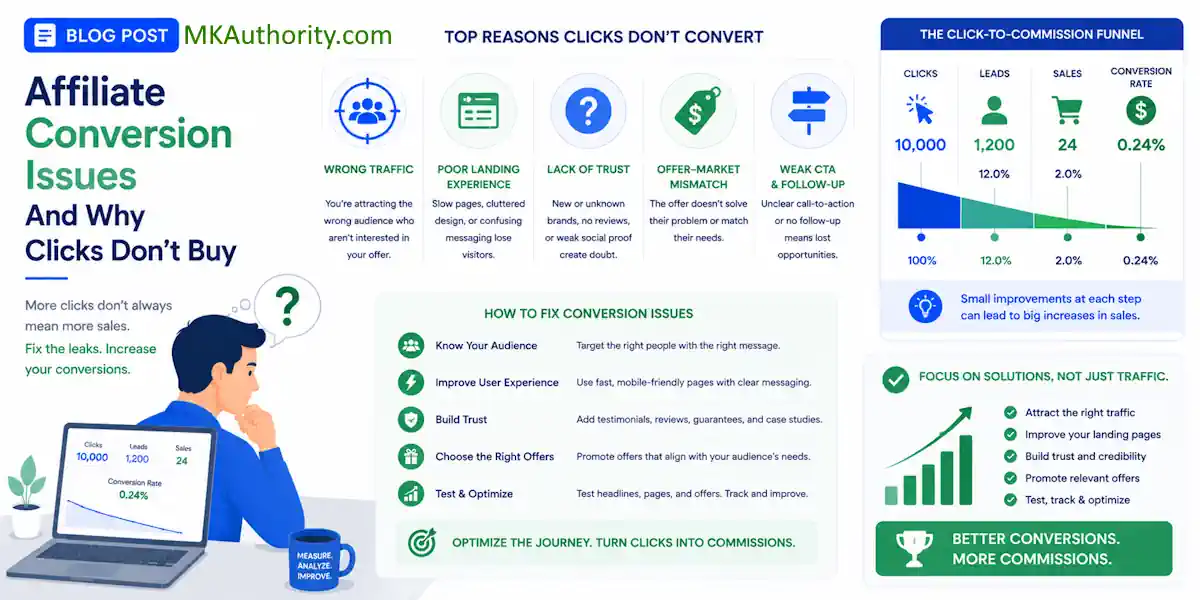

Nothing stings like seeing clicks roll in while commissions sit flat and that is clear sign of affiliate conversion issues.
If you are a content creator getting traffic but not securing buyers, do not guess at the cause. Most affiliate conversion issues stem from one specific broken step rather than a flaw in your entire approach.
As you refine your affiliate marketing strategies, the trick is to stop labeling every dip as a traffic problem until you pinpoint exactly where the drop happens. Once you find the leak, the fix becomes much more manageable and cost effective.
Key Takeaways On Affiliate Conversion Issues
- Stop treating conversion issues as one giant problem: Affiliate sales issues are almost always caused by a failure at a specific stage, such as poor message match, weak pre-sell content, or merchant-side checkout friction.
- Audit the funnel systematically: Use a granular approach to track the user journey by monitoring click-through rates, outbound clicks, and cart activity separately to pinpoint exactly where the drop-off occurs.
- Align search intent with your content: High click volume from broad curiosity traffic is rarely a substitute for high-intent traffic; focus on reviews, comparisons, and benefits to reach buyers closer to a decision.
- Pre-sell to bridge the gap: If you cannot control the merchant page, use a bridge page to qualify clicks, answer objections, and provide social proof, which filters out freebie hunters and warms up potential buyers.
First, find where the funnel breaks
A lot of affiliates treat no sales like one big problem. It is not. It is usually four smaller ones hiding in a trench coat.
Ask four things.
Did the ad or content get the click?
Next, did your bridge page or pre-sell page move the visitor forward?
On the merchant page, did anyone add to cart?
Then, did checkout turn that cart into money?
When you lump those steps together, you stay blind. A strong click-through rate can hide weak intent. A good outbound click rate can hide a weak merchant page. Even solid cart activity can still die at shipping, taxes, or a clunky checkout.
This quick map keeps the diagnosis honest:
| Funnel stage | What you see | Likely problem |
|---|---|---|
| Ad or content -> click | Good CTR, cheap clicks, no revenue | Curiosity traffic, bad promise, weak targeting |
| Bridge page -> merchant click | Plenty of visitors, low outbound clicks | Thin pre-sell, weak CTA, message mismatch |
| Merchant page -> add-to-cart | Good outbound clicks, little cart activity | Poor offer fit, low trust, weak page experience |
| Add-to-cart -> purchase | Cart activity but few sales | Price shock, checkout friction, hidden costs |
The fastest way to spot the leak is to prioritize conversion tracking. Assign a unique click ID to every visitor to see the full customer journey. Use various attribution models to understand how specific traffic sources contribute to revenue rather than just looking at total clicks.
If your network supports postback tracking or detailed cart-event reporting, turn them on immediately. By monitoring granular data instead of just looking at total sales, you avoid the common trap of spending a week trying to fix the wrong part of the funnel.
Bad traffic and good traffic can look the same in reports
A click is not intent. That is the part that fools people.
One visitor clicks because your headline made them curious. Another clicks because they were already half ready to buy. They look like the same click in your dashboard, but they represent totally different values when you analyze the search intent behind them.

Search traffic around reviews, pricing, comparisons, and bonuses usually carries stronger buyer intent than broad curiosity traffic. Successful content creators understand that the buyer journey works the same way.
A post called “What is affiliate marketing?” brings in learners, while a page built around product comparisons or a real review attracts readers who are much closer to a purchase decision.
If you are buying traffic, do not send cold visitors straight to a merchant page and hope for the best. A short bridge page can pre-frame the offer, qualify the click, and filter out freebie hunters. That is why paid traffic tips for affiliate marketing keep coming back to the importance of message match between the ad and the landing page.
Here is a plain example.
If your ad says “Start a home business with no monthly cost,” and the next page asks for a credit card or pushes a high-ticket program, the click was never a win. You got attention, then broke the promise.
Strong click volume can hide weak buyer intent.
Watch the combination of a high click-through rate, low time on page, weak outbound clicks, and flat earnings per click. That usually means people liked the hook more than the actual offer.
If you want a quick gut check, this PPC thread on clicks but no sales shows the same pattern over and over. The problem often starts after the click, when the promise and the landing page stop matching.
When the merchant page kills the sale
Sometimes your traffic is fine, but the offer page is the weak link.
Affiliates do not always control the merchant page, yet they still pay for its mistakes. A slow mobile page, dated layout, weak proof, confusing pricing, or a messy checkout can crush conversions before you ever see a commission.
Building audience trust matters more than most affiliates want to admit. People notice missing contact details, vague guarantees, strange claims, and checkout pages that feel off. The brand integrity of the merchant’s site is a major factor; if the offer sits in health, finance, or business opportunity, the threshold for professionalism is even higher.
Offer quality matters, too.
A high payout can fool you into staying too long, but if the product feels generic or poorly explained, the commission rate will not rescue it. To combat this, look for offers that provide clear product demonstrations, as buyers can smell thin value fast.
Test the merchant page yourself on mobile and desktop. Load it on regular Wi-Fi and on mobile data. Count how many clicks it takes to buy. Look for friction where doubt usually shows up, such as pricing, shipping, billing, upsells, and refund terms.
Instead of sending traffic to a generic homepage, use deeplinks to send users directly to specific product pages that align with their intent.
If the network or seller gives you access, ask for more than just EPC. Ask about mobile conversion rate, top geos, average order value, refund rate, and whether there is a gap between cart starts and completed purchases. Good affiliate managers usually know where the funnel is leaking.
A short Referwo article on clicks without conversions makes a fair point here, as context often does more selling than raw traffic volume.
When you cannot change the merchant page, change what happens before it. Your pre-sell page can answer objections, show social proof, explain who the offer is for, and tell the truth about price and commitment.
That alone can clean up a lot of wasted clicks.
How to diagnose affiliate conversion issues fast
You do not need a giant dashboard to fix most affiliate conversion issues. You need a clean audit and a little discipline.
Start with the last 100 to 300 clicks for one offer. Do not use lifetime data or mash three traffic sources together. Focus on one slice and one story.
Then walk the funnel in order. Check the ad or article headline, the bridge page, the merchant page, and the checkout flow. Pull numbers for click-through rate, outbound click rate, affiliate conversion rate, and earnings per click. If one step is healthy and the next step falls off a cliff, that is your target.
A simple testing routine beats random tinkering every time. That is the same logic behind a proven affiliate marketing framework: track one stage at a time, then fix the weakest part first.
Use this checklist when clicks are not turning into sales:
- Re-read your ad and landing page side by side. If the promise changes, fix that first.
- Break traffic out by device, source, placement, keyword, and geography. One bad segment can poison the whole campaign.
- Verify your tracking parameters to ensure you are capturing the correct data sources.
- Check for broken affiliate links that might be sending traffic to dead ends.
- Audit your technical setup, including cookie consent banners and pixel tracking, as these often disrupt the user journey.
- Compare cold traffic and warm traffic separately. Retargeted visitors can tell you whether the offer converts at all, while your email marketing lists should be segmented to ensure you are reaching the right audience.
- Click through the full buying path on your phone. Most ugly surprises show up there.
- Look for price shock. Free, cheap, trial, and premium angles attract different buyers.
- Check load speed and page stability. If the page hangs, jumps, or looks broken, people bounce.
- Ask the affiliate manager whether tracking is healthy, check for any reported tracking discrepancies, and confirm whether other affiliates are converting the same page.
- Pause bad creatives before you rewrite the whole funnel.
- Change one variable at a time, then give it enough clicks to mean something.
Here is a common pattern.
A review page gets solid search traffic, sends plenty of clicks to the offer, and still earns almost nothing. The page is ranking, but the visitor is early in the buying cycle. Smart content creators add a comparison section, real pros and cons, expected price range, and a note on who should skip the product.
That small pre-qualification step can beat another thousand visitors.
The best affiliates do not panic when sales dry up. They narrow the problem. Then they fix the step that is bleeding.
Frequently Asked Questions About Affiliate Conversion Issues
Why am I getting clicks but zero sales?
This usually indicates a disconnect between the promise you make in your content and what the user finds on the merchant’s landing page. If your ad or article attracts curious learners but the destination is a hard-sell checkout, you are dealing with a mismatch in buyer intent.
How can I tell if the merchant page is the problem?
Test the merchant’s site yourself on both desktop and mobile to look for friction points like slow load speeds, confusing checkout processes, or a lack of professionalism. If your outbound clicks are high but conversion remains low, the issue likely resides in the merchant’s ability to close the sale once the user arrives.
Should I change my entire funnel if sales are slow?
No, you should only change one variable at a time to keep your data clean. By isolating specific stages of the funnel—such as your ad copy, your landing page, or your call-to-action—you can identify exactly which tweak actually improves your bottom line.

Conclusion on finding affiliate conversion issues
Clicks are not the ultimate goal; sales are. When visitors click your links but fail to complete a purchase, the answer usually lies in one of four areas: traffic quality, message match, the merchant page, or checkout friction.
Addressing affiliate conversion issues requires a methodical approach rather than guesswork. You must tag every traffic source, inspect each step of the user journey, and avoid the mistake of changing too many variables at once.
Effective affiliate marketing strategies must also account for the limitations of last-click attribution, which often hides the true path a customer takes before converting.
When you know exactly where the affiliate conversion issues are and where potential buyers drop off, you can make better decisions quickly. By plugging these leaks in your funnel, you stop wasting ad spend and start driving more incremental sales for your business.