 Malcolm Keith 2026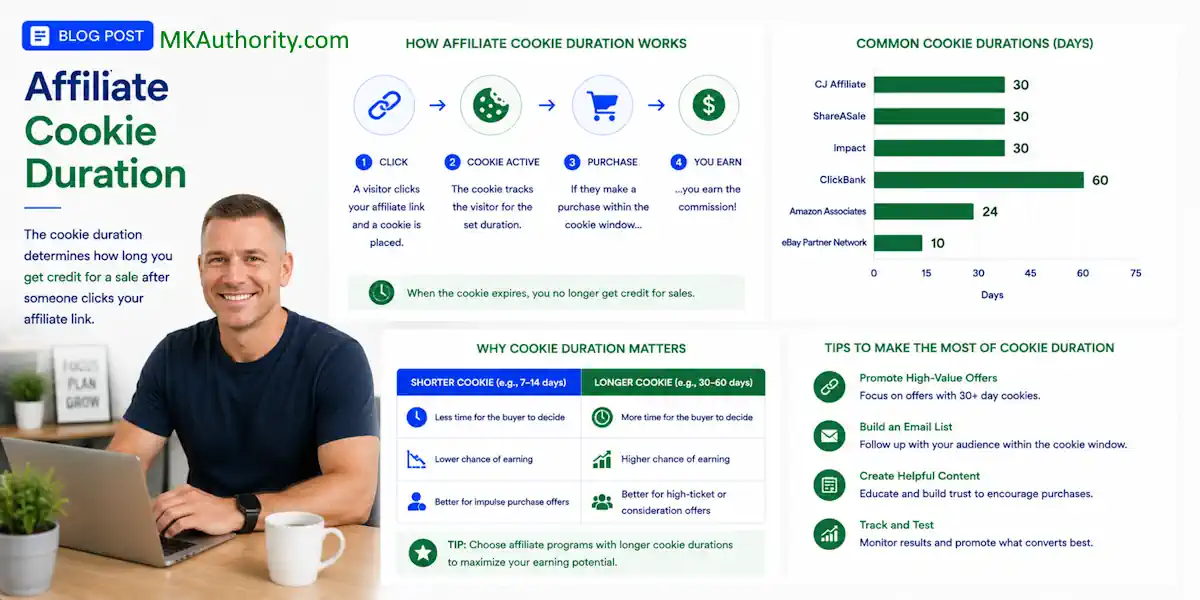


You can send someone to an affiliate offer today, they might buy next week, and you could still get paid. On the other hand, you may receive nothing at all. The difference often comes down to the specific affiliate cookie duration set by the merchant.
It sounds technical, but the concept is quite simple once you see it as a purchase timeline. The tracking cookie is the little bit of data that connects your affiliate link to a later order.
Before spending money on traffic, you need to know how long that memory lasts and what factors can wipe it out.
Key Takeaways
- An affiliate cookie duration represents the specific timeframe during which a program can attribute a purchase back to your unique affiliate link.
- Comparing a 24-hour cookie to a 90-day cookie reveals how different windows can lead to significantly varied results from the same amount of traffic.
- Cookie length is only one factor to consider. Attribution models, device switching, browser privacy settings, user consent, and product returns can all influence your final payouts.
- Understanding these program rules is essential for protecting your affiliate earnings and ensuring you are accurately compensated for your promotional efforts.
- Always read an offer’s terms and conditions before you begin promoting a product or investing in paid clicks.
- Seeing a sale appear in your dashboard is encouraging, but only a cleared commission truly contributes to your bottom line.
What an Affiliate Cookie Duration Actually Means
When a potential customer clicks your affiliate link, the merchant or their affiliate network places a small tracking cookie in the user’s browser. This tracking cookie acts as a digital receipt, identifying you as the referral source. In plain English, the system uses this file to recognize that the visitor arrived specifically through your unique affiliate link.
These files generally fall into two categories: first-party cookies, which are set by the website the user is currently visiting, and third-party cookies, which are often used by advertising networks to track users across different sites. The affiliate cookie duration refers to the specific timeframe this tracking window remains active.
To put this into perspective, imagine you promote a software tool with a 30-day cookie window. If a visitor clicks your link on July 1, browses the site, and leaves without buying, you remain in the running. If that same visitor returns directly on July 20 to complete their purchase, you receive the commission because the event occurred before the cookie expiration.
However, if the program only offers a 24-hour cookie, your referral credit would vanish as soon as the next day arrives.
While a longer window provides a safety net, it is not a guarantee of payment. It simply defines the time-frame in which you can receive credit if the buyer completes their purchase. For more technical insights, you can review this guide on affiliate marketing cookie duration.
A long cookie window gives a prospect more time to think. It does not fix a weak offer, poor targeting, or traffic with no buying intent.
The importance of this window often depends on the type of product. Impulse purchases, like low-cost items on Amazon, usually happen within minutes of clicking a link. Conversely, high-ticket items or complex business tools often involve a much longer sales cycle.
Because expensive software, coaching programs, or cloud services require several touchpoints and repeat visits before a buyer is ready to convert, a longer cookie expiration period is essential for your long-term success.
Ultimately, your payout depends on the tracking rules set by the program. You are not always paid for the first click, but by understanding how these tracking windows function, you can better align your promotions with the actual buying behavior of your audience.
Short, Medium, and Long Cookie Windows
There is no standard duration across the industry. When you research a potential program, the specific cookie window defines how long your referral remains active. One program may offer a 24-hour cookie window, while others provide 30, 60, or 90 days.
Some programs even offer lifetime cookies, though you should read the terms to understand if that covers every future purchase or just the initial conversion.
Here is how common cookie durations can feel in real life:
| Cookie window | Simple purchase timeline | What it means for you |
|---|---|---|
| 24 hours | Visitor clicks Monday and buys Tuesday morning | The commission may be gone |
| 7 days | Visitor clicks Monday, researches, then buys Saturday | You may be credited |
| 30 days | Visitor joins your list, gets follow-up emails, then buys three weeks later | Better fit for considered purchases |
| 90 days | Visitor compares options and returns much later | More room for slow decisions |
| Lifetime or recurring | Visitor becomes a customer through your link | Rules vary, so check the small print |
A shorter duration is not automatically bad. It often works perfectly for impulse buys or well-known brands. For example, the Amazon Associates program uses a 24-hour cookie, which relies on the high conversion rate of the Amazon platform. In these cases, the sales cycle is short because the customer is already primed to buy.
However, when you are paying for traffic, short windows can make it difficult to earn a return on investment. If you are promoting high-ticket items, a longer window is vital because these products often require a longer sales cycle. Potential buyers need more time to research and build trust before they pull the trigger.
A longer window gives your traffic more chances to pay you back. This is especially useful if you build an email list first. You can provide training, tips, and value over time instead of hoping for a quick sale from a cold visitor.
If you are new and still choosing where to begin, browsing a reputable affiliate network can help you find programs that balance competitive payouts with favorable tracking terms. These platforms help you compare different products and understand the tracking rules before you commit your time and marketing budget.
Why the Cookie Is Not Always the Final Answer

This is where beginners often get caught out. You might see a 90-day cookie window and assume every purchase within that timeframe earns you money. That is not always the case, as the specific attribution window of the program dictates how credit is assigned.
Affiliate programs rely on specific rules to determine which partner receives credit for a sale. Modern affiliate tracking software is typically configured by the merchant to follow one of several models.
Many programs use last-touch attribution, which means if a user clicks your link but later clicks another affiliate’s link before purchasing, the second partner gets the credit.
Conversely, some programs use first-touch attribution, where the initial referral receives the commission regardless of subsequent clicks. Other merchants may use split credit or coupon-code attribution to manage their payouts.
Here are common factors that can affect your tracking and lead to potential issues:
- The visitor clicks another affiliate link before making a purchase.
- The user clears their cache or blocks first-party cookies in their browser settings.
- The user employs a private browsing mode or an ad blocker.
- The customer switches from a desktop computer to a mobile device.
- The purchase is completed through a mobile app instead of the website.
- The visitor refuses to provide consent for non-essential tracking cookies.
- A discount code associated with a different partner is applied at checkout.
- The order is cancelled, refunded, or flagged as invalid by the merchant.
Because of these variables, you should never guarantee that you will receive a commission for a referral. You can share products and explain your links, but the final attribution remains under the control of the merchant’s system.
Furthermore, privacy regulations and updates to the user’s browser significantly impact your results. Safari, Firefox, and Chrome handle tracking differently, and mobile apps often prevent standard tracking entirely. Because a tracking cookie typically cannot follow a user across different browsers or devices, you may experience early cookie expiration or lost attribution.
You will see plenty of real-world confusion around this in affiliate cookie discussions. This confusion is understandable, as the rules for managing these digital footprints are rarely identical across different programs.
Match the Cookie Window to the Offer You Promote
Think about the buying decision before you decide if a cookie duration is good enough.
A $10 ebook or a simple household item can be categorized as impulse purchases. A one-day or seven-day cookie might be workable if your content aligns perfectly with what the visitor already wants.
A $500 course, a recurring software subscription, or a business opportunity represents high-ticket items that usually take more thought. People may watch videos, compare competitors, ask questions, wait for payday, and then return later. A 30-day or longer cookie is often more practical for those types of offers.
Still, do not choose a product only because it has a huge cookie window. A 365-day cookie on something nobody wants is not much use. As part of your conversion rate optimization, you need a product that solves a clear problem and a commission that makes business sense for your marketing strategy.
When comparing programs to maximize your affiliate earnings, look at these points together:
- Cookie duration and attribution model
- Commission per sale and recurring commission terms
- Average price of the product
- Refund or reversal policy
- Whether the merchant gives you reports and reliable tracking
- Whether you would feel happy recommending it to a friend
For a beginner-friendly way of sorting through the choices, have a look at these affiliate product selection tips. There are thousands of offers out there, but you do not need to promote them all just because you have an affiliate link.
The same goes for traffic. Traffic exchanges, solo ads, paid clicks, social media, SEO content, and email lists all produce visitors with different levels of interest. People clicking simply to earn credits are rarely ready to buy. A longer cookie cannot turn poor-quality clicks into buyers.
Good traffic and a useful offer are still the foundations.
Read the Terms Before You Promote or Pay for Clicks
You do not need to become a legal expert to succeed in this industry, but you must thoroughly review the affiliate program terms for every offer you join. Before you commit time or money to a campaign, locate the commission terms and frequently asked questions to understand exactly how your referrals are tracked.
Look for the cookie duration first. Then, find out what happens if another affiliate refers the person later. Determine whether the program uses advanced conversion tracking to link orders across devices and verify if the data is stored within the user’s browser or if it relies on server-side attribution.
Ask whether existing customers count toward your commission and if coupon websites might override your referral link. Some modern platforms even offer features like a 90-day cart extension, which can significantly improve your chances of getting paid if a user adds an item to their cart but completes the purchase later.
If the affiliate program terms remain unclear, contact the affiliate manager or support team directly. It is vital to get a clear answer before you send thousands of visitors to a landing page. Using reliable affiliate tracking software can also give you better insight into how these merchants report their data.
This level of due diligence is especially important when you are buying traffic.
A lucrative commission offer can easily become a financial trap if you ignore potential refunds or delayed payouts. Consider this basic example:
Suppose an offer pays $40 per sale. You expect one sale for every 50 clicks, which suggests an expected value of $0.80 per click before accounting for refunds. If you pay $1.20 per click for traffic, your numbers are already moving in the wrong direction.
Now, factor in refunds, reversals, software costs, autoresponder fees, and landing page expenses, while remembering that commission payouts often take weeks to clear. That $40 sale is not the same as $40 sitting in your bank account.
A sensible estimate follows this formula:
Expected commission per click = sales conversion rate x commission per sale x (1 – refund reserve)
Use this figure as a rough ceiling rather than a license to spend every penny of your projected revenue. Always leave yourself breathing room. If your expected payable value per lead is $1.80, paying $1.35 per lead leaves a 25 percent margin for costs and risk. It is not exciting math, but it prevents expensive mistakes.
Track visitors, opt-ins, sales, refunds, and cleared payouts separately. A reported sale is a signal. Cleared cash is the result.
Build Trust So the Cookie Is Not Your Only Hope
The cookie provides a tracking window, but trust provides a better chance of securing a sale.
Do not send cold visitors straight to an offer with no context, especially for a product that requires explanation. A short review, a comparison, a useful tip, or a simple bridge page where you place your affiliate link can help your audience understand why the product matters.
Incorporating this into your overall marketing strategy ensures that you are providing value rather than just pushing a product.
Next, capture the lead where it makes sense. A good lead magnet should solve a small, real problem for the exact people you want to reach. Once they are on your list, focus on lead nurturing through useful emails rather than endless hype and a constant stream of links.
Email provides a powerful way to bring interested people back to the offer. Even if their original cookie has expired, you can still drive conversions by maintaining contact. Consistent lead nurturing helps you build a real audience and stabilize your long-term affiliate earnings instead of depending on the outcome of a single visit.
For more basic ideas on building an affiliate business without a giant ad budget, this easy affiliate marketing guide is a useful starting point.
The big point is simple. Do not build your whole marketing strategy around a cookie lasting 30 days. Build a relationship, collect permission-based leads, and promote offers you can stand behind to ensure your affiliate earnings grow over time.
Frequently Asked Questions About Affiliate Cookie Duration
Does a longer cookie duration guarantee a commission?
No, a longer cookie window does not guarantee payment. It simply defines the timeframe in which a purchase can be attributed to your link if the user does not clear their cache, click another partner’s link, or encounter other tracking blockers.
Can I earn a commission if a customer switches devices?
It depends on the program’s tracking technology. If the merchant uses browser-based cookies, switching from a phone to a desktop will likely break the link, whereas more advanced server-side or cross-device tracking may still credit you for the sale.
What happens if a user clicks multiple affiliate links?
Most programs operate on a “last-touch” attribution model, meaning the final affiliate link clicked before the purchase receives the credit. Some programs use “first-touch” instead, so it is important to check the specific terms and conditions of each offer.
Are cookies always necessary for an affiliate sale?
While cookies are the standard for tracking web-based referrals, they are not the only method. Some sophisticated programs use unique coupon codes or internal IDs to track sales, which can sometimes provide more reliable attribution than browser-based cookies alone.
Final Thoughts on Affiliate Cookie Duration
Affiliate cookie duration matters because buyers rarely purchase on their very first visit. A longer cookie window can give your content, email campaigns, and follow-up strategy more time to drive a conversion.
However, the duration is only one piece of the puzzle. You must also consider attribution rules, traffic quality, refund policies, and how the tracking cookie behaves within the user’s browser before determining if a campaign is truly profitable.
Always verify the specific terms of a program before you begin promoting. By understanding how these variables work, you ensure that every click has a better chance of becoming a cleared commission. Ultimately, the accuracy of your earnings will always depend on the reliability of the affiliate tracking software.