 Malcolm Keith 2026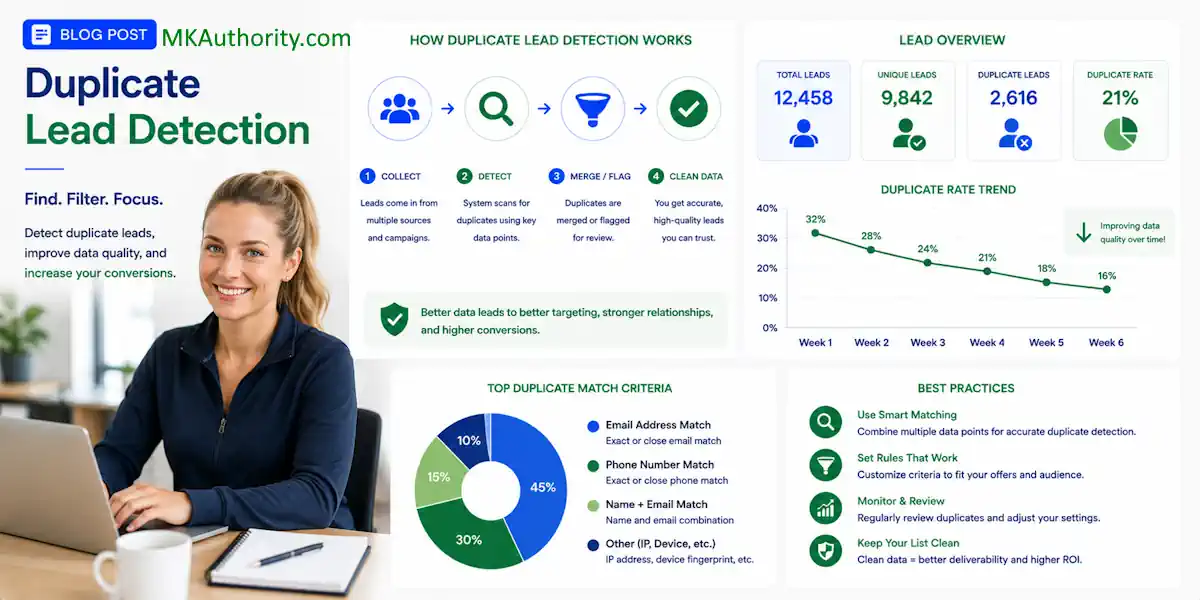

Nothing ruins your affiliate marketing metrics faster than paying for the same lead twice, so we need to look at duplicate lead detection..
You might see 100 opt-ins in your dashboard and assume that your traffic source is performing perfectly. However, a closer look often reveals that the same individuals filled out multiple forms, clicked several ads, or used different email addresses across various devices.
This is exactly why you need a robust strategy for duplicate lead detection.
Effectively managing your data is not about simply discarding contacts. It is about accurately identifying which leads are genuinely new, which represent repeat conversions, and which records require a careful cleanup to prevent inaccuracies in your payouts and campaign performance analysis. By prioritizing accurate duplicate lead detection, you ensure your marketing decisions are based on reliable data.
Key Takeaways
- Match leads using more than one field because relying on an email address alone is not always enough to identify unique users.
- Keep original source and timestamp data before merging any records.
- A repeat buyer or repeat opt-in is not automatically a duplicate lead.
- Click IDs, affiliate IDs, UTMs, and landing-page data show where each lead came from.
- Protect consent records and remove old data on a sensible schedule.
- Implement robust de-duplication strategies to ensure data accuracy and protect the long-term integrity of your affiliate funnels.

Why Duplicate Leads Can Cost You Real Money
Affiliate funnels can create duplicates in all sorts of normal ways. A person may fill in your form, not receive the promised email straight away, then submit it again. They may come back through a different Facebook ad, a retargeting campaign, a solo ad, or a referral link.
Then there are the less innocent cases.
Some leads are submitted repeatedly to trigger commissions, claim bonuses, or make a traffic source look better than it is. Repeated form fills from the same device, phone number, or IP address can be a warning sign of malicious activity.
Implementing robust duplicate lead detection is the most effective way to address these rising costs and ensure your data remains accurate. Tapfiliate also highlights repeated clicks and conversions from the same IP or device as signals worth monitoring in its guide to affiliate fraud prevention.
Bad duplicate data causes three big problems:
- You pay affiliates or ad sources for leads you already had.
- Your opt-in rate looks better than it really is.
- Your email list gets messy, with people receiving the same follow-up sequence more than once.
That last one matters more than people think. A lead who gets three copies of the same email may unsubscribe, report it as spam, or decide your business is all noise.
More traffic is not always more leads. Sometimes it is the same lead coming back through a different door.
Before you blame the traffic source, though, get your tracking in order. A proper affiliate conversion tracking guide can help you connect the ad click, opt-in, sale, and commission without relying on guesswork.
Build a Lead Record That Tells the Full Story
You cannot spot duplicates if your funnel only stores a first name and email address. That is like trying to identify a car using only its colour. It is useful sometimes, but not enough when there are 50 silver cars in the car park. High-quality CRM data serves as the foundation for this process, ensuring you have the depth required to distinguish unique prospects from repeats.
Every lead record should keep a few pieces of data from the moment the person arrives. You do not need expensive software to start monitoring duplicate lead detection.
A spreadsheet, CRM, autoresponder, or tracking platform can all hold these fields.
| Data field | What it helps you check |
|---|---|
| Email address | Exact matches and minor spelling variations |
| Phone number | Repeat submissions using different emails |
| Company name | Identifying leads from the same organization |
| Click ID | The individual paid or affiliate click tied to the lead |
| Affiliate ID | Which partner referred the person |
| Date and time | Whether forms were sent minutes or months apart |
| UTM source and campaign | The ad, email, social post, or traffic source |
| Landing page URL | Which page produced the opt-in |
| IP address or device data | Possible bots, fraud, or repeat activity |
| Consent status | What permission the lead gave you |
Start by standardising what you can.
Convert every email address to lowercase and remove unnecessary spaces. Store each phone number in one format, including the country code where possible.
While basic sorting helps, sophisticated systems often employ a fuzzy matching algorithm to identify records that are nearly identical but not perfect matches. In more complex environments, a Dataverse search can help unify records across disparate platforms.
Many modern platforms also offer a built-in duplicate detection feature to automate these checks, saving you manual effort.
Do not make IP address your only duplicate rule. Families share Wi-Fi, offices share networks, and a mobile user can appear under several IPs in one day. It is a useful clue, rather than a final verdict.
Phone, IP, ZIP code, and other data points are often checked together when looking for suspicious lead activity. Phonexa gives a useful view of these checks in its article on detecting lead generation fraud.
Click IDs are gold when you run paid traffic. Your tracker creates a unique ID when somebody clicks, then passes that ID into the funnel and affiliate network. If the same click ID shows up against multiple form submissions, you can see what happened without guessing.
If your links are not carrying that information yet, have a look at these affiliate link tracking tools. Even a simple tracking setup can stop a lot of wasted spend.
Tell a True Duplicate From a Repeat Conversion
Here is where many marketers get it wrong. They see the same email address twice and delete one record. Job done, right?
Not always.
A genuine duplicate is usually the same person submitting the same offer or form again, with no meaningful new action. A repeat conversion is a person who has come back and done something different. They may have joined a second list, bought a second product, booked a call, or upgraded after seeing a new offer.
The difference is in the details. You should implement clear matching rules to ensure your data hygiene practices do not interfere with your lead qualification process.
A lead is more likely to be a duplicate when the email or phone matches, the form is the same, and the submissions happened within a short period. In B2B contexts, you should also look for a similar name and company to identify potential duplicates, especially if the company name appears slightly different across separate entries.
Matching click IDs, landing pages, and affiliate IDs makes the case for a duplicate even stronger.
A repeat conversion may have the same email, but a different event type. For example, an existing subscriber downloading a new lead magnet is not a duplicate opt-in if they gave consent for that new list. Neither is a customer purchasing an upgrade after their first order.
Affiliate attribution also needs care. A person may first reach you through an affiliate email, then later return through Google, Facebook, or your own follow-up sequence. Do not blindly credit the last click, or delete the earlier record. Keep both attribution events and apply the rules of the affiliate program.
Different programs use first-click, last-click, or multi-touch credit rules. This overview of affiliate attribution models shows why a repeated visit does not automatically mean the original referral was worthless.
Use a simple decision rule:
- Check for an exact email or phone match.
- Compare the event type, offer, and form submitted.
- Look at the time gap between submissions.
- Check click ID, affiliate ID, UTM values, and landing-page URL.
- Mark the record as duplicate, repeat conversion, or needs review.
The “needs review” option is important. Some data is too close to call automatically. Do not let a rigid rule throw away a good lead or deny a legitimate affiliate commission.
A Practical Duplicate Lead Detection Workflow
You do not need to spend all day clicking through dashboards. Set up a small routine and make it part of your campaign management. Daily is good for paid ads, while weekly works well for small organic or email-driven funnels.
To streamline your duplicate lead detection, you can leverage robust CRM technology. For instance, Dynamics 365 Sales allows you to manage this within the Sales Hub app, where a built-in duplicate detection feature uses an AI model to flag redundant entries.
Similarly, a Salesforce Marketo integration can trigger automated deduplication workflows to clean your database. These systems are highly effective at helping you identify potential duplicate leads before they ever reach the sales team.
Regardless of the tool, start by pulling lead records into one central place. If your leads live in five different systems with no shared ID, duplicates will continue to slip through. Create matching rules in layers, starting with exact email matches, then phone matches, and finally, close matches like similar names with slightly different contact details.
A simple setup might classify records like this:
- Exact duplicate: Same normalized email or phone, same form, same offer, and a short time gap.
- Probable duplicate: Matching phone or device data, similar name, and the same campaign.
- Repeat conversion: Same contact, but a different offer, purchase, or clearly separate action.
- Suspicious lead: Repeated submissions, strange data patterns, many accounts from one device, or no believable engagement after opt-in.
Advanced platforms provide an interface to view possible duplicates and merge duplicate leads into a single primary record to keep your database organized. When you merge, ensure the master or primary record retains the earliest opt-in date, original affiliate ID, first click ID, consent details, and source data.
Some tracking platforms already have these filters. For example, WhatConverts lets users add a duplicate column and filter records marked “Yes” in its duplicate leads help guide. The important bit is still your rule. Software can find similar records, but it does not know your commission terms or customer journey.
Never overwrite the first source with the latest source. You may need that original data later if an affiliate disputes a commission or a lead asks when they gave permission.
Before paying traffic partners, compare unique leads against total leads, and then compare qualified leads against sales. You will get a much more honest picture of campaign performance. For help reading the rest of those numbers, see this guide to CTR, opt-in rate, and EPC.
Use This Lead Review Checklist Before You Merge
Before you apply your duplicate detection rules and finalize your database cleanup, run through this quick verification process. The goal is to determine exactly which data points should be moved to the primary record when you decide to merge duplicate leads.
- Is the email an exact match after lowercasing and removing extra spaces?
- Does the phone number match after formatting it properly?
- Is the lead submitting the same form and offer?
- Are the timestamps close together, or are they weeks apart?
- Do the click ID and affiliate ID match?
- Are the UTM source, campaign, content, and landing page the same?
- Did the person give fresh consent for a separate list or offer?
- Have you preserved the original source, timestamp, and consent record?
- Does the record look like fraud, or could it be a normal repeat visitor?
This takes a few minutes, but it can save you a pile of arguments later. This is especially important if you are paying per lead, buying solo ads, running co-op traffic, or building a team around a funnel.
Consent, Retention, and Privacy Still Matter
Duplicate checking does not give you a free pass to collect every bit of data possible. Effective data governance requires you to only collect information that you can explain and use. If email and phone are enough to operate your funnel, do not go hunting for extra personal details.

Make your opt-in form clear about what people are joining. Keep proof of consent, including the form, date, time, and source where practical. If somebody unsubscribes, do not re-add them because a duplicate record appears later.
Maintaining a clean database is not just a best practice for marketing efficiency; it is also a legal and operational necessity.
Set a retention period for inactive leads and old tracking data. Your exact period depends on where you operate, your legal duties, and the services you use. Furthermore, ensure that security roles are properly configured so that only authorized personnel can perform lead merges or bulk deletions.
The common-sense rule is simple: keep what you need, protect it properly, and delete what you no longer have a legitimate reason to hold.
Frequently Asked Questions About Duplicate Lead Detection
Is every repeat lead submission a duplicate?
No, a repeat submission is not always a duplicate. A lead might return to download a different lead magnet, purchase an upgrade, or join a separate list, which signifies a repeat conversion rather than a redundant entry. You should always distinguish between these meaningful actions and instances where the same person submits the same form repeatedly without new intent.
Why shouldn’t I rely solely on email addresses to detect duplicates?
Depending only on email addresses is risky because users often provide variations or use secondary accounts across different devices. To ensure higher accuracy, you should implement multi-field matching that includes phone numbers, IP addresses, and unique tracking identifiers like Click IDs.
Combining these data points creates a much more reliable profile of your prospects.
What is the biggest risk of ignoring duplicate leads in affiliate marketing?
The primary risk is financial, as you may end up paying commissions for the same lead multiple times. Furthermore, allowing duplicates to persist leads to inflated conversion metrics and a degraded user experience, where prospects are bombarded with redundant follow-up emails that may cause them to unsubscribe or mark your content as spam.
Final Thoughts on Cleaner Affiliate Leads
Duplicate lead detection is not about making your numbers look smaller. It is about making them true.
By implementing effective de-duplication strategies, you ensure that your data remains accurate and reliable. Keep the original source data, compare several matching signals, and treat repeat conversions with a bit of common sense. When you know which leads are new, which are returning, and which are suspicious, you can spend your traffic budget with far more confidence.
Furthermore, these efforts ensure that your lead routing rules function correctly, making certain that the right leads are always sent to the right partners.