 Malcolm Keith 2026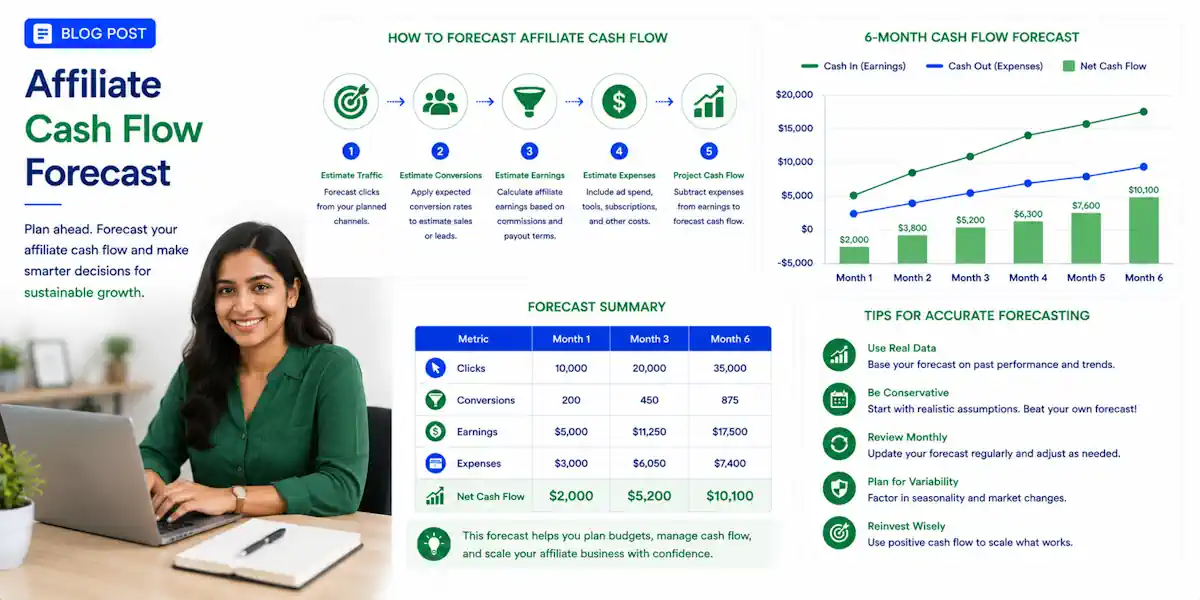


Buying traffic before you understand your numbers is like filling your car with fuel before checking where the road goes. You might generate leads or secure sales, but you can still run out of liquidity before your affiliate cash flow forecast aligns with actual network payouts.
A proper plan tells you what you can afford to test, what a click can cost, and how long your capital will be tied up. Implementing consistent affiliate cash flow forecasting is a vital tool for strategic planning, ensuring you never run out of funds while waiting for commissions to clear.
It does not predict instant riches, but it does prevent you from making expensive, uncalculated guesses.
Before you load up an ad account or purchase a solo ad, get the calculator out.
Key Takeaways
- Revenue shown in an affiliate dashboard is not the same as cash in your bank.
- Forecast clicks, leads, sales, commissions, refunds, and payout dates before spending.
- Build your numbers around conservative assumptions rather than best-case scenarios from a sales page to ensure you maintain sufficient liquidity during long payout windows.
- Set a fixed test budget and a maximum loss you can live with.
- Scale traffic only when the numbers still work after accounting for refunds, payment holds, and all operational costs.
Affiliate Revenue Is Not Yet Affiliate Cash
This is where a lot of people get caught out.
You buy $500 of traffic today. A few days later, your affiliate dashboard shows $750 in commissions. Great news, right? Well, maybe. That $750 may still be pending, effectively acting as accounts receivable that you cannot touch yet.
Some sales may refund, some may be reversed, and the network might hold funds for 30, 45, or 60 days.
You cannot pay tomorrow’s accounts payable with a commission that is still sitting in pending status.
Successful cash flow forecasting relies on accurately tracking when money leaves your bank account and when cleared, spendable money finally arrives. The basic small business calculation is simple:
Opening cash balance + cash inflow – cash outflow = closing cash balance
That is also the core formula used in Xero’s cash flow forecasting guide. For affiliate marketers, the difficult part is working out which commissions are likely to become real cash and when.
Your traffic cost is usually an immediate cash outflow. Google Ads, Meta Ads, TikTok Ads, solo ads, and newsletter placements all require upfront capital. Think of these expenses like payroll; you must be able to cover your fixed costs and ad spend obligations while waiting for your commissions to clear.
That time gap is the specific financial burden you must fund yourself.
It does not matter if you use search ads, social ads, or email drops. The numbers work the same way. The traffic source needs to match the offer, the audience, and your budget. A look at these top paid traffic sources for affiliates can help you choose the right channel, but your forecast determines whether you can actually afford the strategy.
A campaign can look profitable on paper while creating a severe cash shortage in real life. That is why simply looking at gross commission totals is not enough to manage your business effectively.
Build Your Forecast From Clicks to Cleared Commissions
Keep it simple at first. A spreadsheet is fine. Google Sheets, Excel, or any basic cash management software can help you track these figures. You do not need expensive tools to stop yourself from wasting money.
This forward-looking logic is known as the direct method of tracking cash. By starting with traffic costs and working forward through the funnel, you can identify the working capital required to bridge the gap between when you pay for ads and when you receive your final payouts.
| Forecast item | Formula | What it tells you |
|---|---|---|
| Clicks | Ad spend / cost per click | How many visitors you expect to buy |
| Leads | Clicks x opt-in rate | How many email subscribers you may get |
| Sales | Clicks x sales conversion rate | How many buyers you may get |
| Gross commissions | Sales x commission per sale | Commission before refunds or reversals |
| Expected payable commission | Gross commissions x (1 – reserve rate) | More realistic commission estimate |
| Cash profit or loss | Cleared cash received – all cash costs | What actually stays with you |
You can also calculate expected commission per click:
Expected commission per click = sales conversion rate x commission per sale x (1 – refund and reversal reserve)
That number is your rough ceiling. If you expect to make $0.80 per click after refunds, you cannot pay $1.20 per click and call it a business model. You may get lucky for a few days, of course, but you will not have a repeatable plan.
Do not forget your smaller operating expenses, as these can eat up a thin margin fast:
- Ad spend or traffic purchase cost
- Landing page software or funnel fees
- Email autoresponder costs
- Tracking tool fees
- Creative costs, if you pay for copy, video, or graphics
- Payment processing charges, where they apply
- Agency or freelancer fees
Your traffic cost is not always your full customer acquisition cost. If you pay $600 for clicks and another $60 for tools, your real outlay is $660.
For a quick profit calculation, the formula used in this cash flow projection explanation is useful:
Cash flow = estimated cash inflow – estimated cash outflow
The key word is cash. Pending commissions are not yet cash inflow, and you must ensure your operating expenses do not exceed your available capital before those commissions clear.
Use Conservative Assumptions, Not Hopeful Numbers
Affiliate marketing is full of screenshots, big claims, and people showing one good day. None of that should be the foundation for your forecast.
Use your own real-time data when you have it. If you do not, begin with modest assumptions and improve them as actual clicks come in. By comparing your forecast against actual performance, you can build a more accurate statement of cash flows for your business.
Let’s say an offer has a $35 commission. It might be tempting to assume every sale sticks. It won’t. People change their minds. Cards fail. Trials cancel. Some merchants reverse sales that do not meet their rules.
A safer forecast includes a reserve. You hold back a percentage of reported commissions until they have cleared. This is a form of scenario planning that helps you prepare for various outcomes, ensuring you are never caught off guard by a spike in refunds.
Here is a simple way to think about it:
- Use a 10% reserve when you have a proven offer with low refunds and reliable reporting.
- Use a 20% reserve when the offer is new to you or refund rates are unknown.
- Use a larger reserve for trials, supplements, high-ticket coaching, recurring offers, or anything with a long refund window.
You are not trying to be negative. You are trying to stay in business long enough to learn what works.
Also be careful with funnel conversion rates. A 35% opt-in rate does not mean 35% of visitors will buy. A big email list with no buyers is not a cash flow solution. It may become valuable later, but it does not pay today’s traffic bill.
Track the stages separately:
- Visitors who land on your page.
- Leads who opt in.
- Leads who open and click emails.
- Buyers who purchase.
- Sales that clear the refund and hold period.
- Payments that reach your bank or payment account.
That is the real path. Anything earlier is a signal, not a final result.
A sale is encouraging. A cleared commission is a number you can spend.
If you are building a list before sending people to affiliate offers, calculate lead value as well. For example:
Expected value per lead = lead-to-sale rate x expected payable commission per sale
That figure gives you a sensible maximum cost per lead. Without it, you are paying for names and hoping they become money later.
A Worked Affiliate Cash Flow Forecast Example
Here is a basic hypothetical example. These are not promised results. They are labeled assumptions so you can see how the math works before spending a dollar. Using a structured approach to budgeting during this phase helps you remain objective before you commit your capital.
Assumptions for the test
A marketer wants to test an affiliate offer using a paid traffic source.
| Assumption | Figure |
|---|---|
| Ad budget | $600 |
| Average cost per click | $0.60 |
| Expected clicks | 1,000 |
| Landing-page opt-in rate | 30% |
| Expected leads | 300 |
| Sales conversion rate from clicks | 2% |
| Expected sales | 20 |
| Affiliate commission per sale | $35 |
| Gross reported commission | $700 |
| Refund and reversal reserve | 20% |
| Expected cleared commission | $560 |
| Tracking and creative costs | $30 |
| Total cash spent upfront | $630 |
The forecast starts with 1,000 clicks because $600 divided by $0.60 equals 1,000.
At a 30% opt-in rate, the campaign produces an estimated 300 leads. At a 2% visitor-to-sale rate, it produces 20 sales. Twenty sales at $35 each creates $700 in gross affiliate commissions.
Sounds profitable at first glance. You spent $600 and generated $700.
But now take off a 20% reserve:
$700 x 80% = $560 expected cleared commission
Then include the $30 spent on tracking or creative tools, which are classified here as operating expenses:
$560 cleared commission – $630 total cost = -$70 net cash flow
The campaign is not profitable under these assumptions. It has produced sales, leads, and reported commission. But it has not yet produced a positive net cash flow.
Now add payment timing.
| Timing | Cash movement | Running cash result |
|---|---|---|
| Day 1 | Traffic and tools paid: -$630 | -$630 |
| Days 1 to 14 | Sales reported in affiliate dashboard | -$630 |
| Days 15 to 30 | Refunds and reversals may occur | -$630 |
| Day 45 | Estimated cleared payout received: +$560 | -$70 |
This is why forecasted revenue is not cash received. You were out $630 for 45 days, then still finished $70 down.
Could the real campaign do better? Yes. Could it do worse? Absolutely.
The point is to see the situation before the money disappears. Once the campaign is live, you should perform a variance analysis by comparing these initial estimates to your actual performance data to refine your future models.
To reach break-even in this example, the campaign needs one or more of these improvements:
- A lower cost per click
- A higher sales conversion rate
- A higher commission per sale
- Fewer refunds and reversals
- Lower tool and creative operating expenses
- Better follow-up sales from the email list
Don’t change five things at once. You won’t know what fixed the problem. Start with the biggest weak point.
Put Payout Delays and Refund Windows on the Calendar
Affiliate networks operate under unique rules that dictate when you actually get paid. Some approve commissions quickly, while others hold funds until the refund period expires. Merchants may pay on a weekly, monthly, or delayed net schedule, often subject to a minimum payout threshold.
You should review the affiliate terms before buying traffic, never after. To maintain proper liquidity, you need answers to these basic questions:
- When does a commission move from pending to approved?
- What is the length of the refund period?
- Can the merchant reverse a commission after initial approval?
- Is there a minimum payout balance required?
- What day of the month does the network issue payments?
- Does payment arrive via bank transfer, PayPal, Payoneer, wire, or another method?
- Are there additional fees or delays for receiving your funds?
You must treat pending commissions as accounts receivable and your ad platform bills as accounts payable. When mapping your forecast, enter expected payments into the specific week or month you will actually receive them. Do not record them on the date the customer made the purchase.
For example, a sale on January 10 might generate a $50 commission. If the refund period is 30 days and the network pays on the 15th of the following month, that capital will not reach your account until March 15. That is more than two months after your initial traffic expense.
This is not an unusual problem, but rather the reality of business timing.
Effective cash management software can help you track these specific network rules and separate reported earnings from actual inflows. The Post Affiliate Pro cash flow projector is one example of a tool designed to model the timing of incoming and outgoing cash. However, your master spreadsheet must still incorporate your specific payout rules and refund assumptions.
If your ad platform bills weekly while your network pays monthly, you need enough liquidity to bridge the gap. Never spend money intended for rent, food, bills, payroll, or your main household commitments on an unproven traffic test. Traffic is a business expense, not a financial rescue plan.
Set a Test Budget Before You Fall in Love With an Offer
Most traffic disasters do not start because the affiliate offer was terrible. They start because the marketer kept spending after the numbers had already said stop.
Effective budgeting is essential, so set your maximum test budget before you launch. A reasonable test budget has two limits:
- It must be enough to collect useful information.
- It must be small enough that a total loss does not hurt your life.
That second point matters most. If losing 300 dollars would create a real problem, such as being unable to cover your monthly rent or business payroll, do not risk that 300 dollars. Start smaller, use free traffic while you learn, or build a cash reserve first. There is no shame in that.
For a paid test, include these numbers in your strategic planning:
- Your maximum total cash outflow
- Your maximum cost per click
- Your maximum cost per lead
- Your minimum acceptable opt-in rate
- Your expected sales conversion rate
- Your refund reserve
- The date when you will review results
- The exact point where you pause the campaign
Suppose your expected payable commission per lead is 1.80 dollars. You may decide to pay no more than 1.35 dollars per lead, leaving a 25 percent margin for risk and profit.
The formula is:
Target cost per lead = expected payable value per lead x (1 – target margin)
So:
1.80 dollars x 75 percent = 1.35 dollars target cost per lead
If your campaign is producing leads at 2.40 dollars, do not pretend that a future email sequence will magically repair everything. It might. But your forecast should not depend on miracles.
For the worked example, the cost per lead was:
630 dollars total cost / 300 leads = 2.10 dollars per lead
That is well above the 1.35 dollar target. It gives you a clear issue to fix before scaling.
Paid traffic is quicker than waiting for organic visitors. It also makes mistakes faster. If you are unsure which route suits your situation, compare the pros and cons of paid affiliate traffic before committing your budget.
Use Decision Thresholds So Emotion Doesn’t Spend Your Money
Good traffic buying is not about pushing harder because you feel close to a breakthrough. It is about deciding what the numbers need to do. Before a campaign starts, use scenario planning to write your decision rules down. By defining exactly what should happen (If X, then Y), you remove emotional bias from the equation.
Here are practical examples of these thresholds:
- Pause if your cost per click stays above your maximum after a pre-set number of clicks.
- Pause if your opt-in rate is far below the level needed for your lead value.
- Pause if you get enough clicks to test the page and there are no sales, provided the offer has had a fair chance.
- Continue cautiously if clicks are affordable, opt-ins are strong, and sales are beginning to track near your forecast.
- Scale only after commissions have cleared and the full costs still leave a profit.
The number of clicks needed depends on your offer and conversion rate. There is no magic 100 clicks tells all rule. A low-priced offer with a 5% conversion rate can give feedback sooner than a high-ticket offer that converts at 0.3%.
Still, you need enough data to make a sensible call.
If you expect a 1% sales rate and want to see five estimated sales before judging the offer, you need around 500 qualified clicks. At $0.60 per click, that is a $300 traffic test before tool costs.
Don’t scale from one sale. Don’t scale from one good day. And don’t scale based only on dashboard revenue that has not cleared.
Once you have a winning campaign, increase your spending slowly. A 20% to 30% budgeting lift gives you room to spot changes in cost, conversion, and quality. Doubling spend overnight can change traffic quality and wreck the numbers that looked good at a lower level.
Building a sustainable business requires strategic planning to ensure you are scaling only after your commissions have cleared. Repeating what works is better than chasing the loudest traffic promise. A consistent affiliate traffic strategy can give your campaigns more structure, but every traffic source still has to earn its place in the forecast.
Keep a Rolling Forecast, Not a One-Time Spreadsheet
Your first forecast is an educated estimate. Your second one should be better. After each test, replace your initial assumptions with actual data. A best practice is to maintain a 13-week cash flow forecast, as this timeframe provides a clear window to monitor liquidity and anticipate upcoming expenses.
When building this, you can choose between the direct method, which tracks actual cash receipts and disbursements, or the indirect method, which adjusts net income for non-cash items. For affiliate marketers, the direct method is usually more intuitive because it aligns with your daily bank movements.
As you gather information, use real-time data from your accounts receivable to update your spreadsheet and refine your projections for your affiliate cash flow forecast.
Update your spreadsheet with:
- Actual click cost
- Actual landing-page conversion rate
- Actual lead cost
- Actual sales rate
- Reported commissions
- Refunds and reversals
- Cleared commission rate
- Average days until payment
- Total costs, including tools
This creates a rolling forecast. You can see what is likely to happen next week, next month, and after the next network payout.
Separate campaigns by traffic source as well. A $0.50 click from one source may be worth far more than a $0.25 click from another. Cheap traffic that never opts in or buys is not cheap. It is wasted money.
Also separate cold traffic from warm traffic. Visitors from your email list, blog, YouTube channel, or existing audience usually behave differently from people seeing your offer for the first time. Mixing the data makes the forecast fuzzy.
Keep your tracking clean. Use separate links or tracking IDs where allowed. Know which ad, email, landing page, and offer produced each sale. If you cannot see where the money came from, you cannot improve it.
Frequently Asked Questions About Affiliate Cash Flow Forecast
Why is my dashboard revenue different from my actual cash?
Affiliate dashboards often display gross commissions that have not yet cleared the payment hold period or the refund window. You must account for potential reversals and network delays, as this pending amount is not available to pay for your ongoing traffic expenses.
How do I calculate my true cost per lead?
To find your true cost per lead, you must divide your total investment—including traffic, landing page tools, and creative costs—by the number of leads generated. If this figure exceeds the expected value per lead, you are likely operating at a loss regardless of what your dashboard reports.
What is a conservative reserve rate for new offers?
A 20% reserve is generally recommended for new offers or traffic sources where refund rates and reversal patterns are unknown. This buffer helps ensure your cash flow remains positive even if actual sales performance falls short of your initial projections.
Should I include operating expenses in my affiliate cash flow forecast?
Yes, you must include every operational cost, such as tracking tools, autoresponders, and design fees, alongside your ad spend. These smaller expenses can quickly erode thin margins, and failing to include them often leads to inaccurate cash flow planning.
Final Thoughts On Doing An Affiliate Cash Flow Forecast
The best affiliate cash flow forecast is not fancy. It is honest.
It is important to remember that a standard profit and loss statement can often hide the realities of your business. While a profit and loss statement shows your earned revenue, it does not always reflect your net cash flow.
A true affiliate cash flow forecast ensures that you have enough liquidity to meet your obligations, such as payroll or accounts payable, while you are actively scaling your traffic.
Count every cost. Discount reported commissions for refunds and reversals. Put payments on the date you expect to receive them, not the day you hope they will arrive.
Traffic can build a real affiliate business, but only when each test has a downside limit and the cleared cash supports the next step. By keeping a close eye on your statement of cash flows by performing an affiliate cash flow forecast, you ensure that your business remains healthy and sustainable for the long term.