 Malcolm Keith 2026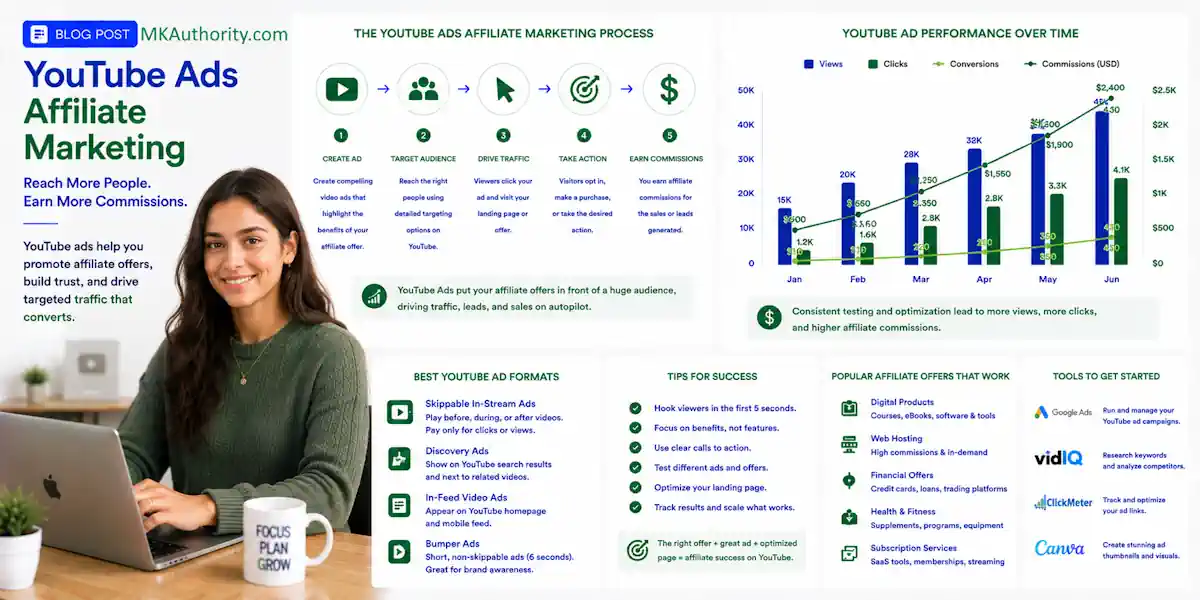

Paying for legitimate YouTube advertising is easy. Buying the right reach, tracking it, and earning a valid affiliate commission is where the real work begins. YouTube ads affiliate marketing can help content creators reach a defined target audience before they have a large channel or email list.
That’s affiliate marketing on YouTube through paid distribution, separate from the YouTube Shopping affiliate program’s product-tagging model. It can also burn a small budget fast when the math, page, and tracking are missing.
So don’t chase views or assume affiliate commissions are passive income. Start with one honest offer, one clear page, and numbers you can test and monitor.
Key Takeaways About YouTube Ads Affiliate Marketing
- Choose one affiliate offer you are allowed to advertise, and confirm its rules for Google Ads, YouTube paid traffic, landing pages, and link placement.
- Work backward from the payable commission, refund reserve, and expected conversion rate before setting a bid or daily budget.
- Send traffic to a useful landing page on your own domain, disclose the affiliate relationship clearly, and avoid unsupported claims or misleading urgency.
- Start with one video, one audience, one page, and one tracked conversion action instead of optimizing for views or watch hours.
- Track the full path from ad click to lead, approved sale, refund, reversal, and payout, while keeping paid traffic separate from organic search and YouTube Shopping reports.
YouTube ads affiliate marketing starts with the numbers
Don’t build a campaign because the commission rate looks awesome. Paid traffic has to fit the offer’s rules, your budget, and the real value of each visitor.
Choose one offer you are allowed to advertise
Choose an offer for a defined target audience and a problem they want to solve now. Product reviews, tutorial videos, or a free beginner lesson give the ad a believable reason to exist.
Compare affiliate programs before filming anything, and read their terms carefully. Confirm whether Google and YouTube paid traffic, email follow-up, and your planned ad wording are allowed. Check whether affiliate links may appear on a landing page or in a video description.
Some affiliate programs ban trademark bidding, coupon claims, or direct-to-merchant links. Those affiliate programs’ terms win, even if another advertiser appears to be doing something different.

You don’t need millions of subscribers to buy YouTube traffic. Paid distribution is separate from channel monetization. The YouTube Shopping affiliate program says Shopping invitations begin with a channel in the YouTube Partner Program.
The YouTube Shopping affiliate program is separate from buying paid website traffic, so one doesn’t automatically qualify you for the other. Check current country availability and eligibility before planning around product tags.
A subscriber threshold and monetization features can affect channel access, while buying ad placements is separate. Use YouTube Studio to inspect channel-level data before mixing it with paid results.
Paid traffic and channel eligibility are separate. Watch hours and paid ad views are different metrics. Paid ad views don’t replace watch hours for channel eligibility. Watch hours don’t prove paid traffic works. Judge the campaign by leads or sales, not watch hours.
Work backward from payable commission
The payout on an affiliate dashboard is not always the cash you keep. Compare offers using their custom commission rates, and remember that brand partnerships follow a different revenue model. Refunds, chargebacks, reversals, software fees, tracking costs, and delayed commissions can shrink a thin margin.
Amazon Associates may impose separate paid-traffic and link-placement rules. Amazon Associates also sets its own payout and reversal terms.
Plug an offer’s custom commission rates into this simple estimate before you set a budget:
Expected commission per click = sales conversion rate x commission per sale x (1 – refund and reversal reserve)
Say an offer pays $35 per sale. You estimate that 2% of visitors buy. You also hold back 20% for refunds and reversals.
0.02 x $35 x 0.80 = $0.56 expected value per click
After refunds and reversals, check the margin using the offer’s custom commission rates.
A $0.56 expected commission per click is not permission to pay $0.56 per click. Your actual bid needs room for costs and mistakes.
That number is a rough ceiling, not a profit promise. If a click costs $0.70, the campaign is already in trouble. A cheap lead can also be expensive when those leads never buy.
Use a real landing page, not a redirect shortcut
Affiliate links may look faster, but sending traffic straight to a merchant can create approval problems. A controlled page gives you more control over the visitor’s experience.
Some affiliate programs allow direct links, but others don’t. Check each program’s landing-page rules, including Amazon Associates, and confirm payout conditions and custom commission rates before launch. Google Ads policies and program terms can also change, so review the current Google Ads destination requirements before you launch.
Give the visitor a useful reason to stay
Your final URL should lead to a real page on your own domain. It can be a short product reviews page, product comparison, demonstration, free training page, or opt-in page with useful information.
The page should add something the visitor cannot get by clicking an ad straight to the merchant. Explain who the product is for, what it does, what it does not do, and what happens before visitors click your affiliate links. Place the page’s affiliate links and disclosures where visitors can easily find them. Add a privacy policy, contact method, and clear terms where needed.
Don’t build a dead-end bridge page with a huge income promise, a fake countdown, and one button. That kind of page may get curiosity clicks, but it doesn’t build trust. It can also put your ad account and affiliate status at risk.
Disclose affiliate relationships clearly
If you may earn a commission, say so plainly in the video and near the link. The FTC’s social media disclosure guidance says financial relationships with brands need clear disclosure.
A simple spoken line works: “I may earn a commission if you buy through my link, at no extra cost to you.” Put similar wording high in the video description, close to the affiliate link.
Before publishing, use a quick checklist. Say the disclosure aloud, place it near the affiliate link in the video description, and review every claim.
Don’t hide it under a pile of hashtags. Don’t make claims you can’t prove. If a product has limits, say that too. Honest ads may feel less flashy, but they pull in better prospects.
First YouTube Ads Affiliate Marketing Campaign Setup
Keep your first campaign small and simple. One offer, one landing page, one target audience, and one main conversion action is enough.
Build a short video around one problem
Your video doesn’t need a movie-level budget. If you’re promoting video editing software, a simple screen recording or direct demonstration is enough.
Start with the problem in the first few seconds. Show the product, method, or result in a realistic way. Then explain the next step with one clear call to action. For organic publication, its title and video description can support video SEO. Analyze organic search separately from paid traffic, since paid settings control delivery and targeting.
For example, a video for email marketing software could open with, “Still sending every follow-up by hand?” It could show a short screen recording, explain one useful feature, then invite viewers to see the full walkthrough.
Avoid vague hype like “Make $10,000 this weekend.” Avoid stock footage of cash, fake urgency, or claims about results you have not earned yourself. Your ad should match the landing-page headline almost word for word. It should usually send viewers to your controlled landing page, not through affiliate links to an unapproved merchant URL.
Set up your first paid test
Inside Google Ads, create the video campaign built for website actions rather than simple reach. Menu names and campaign screens can change, so check the current options as you build.
This is a website-action campaign, not the YouTube Shopping affiliate program. Watch hours aren’t the success metric here. For an affiliate sale campaign, watch hours don’t replace tracked leads or sales.
- Add the landing page as the final URL and check that it loads quickly on a phone.
- Target one country or region where the offer is available. Don’t target every person interested in “making money online.”
- Build an audience around one problem. For example, define a target audience interested in email tools, beginner website builders, tutorial videos, or relevant content.
- Start with one video ad and one landing page. A realistic beginner test is $10 to $20 per day for seven days, but only if you can safely lose the full $70 to $140. Use the offer’s actual custom commission rates when calculating conversion value.
- Choose a tracked lead or sale action as the goal. Don’t treat a video view as proof that the campaign works. Use engagement rate as a secondary diagnostic, never as proof of profitability.
Before spending, follow Google’s web conversion setup steps and confirm the tag records a real action, such as a form submission or completed purchase. Before launch, review the video description for disclosure and supporting information, then check the tracked destination and video SEO. A broken conversion event can make a weak campaign look good.
Track the whole journey, not only clicks
Your Google Ads dashboard can report video views and ad clicks. YouTube Studio can report watch hours for channel-side performance. Your affiliate network may report sales days or weeks later. Those reports won’t always match perfectly, so you need a simple tracking trail.
Connect the ad to the affiliate sale
Tag each campaign link with details that identify its source, campaign, audience, and creative. Use tagged affiliate links for the destination URL, rather than relying on an unlabelled redirect.
For example, use source=youtube, campaign=beginner-course, audience=retargeting, and creative=demo-01. Place the tagged destination in the video description beside a clear disclosure. Keep the URL readable and identify the source without exposing unnecessary personal data. Check the video description during each audit to confirm the link and disclosure remain current.
Store the affiliate links and their UTM fields in a tracking sheet. Add columns for clicks, leads, approved sales, refunds, reversals, payout, and date. Record custom commission rates as the payout assumption used in the spreadsheet.
Compare those rows with Google Ads clicks, landing-page sessions, and reports from affiliate programs. Use sale and approval dates to reconcile delayed commissions with the original click.
Compare Google Ads clicks with landing-page leads and delayed affiliate sales. Watch hours don’t equal leads or approved commissions. Treat watch hours as a viewing diagnostic, not a conversion total. Use engagement rate to diagnose creative quality, not revenue.
Keep product-tag or Shopping reports separate when using the YouTube Shopping affiliate program. Those reports shouldn’t be mixed with paid website-action conversions. Label unpaid discovery as video SEO or organic search, keeping it separate from paid campaign traffic.
At the end of each reporting period, run a final click-to-sale quality check. Confirm that affiliate links preserve the campaign source and map to the correct approved sale.
Frequently Asked Questions About YouTube Ads Affiliate Marketing
Do I need a large YouTube channel to start affiliate marketing with ads?
No. Paid YouTube distribution is separate from channel size and organic reach, so you can test an offer without millions of subscribers. However, paid ad views do not replace watch hours or qualify you automatically for the YouTube Shopping affiliate program.
Can I send YouTube ad traffic directly to an affiliate link?
Some affiliate programs allow direct links, but others require a landing page or restrict paid traffic. Check the program’s current terms and Google Ads destination requirements before sending visitors to a merchant or affiliate URL.
How much should I spend on a first YouTube affiliate campaign?
A small test of $10 to $20 per day for seven days can be reasonable if you can safely lose the full amount. Set the budget only after estimating the expected commission per click and confirming that your conversion tracking records a real lead or sale.
What should I track in a YouTube ads affiliate campaign?
Track Google Ads clicks, landing-page sessions, leads, approved sales, refunds, reversals, and final payout. Use tagged links and a tracking sheet to connect each sale to its campaign, audience, and creative, and keep watch hours and organic traffic separate from paid conversions.
YouTube Shorts Affiliate Marketing for Lead Generation