 Malcolm Keith 2026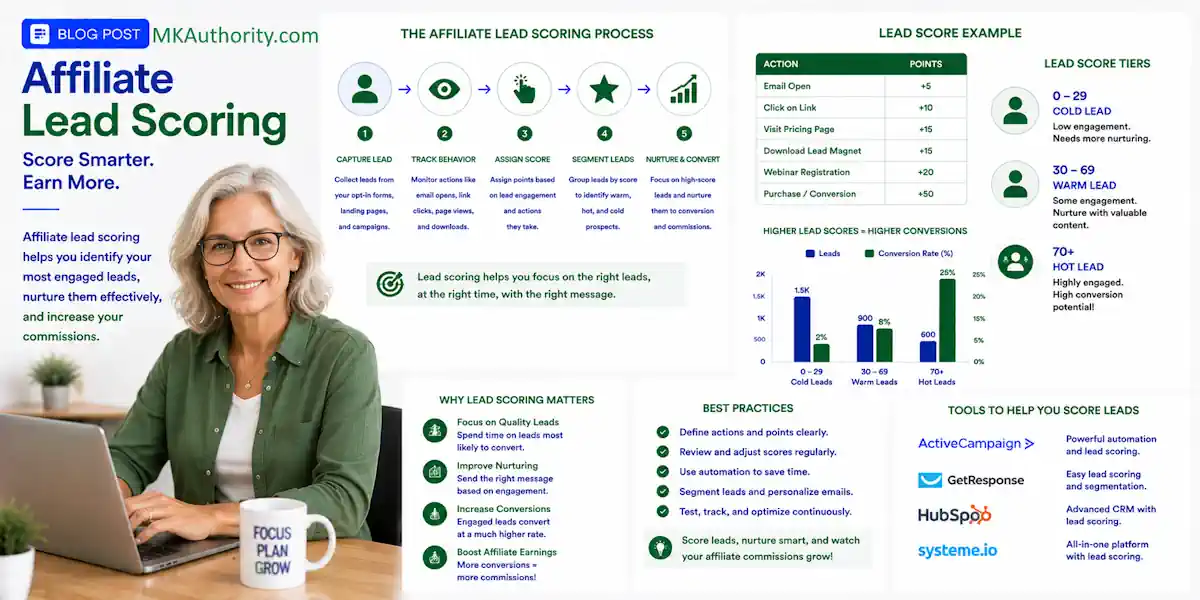

I’d never considered affiliate lead scoring before I started looking in to it. A packed lead dashboard can look exciting, but it can also hide a big problem. If your sales team is chasing every form fill, they may be spending their best hours on people who were never serious.
The method of affiliate lead scoring ranks incoming prospects or partner referrals using a point system. It evaluates data like user actions and profile fit. For an affiliate lead generation program, lead scoring helps sort genuine prospects from curiosity clicks, fake details, repeat submissions, and people who simply aren’t ready yet.
You don’t need a complicated system to start. You need clear rules, clean tracking, and a follow-up plan your team will actually use.
Lead Scoring Is About Quality, Not More Names

Lead scoring gives each prospect a value based on their fit, actions, and likelihood of buying. In affiliate marketing, the score should show where the lead came from. It should also show what they agreed to receive and whether their contact details are real.
One person who requests information, confirms their phone number, and checks pricing can be worth more than 50 random opt-ins. That’s why lead volume and lead quality are not the same thing.
More leads can feel like progress for any lead generation program. But if those leads don’t answer calls, open emails, qualify for the offer, or ever buy, they create extra work without creating extra income.
A useful score helps salespeople focus on leads with three things in place:
- They fit the offer, based on location, budget range, experience level, company type, or other relevant details.
- They have shown real interest, such as visiting a pricing page, replying to an email, booking a call, or completing a quiz.
- Their details and consent are valid, so your follow-up is welcome and permitted.
Demographic data tells you who an individual is. Firmographic information describes a business account, including its company size, industry, and role. Behavioral data records what someone did after interacting with your ad, landing page, email, or bridge page.
Permitted lead enrichment can fill in missing company, role, location, or contact context. It should never replace verification or consent.
For affiliate lead generation, record the affiliate ID, sub ID, traffic source, campaign, landing page, click ID, submission time, and offer. Historical data from these source and outcome records reveals which partners send buyers, rather than merely producing clicks.
Without attribution, you can’t tell which partner is sending buyers and which one is sending headaches.
A basic lead scoring overview can help if you’re setting up your first system. Still, don’t copy somebody else’s score card without checking whether it matches your offer and audience.
Build a Lead Scoring Model That Sales Will Trust
A useful lead scoring model should fit the way your team handles lead management. It should help sales close more business, not overwhelm them with fields.
Start with the end result. Look at your last closed sales and ask what those buyers had in common.
Did they:
- request a demo?
- answer a call quickly?
- come from search traffic instead of a cold social ad?
- choose a certain product category?
Then build your score around those patterns.
- Agree on what a qualified lead looks like. Sales and marketing need the same definition of a marketing qualified lead. Base it on an ideal customer profile covering location, budget, role, company type, or experience level. If marketing calls every opt-in an MQL but sales only wants people who requested a call, the handoff will stay messy.
- Review historical data before assigning points. Pull data from closed sales, valid non-buyers, invalid records, refunds, reversals, and duplicates. Base the model on outcomes, not assumptions.
- Use simple scoring criteria. Group points around fit, intent, verification, source quality, and risk flags. A spreadsheet works fine at first. A CRM can automate them later.
- Give points to actions that matter. Opening one email may be worth two points. Requesting a call may be worth 20. A confirmed phone number may be worth 15. A disposable email address or duplicate submission should reduce the score.
- Set a review date. Check whether high-score leads actually become customers as they move through the sales cycle. If they don’t, change the model. A score is a working tool, not a permanent rulebook.
Here is a simple starting structure for a 100-point lead score:
| Score area | What you can measure | Suggested range |
|---|---|---|
| Offer fit | Location, need, budget, role, experience level | 0 to 30 |
| Purchase intent | Pricing visits, booked calls, product-page activity | 0 to 35 |
| Contact verification | Valid email, confirmed phone, complete form | 0 to 20 |
| Source history | Affiliate, placement, campaign, or keyword performance | -15 to 15 |
| Risk flags | Duplicate records, invalid details, missing consent | -30 to 0 |
Source history can inform lead distribution rules, but it shouldn’t override consent or lead fit.
The score doesn’t have to be perfect on day one. It has to be honest enough to separate strong opportunities from weak ones.
Tools can help with automation. HubSpot’s lead scoring options are one example of how custom scoring rules can be handled inside a marketing platform. Pardot uses scoring and grading, while Marketo can combine behavioral and profile data. The platform matters less than the quality of your rules and outcome data.
Set a Lead Score Threshold for Fast, Sensible Follow-Up
A score only matters when it changes what happens next. Score bands should reflect a prospect’s place in the sales funnel and trigger a clear owner, response time, and next action.
Thresholds also guide lead distribution. They show whether a lead goes to sales, stays in an education track, or waits for validation.
Here is a practical way to treat affiliate leads before sales follow-up:
| Priority | Typical lead profile | What happens next |
|---|---|---|
| High, 70+ | Verified details, clear offer fit, recent pricing or call-request activity, valid consent | Contact quickly by the approved channel and assign a sales owner. |
| Medium, 40 to 69 | Real contact details and some interest, but still researching or missing a buying signal | Begin lead nurturing with educational email content and watch for fresh behavioral signals. |
| Low, below 40 | Weak fit, duplicate record, invalid details, no consent, or low-quality source pattern | Don’t push to sales. Suppress, validate, or hold for review. |
A high-priority lead could be someone who came through a paid search campaign, selected a relevant solution on your form, confirmed their phone, and booked a time to talk. That person deserves quick attention.
A medium-priority lead may download a beginner guide, open two emails, and visit your training page. They’re interested, but they may need education before a sales call makes sense.
A low-priority lead could include a disposable email address, an invalid phone number, repeated form submissions, or a lead from a source with a long history of no-shows and reversals. Don’t reward bad traffic with more sales labor.
A high behavioral score should never cancel a risk flag. Missing consent, fake contact details, or a suspicious duplicate needs review before it reaches a salesperson.
Sales and marketing alignment matters here. If sales says a 70-point lead is too cold, listen and adjust. If marketing sees that 55-point leads are quietly producing the best lead-to-sale rate, adjust again. The point is not to defend the original score. The point is to improve customer acquisition.
Score Affiliate Leads Before You Route Them
Affiliate networks and lead buyers have an extra job. They must decide not only whether a lead is good, but where that lead should go.
This is where affiliate lead scoring becomes useful for multi-tier lead distribution. A lead can be ranked before it reaches a buyer, sales rep, or downstream partner. Stronger leads can receive priority routing, while questionable records can be held for validation.
Ping post calls can begin the availability check before a lead enters the routing path. These ping post calls send only approved lead details in a brief ping, and they don’t authorize sharing anything the prospect didn’t agree to provide.
Results from those ping post calls show which buyers accept the lead and at what price. Score, consent, validation status, and buyer rules then determine the lead distribution path, with the full record posted only to an approved buyer.
That doesn’t remove your responsibility for privacy safeguards around every lead distribution decision. Your consent wording should identify the type of follow-up the prospect can expect, and you should retain the source page, timestamp, affiliate ID, and consent record.
Don’t collect every possible data field because a buyer might want it later. Collect what you need to qualify the lead and serve the prospect properly. Keep sensitive data protected, restrict access, and follow the privacy rules that apply to your market.
Fraud detection also belongs in the scoring process. Review failed ping post calls for unusual failure patterns. Check duplicate emails, repeated phone numbers, strange names, impossible entries, placement spikes, repeated clicks, reused addresses, and rapid retries.
Before scaling affiliate lead generation, it also pays to audit low-quality affiliate clicks. A source can produce cheap clicks and many form submissions while still sending leads that never answer, never buy, or generate unpaid or reversed commissions.
Let Sales Results Improve Your Scores Over Time
Don’t judge a traffic source by opt-ins alone. Track raw leads, valid leads, contacted leads, appointments, sales, refunds, reversals, and cleared commissions.
Your lead-to-sale rate is simple:
Lead-to-sale rate = confirmed sales / valid leads x 100
Compare conversion rates by affiliate, placement, campaign, and score band.
Use valid leads, not raw submissions. If 100 people fill out a form but 20 have fake, duplicate, or unusable details, your sales team is working with 80 leads, not 100.
Also watch the money behind the score. A $35 commission with a 2% visitor-to-sale rate looks like $0.70 per click. Hold back a 20% refund and reversal reserve, and the expected payable value drops to $0.56 per click. Track revenue per lead separately to understand what each valid lead is worth after sales outcomes.
That $0.56 isn’t your target cost per click. Your allowable acquisition cost must stay below this rough ceiling after email tools, landing-page fees, tracking, creative costs, refunds, and profit.
As your data grows, predictive lead scoring and machine learning can identify patterns in historical data. Predictive scoring based on historical conversion data may save time, but it won’t fix poor tracking or weak traffic. Feed the models closed sales, refund data, source details, and verified lead outcomes, not vanity metrics, and use them only after basic scoring and attribution are reliable.
Frequently Asked Questions
What is affiliate lead scoring?
Affiliate lead scoring ranks prospects based on offer fit, behavior, contact verification, source quality, and risk. It helps sales teams focus on leads that are more likely to respond, qualify, and buy.
What should be included in an affiliate lead score?
Use factors such as location, budget, role, purchase intent, confirmed contact details, affiliate source, and consent status. Add negative points for duplicate records, invalid details, missing consent, and suspicious traffic patterns.
What is a good lead score threshold for sales follow-up?
A practical starting point is to route verified, high-intent leads with scores of 70 or more to sales quickly. Leads scoring 40 to 69 can enter a nurturing track, while lower-scoring or risky leads should be validated, suppressed, or held for review.
How can affiliate lead scoring improve over time?
Compare score bands with valid leads, contacted leads, appointments, sales, refunds, reversals, and cleared commissions. Review the model regularly and adjust the rules when lower- or higher-scoring leads produce different outcomes than expected.
Final Thoughts On Using An Affiliate Lead Scoring Method
More leads don’t automatically mean more sales. A smaller group of verified, permission-based, high-intent prospects can beat a large list of people who never asked to hear from you.
Build your affiliate lead scoring around fit, real behavior, source quality, consent, and cleared results. When scores match what sales sees in real conversations, follow-up gets faster, traffic decisions get smarter, and your business stops paying for numbers that don’t pay you back.