 Malcolm Keith 2026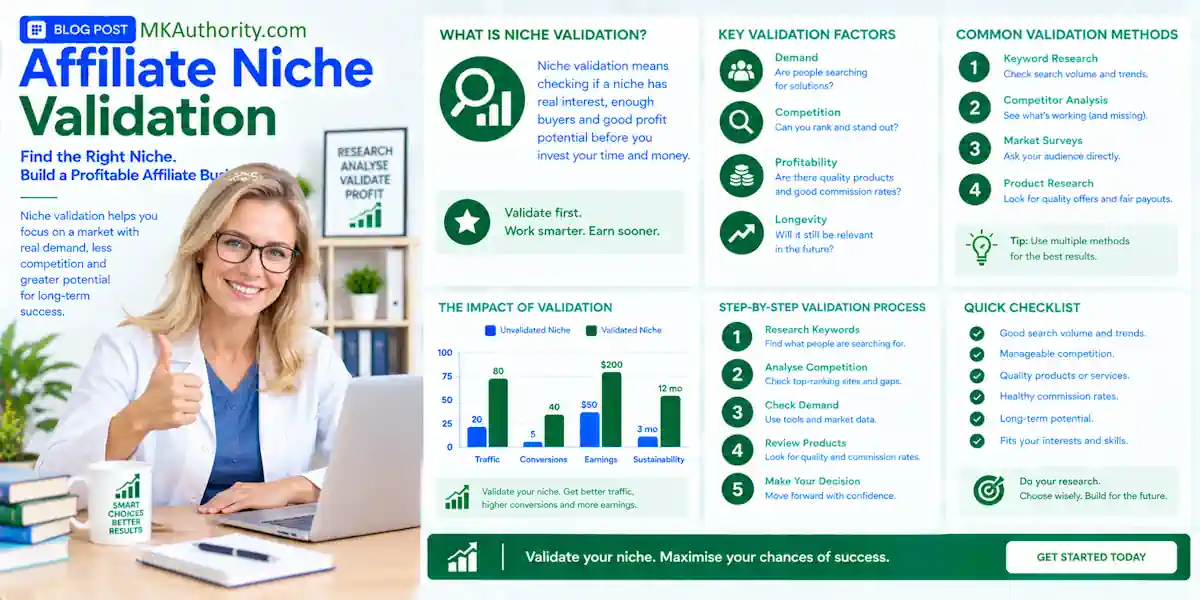


A website can look great and still have nobody ready to buy. That’s an expensive way to discover you picked the wrong niche. What’s needed first is affiliate niche validation to prove that a topic has active buyers, real search demand, and good-paying programs before you spend months building content.
Don’t pay for a domain or write dozens of posts before doing affiliate niche validation. While you won’t get certainty from a spreadsheet you can at least spot weak ideas early.
Start with one audience and one problem when evaluating an affiliate marketing niche. Then look for buyer questions, market demand, and seasonal trends that show people want help choosing a solution.
Affiliate niche validation starts with a narrower audience
“Online business” is a topic, not a workable niche. Broad areas like personal finance and health and wellness need a specific target audience and problem. “Email tools for affiliate beginners building their first list” gives you a person, a problem, and products to investigate.
Name the problem before the product
Write one plain sentence: “I help [audience] choose [type of solution] for [specific problem].” If you can’t fill it in without vague words, narrow the idea.
Then check the language people use in Reddit threads, product reviews, YouTube comments, and relevant communities. Are they asking which tool to buy? Complaining about a feature? Comparing prices? Save the exact questions, not only the broad topic names.
Don’t mistake a busy discussion for demand. Lots of people may want free advice without wanting the product you’re hoping to recommend.
Check whether you can add useful experience
Could you test the tools, show a setup, compare their limits, or explain who should skip them? Your guidance needs to be genuinely useful and credible. In regulated or sensitive areas, make sure you have the knowledge to help readers responsibly.
Try outlining five useful answers now. If every idea sounds like “best product” with a new adjective attached, you may need a tighter audience or a problem you can address with more credibility.
Find searches that sound like buying decisions
Big search volume feels exciting. Buyer intent is more useful.
“What is email marketing?” and “best email autoresponder for affiliate marketing” aren’t the same opportunity.
The first person may need a lesson. The second is comparing tools for a job they want done. That’s a difference in search intent.
Build a small buyer-keyword list
Start your keyword research with five to ten product, problem, and audience phrases. Add transactional keywords such as “review,” “vs,” “alternatives,” “pricing,” and “for beginners.” Google autocomplete and related searches can reveal wording you wouldn’t have guessed.
Put each phrase in a sheet with its likely page type and a suitable offer. For example, “ConvertKit vs Mailchimp for beginners” calls for a comparison, not a general guide to building an email list. Our guide to finding high-intent affiliate keywords goes further into that process.
A smaller, precise term can beat a broad one if its visitors are closer to choosing. That isn’t a guarantee of sales. It’s a reason to investigate.
Read the affiliate niche validation search results, not just the keyword
Search your promising terms. If the results are comparisons, reviews, and pricing pages, a decision-focused page may fit. If they’re mostly tutorials, people may still be learning.
Watch for misleading shortcuts, too. “Discount” is a buyer term only if you can honestly address the deal. And someone searching for a product login probably wants the login page, not your review.
Your test: Can you match several searches to helpful pages and relevant products without forcing the fit?
Check demand without worshipping search volume
Now you can use the numbers, with your eyes open. Google Ads Keyword Planner helps you find related terms and view search estimates. Record the location you selected, because a niche popular elsewhere may not match the customers or programs you can serve.
Separate paid-ad metrics from SEO difficulty
Keyword Planner is built for advertising. Its competition measure concerns advertisers, not how hard a new website is to rank or earn organic traffic. A high bid may tell you advertisers value a term, but it doesn’t prove your affiliate page will convert.
Paid tools such as Ahrefs or Semrush can help organize keywords and inspect competing pages. You can also do a useful first pass with free tools and manual searches. Either way, don’t let one difficulty score make the decision for you.
Look for seasons and short-lived spikes
Compare terms in Google Trends over several years, in the country you plan to target, to spot seasonal trends. A repeating annual rise is different from one brief burst of attention.
This matters for gifts, tax-related products, and fast-changing AI tools. A rising line can be worth testing, but check whether established products and real buyer questions support it. It shows relative interest, not a count of buyers. Search estimates, advertiser competition, and relative interest can guide research, but none proves conversion.
Inspect the competitors you’d have to beat
Search results are a reality check. Use competitor analysis to review the top pages for your buyer terms, including results on a phone.
Look at who ranks and what they answer
Are the results full of official brands, major publishers, and strong specialist sites? A new affiliate site may struggle to get noticed. But don’t dismiss the niche because one term looks tough. Search narrower questions tied to a particular audience or feature.
Check whether existing pages explain pricing limits, show the product in use, compare drawbacks, and answer current questions. In personal finance or health and wellness, assess whether top pages answer the specific question clearly and demonstrate relevant expertise. An old review isn’t automatically an opening. You need a better answer you can actually produce.
Test your content runway
Before committing to content creation, list 20 distinct questions you could answer, including setup problems, feature comparisons, alternatives, and purchase decisions. Group close searches together so you don’t plan three pages that do the same job.
Can you identify a few clear buyer pages and useful supporting guides? Good. If all 20 ideas depend on one product name, think hard about what happens when that product changes its terms or disappears.
Confirm the offers before you count commissions
A popular problem is hard to monetize if the available products don’t fit your audience. Search merchant websites and networks such as Impact, Awin, and CJ Affiliate to find actual affiliate programs. Read each merchant’s terms, not just a directory listing.
Give yourself a backup option
There’s no magic number of programs. As a practical risk check, look for at least two independent, suitable offers you could recommend honestly. One good offer can be enough to start, but relying on a single merchant leaves you exposed to payout or policy changes.
Check approval requirements for affiliate programs before building around an offer. Network acceptance and merchant approval may be separate. Our guide to choosing affiliate networks for beginners can help you compare where to look.
Compare what you’ll actually get paid
Write down commission rates on approved sales, cookie duration, attribution rules, payout timing, refund policies, and allowed traffic sources. For SaaS tools, check whether renewals qualify for recurring commissions.
High-ticket affiliate marketing offers may pay more per sale but often need more trust and explanation. A low-ticket item may be easier to understand but leave little room for paid traffic. Subscription payouts can build over time only while eligible customers stay active and the program pays. See how to evaluate affiliate offers before getting attached to a headline rate.
Run the math with assumptions you can test
You don’t need an income promise. You need to know what must happen for the idea to work.
Suppose a program pays $35 per approved sale. If 2% of your outbound affiliate clicks became sales and you set aside 20% of projected commissions for refunds or reversals, the estimate would be:
$35 × 0.02 × 0.80 = $0.56 per outbound click.
Those are illustration assumptions, not industry benchmarks or an income forecast. If only one in five page visitors clicks through, that estimate becomes about $0.11 per page visitor, before content costs, tools, or advertising. That’s why traffic volume alone won’t settle the question.
Recurring payouts aren’t guaranteed passive income, either. They depend on eligible customers staying active and the program continuing to pay.
The same per-visitor math applies to high-ticket affiliate marketing. For paid ads, compare your cost per visitor with your estimated value per visitor, not the full sale commission. Check both the merchant’s rules and the ad platform’s rules before testing. Restrictions on brand bidding or traffic sources can rule out a campaign that looked fine on paper.
Test the niche before building the full site
A small test won’t predict what a future website will earn. It can show whether your angle attracts relevant prospects.
Put one helpful answer in front of real prospects
Choose a specific buying query that uses transactional keywords. Write a comparison post for a community where you’re allowed to contribute, make a short video demonstrating a product, or invite people to a simple hosted signup form for a useful buying guide. Follow community rules. Ask what they’re choosing and which concern is holding them back.
If you recommend a product through an affiliate link, make your relationship clear. The FTC’s disclosure guidance explains why people need to see a financial connection. Your opinion must be honest, too; the FTC’s endorsement guidance is useful when you’re planning reviews.
Measure actions, then decide what they mean
Track where visitors came from, how many viewed your content, how many clicked a relevant offer, and what purchase questions they asked. If you have an approved program and can track sales, distinguish reported sales from cleared commissions.
Set a modest test budget and decision rule before you begin. For example, decide you’ll revise the angle if people engage with the problem but ignore the offer. Don’t declare a niche dead after a handful of clicks, and don’t treat general engagement or signups alone as proof of purchase intent.
Make the build-or-wait decision
Bring the evidence into one sheet. A niche earns further work when you find relevant buyer questions, fitting searches that include transactional keywords, a feasible content angle, and suitable offers with clear rules. No niche, even one that appears to be among the profitable niches, is viable based on search estimates alone.
Proceed when buyer evidence, a feasible content angle, and reliable offers align. Refine the audience, angle, or offer fit when one is weak. Check whether demand is sustained or reflects a temporary spike or recurring seasonal trends. Wait if program access or merchant terms remain uncertain.
Key takeaways for an affiliate niche validation:
- Search for decisions people are making, not only topics they like discussing.
- Check the live search results and merchant terms yourself.
- Treat commission math as a testable estimate, not expected income.
- Build a full website when the smaller checks give you a sound reason to continue.
FAQ about affiliate niche validation
What is the best first test for a beginner?
Choose one specific audience problem and collect the questions people ask about buying a solution. Match those questions to search results and available offers. That costs little and can expose a weak idea before you buy tools or publish content.
How many affiliate programs do I need?
No fixed number guarantees a viable niche. Two suitable, independent programs give you a useful backup, provided you can qualify for them and would feel comfortable recommending their products. One strong program may work, but it creates more risk.
Does a recurring commission make a niche better?
Only if the product fits, customers remain subscribed, and the terms pay on renewals. Recurring commissions are worth comparing, not assuming. A solid one-time offer can be better than a subscription your audience won’t keep.
A better reason to build
That attractive niche idea deserves more than a search-volume screenshot. Using affiliate niche validation we can give it a buyer, a problem, a realistic page, and an offer that holds up under scrutiny.
Start small, check the response, and keep your assumptions separate from the results. Then, if you build the website, you’ll have a plan based on evidence instead of hope.