 Malcolm Keith 2026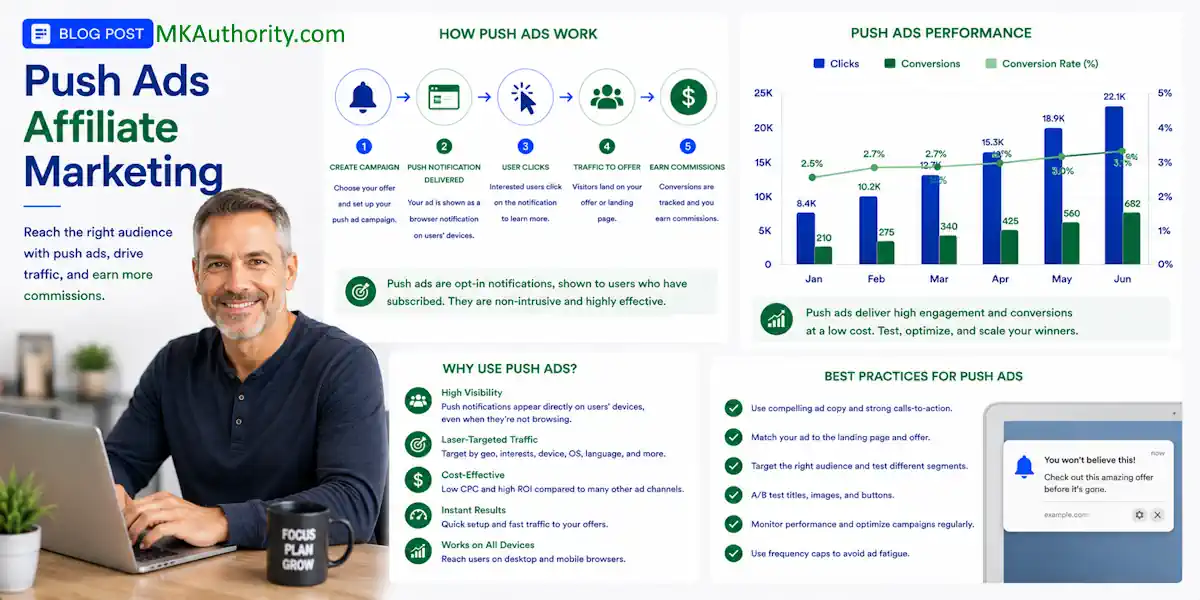

Leveraging push traffic can get your affiliate offer seen fast. But push ads affiliate marketing can also burn through a small budget fast when you send clicks straight to an offer and hope for the best.
The good news? You do not need a huge bankroll to test push notifications and succeed in affiliate marketing. You need a clear offer, a basic funnel, proper tracking, and a number where you stop. That last part saves more money than any clever headline ever will.
Key Takeaways
- Start with a small controlled test for your push campaigns, not a campaign designed to scale on day one.
- Track clicks, leads, sales, refunds, and cleared commissions as separate numbers.
- Use your expected commission per click to set a cost per click ceiling for what traffic can cost.
- Match a short, curiosity-led push ad creatives set to a simple mobile-friendly landing page to boost your click through rate.
- Follow the ad network’s rules and protect user privacy before sending a single click.
Why Push Ads Affiliate Marketing Can Fit a Small Budget
Push ads appear as web push notifications or mobile push notifications for people who have agreed to receive them. They normally contain a small image, short headline, description, and a call to action. The format is quick. The visitor sees a message, taps it, and lands on your page.

That speed is both cool and dangerous.
Unlike search traffic, the person clicking push notifications may not be actively searching for your solution. They were doing something else. So your job is to create enough interest to earn the click, then make the next step feel relevant.
A useful push advertising traffic guide explains the common formats and campaign options available in this traffic source. You will see classic push notifications, in-page push placements, and other variations depending on the network and device. Modern push advertising helps marketers bypass banner blindness that often plagues standard display channels in digital advertising.
Ad networks deliver these messages directly to a targeted audience across various devices, helping you promote simple affiliate offers effectively.
For a beginner, push ads work best with affiliate offers that are easy to understand in seconds.
Think free trials, useful tools, lead magnets, app installs, simple product demos, or an email opt-in that solves one clear problem.
Don’t try to sell a complicated high-ticket opportunity in one notification. That is asking too much from cold traffic.
Instead, use the push ad to get attention. Use your landing page to explain the offer. Then let your follow-up emails do some of the heavier selling. This is why list building can make a paid test more useful, even when the first click doesn’t produce an immediate commission.
A push click is not proof of buyer intent. It is proof that your message created enough curiosity for someone to tap.
If you are comparing options before spending, review these best paid traffic sources for affiliate marketing. Push traffic is one option in your toolbox of traffic sources, not the only answer. For another low-cost test, see this Quora Ads for affiliate leads plan.
Set Your Budget Before You Launch a Push Ads Affiliate Marketing Campaign
Don’t start by asking, “How much can I make?” Start with, “How much can I afford to lose while learning?”
That might be $30, $50, or $100. Some low-budget affiliate guides suggest $100 to $200 for a meaningful offer test, which forms the basis of beginner media buying. That doesn’t mean you must spend that amount. It means tiny tests can run out of data before you learn anything useful.
The money must be small enough that a full loss doesn’t affect rent, bills, food, or your peace of mind. Paid traffic is a business expense, not an emergency-income plan.
Before you open the ad platform for your advertising campaigns, write down:
- Your maximum total spend for this test.
- The country, device type, and language you want to test.
- The one specific affiliate offer and one landing page you will use.
- The exact conversion event you want to measure.
- The point where you pause, change, or continue the campaign.
Keep it simple at first. Choose one country, one device category, and one offer. When you run push campaigns across different push notification networks, you need to monitor traffic quality closely. Avoid stacking five offers, ten countries, and several landing pages into a $50 campaign. That doesn’t create variety. It creates confusion.
A reasonable starting setup may include broad targeting by country, language, and device. Once traffic starts coming in, you can review placements, operating systems, browsers, and other available targeting data. Apply basic optimization strategies to cut obvious waste first. Don’t keep paying for a placement because you feel it may turn around.
Know the Numbers That Decide if You Can Scale
This is where many affiliate marketers get excited about clicks, then wonder why their balance is shrinking. Clicks are nice. Cleared cash is what matters.
Here are the numbers to watch in plain English:
| Metric | What it means | Why it matters |
|---|---|---|
| CPC | Cost per click, what you pay for each visitor | Shows how expensive the traffic is, especially when evaluating your cost per click across networks |
| CTR | Click through rate, the share of people who click your ad | Helps judge creative and message appeal by tracking your click through rate over time |
| CVR | Conversion rate, the share of visitors who take your desired action | Shows whether the page and offer work by analyzing your overall conversion rates |
| CPA | Cost per acquisition, what you spend per lead or sale | Lets you compare cost with value |
| EPC | Earnings per click, average commission earned per visitor | Gives a rough traffic-value ceiling |
| ROI | Return on investment, profit or loss after costs | Shows whether the campaign is a business by measuring your final return on investment |
The basic calculation is simple:
Expected commission per click = sales conversion rate x commission per sale x (1 – refund and reversal reserve)
Say your offer pays $35 per sale. You expect 2% of visitors to buy. You also hold back 20% for refunds or reversals.
Your expected commission per click is:
0.02 x $35 x 0.80 = $0.56
So, $0.56 is your rough ceiling before tracking fees, landing-page costs, email software, creative costs, and profit. It is not your target bid.
If you pay $0.60 per click, the numbers are already too tight. If you pay $1.20 per click, no amount of positive thinking makes that a repeatable model.
Also, don’t confuse reported commissions with money in your account. Successful affiliate marketing relies on using a reliable ad tracker to monitor real revenue because affiliate networks can reverse sales, buyers can request refunds, and payouts may take weeks. Track reported sales, approved sales, refunds, and paid commissions separately.
A campaign can show sales and still lose money after refunds, tools, and traffic costs are counted.
Build a Simple Funnel That Respects the Click
Your ad should not go directly to a random affiliate link unless the program clearly allows it and the destination matches the promise in your ad. Direct linking gives you less control, weakens tracking, and makes split testing harder.
A basic push funnel is enough:
Push ad -> pre-landing pages or landing page -> affiliate offers -> email follow-up
Your bridge page should have one job. It can pre-frame the offer, answer a common objection, or offer a useful free guide in exchange for an email address. Keep it mobile-friendly. Most push traffic is not sitting at a desk with coffee and plenty of time.
The message must match all the way through, especially when connecting your push ad creatives to the final destination. If your push says, “A simple way to organize your online side hustle,” don’t dump visitors on a page screaming about overnight riches. That disconnect kills trust and hurts conversion rates.
For example, a cloud-storage promotion could lead with a practical concern: “Phone full of photos? See a simple backup option.” The landing page can explain the benefit, disclose the affiliate relationship where needed, and let the visitor decide.
Don’t hide important conditions, fake countdown timers, or make income promises you can’t prove. Major ad networks and various traffic sources can reject misleading claims, and visitors can report deceptive pages. Read each network’s current policies before launch, especially rules on prohibited offers, redirects, financial claims, adult content, and data collection.
If you collect email addresses, use a clear privacy notice. Explain what subscribers will receive, don’t buy email lists, and give people an easy unsubscribe option. A small list of real people is better than a big list that never asked to hear from you.
Test Creatives Without Chasing Every Shiny Offer
The temptation is real. You launch one campaign, get 40 clicks, then swap the offer, headline, landing page, country, and bid. Now you have spent money, but learned almost nothing.
Change one main variable at a time.
Start with two or three push ad creatives that use different angles to cut through banner blindness. One may focus on a problem. Another may focus on a benefit. A third can use curiosity, as long as your pre-landing pages and notification copy deliver what the ad suggests.
Here are a few practical angles:
- “Still losing leads because nobody follows up?”
- “A simple tool for building your first email list.”
- “See why some affiliate pages get clicks but no sales.”
Don’t use misleading bait. A higher CTR means little when visitors bounce straight away. You want interested clicks, not cheap clicks from people who feel tricked.
Keep a simple spreadsheet with date, campaign ID, creative, bid, spend, clicks, opt-ins, sales, CPA, and notes. Using a reliable ad tracker is also helpful for measuring traffic quality, though a spreadsheet is enough when your budget is tight.
You can also compare buyer traffic versus incentive traffic before choosing offers and traffic sources. People who click for a reward often behave differently from people who already want a solution.
Once you find an ad and page combination that gets leads at a sensible price, let it run long enough to gather more evidence. Apply basic optimization strategies and scale slowly. Raise a daily cap or bid in small steps, then watch whether CPA and ROI hold up across your push campaigns.
Use Push Ads Alongside Free Traffic
Push ads are fast. Content is slower. Put both to work.
A small paid campaign can tell you which pain points and headlines attract attention. Those findings can help you write better blog posts, emails, YouTube scripts, and social content for your targeted audience. Meanwhile, your free traffic efforts can keep sending visitors after the ad budget is gone.
Building a sustainable affiliate marketing strategy works best when you combine organic reach with paid push advertising. Create honest reviews, comparisons, tutorials, and problem-solving posts around one niche. Use your data from digital advertising to sharpen the language and improve your offers.
Paid traffic is the quick feedback loop. Organic content is the asset you keep building.
Frequently Asked Questions
How much budget do I need to start with push ads?
You can start testing with a small budget of $30 to $100 depending on the ad network’s minimum bid requirements. The key is to treat this amount as a learning expense that you can afford to lose completely without affecting your daily finances.
Should I link my push ads directly to the affiliate offer?
Direct linking gives you less control, weaker tracking, and makes optimization difficult. It is usually much better to send traffic through a simple mobile-friendly landing page or bridge page first.
How do I know if my push ads affiliate marketing campaign is actually profitable?
You must track your cleared cash, refunds, and actual commissions rather than just reported sales. Comparing your cost per acquisition against your expected earnings per click will show if your campaign is truly making money.
Final Thoughts on Small-Budget Push Ads Affiliate Marketing Campaigns
Push ads affiliate marketing works best when you treat it like a measured test, not a lottery ticket. Set a loss limit, track every stage, and give the numbers the final say.
A small budget used in your push ads affiliate marketing can still teach you what message gets attention, what page captures leads, and what offer fails to convert. That knowledge is worth far more than blindly buying another batch of clicks. By managing well-managed push campaigns using targeted push traffic and clear push notifications, you can uncover valuable insights that guide your future scaling efforts.