 Malcolm Keith 2026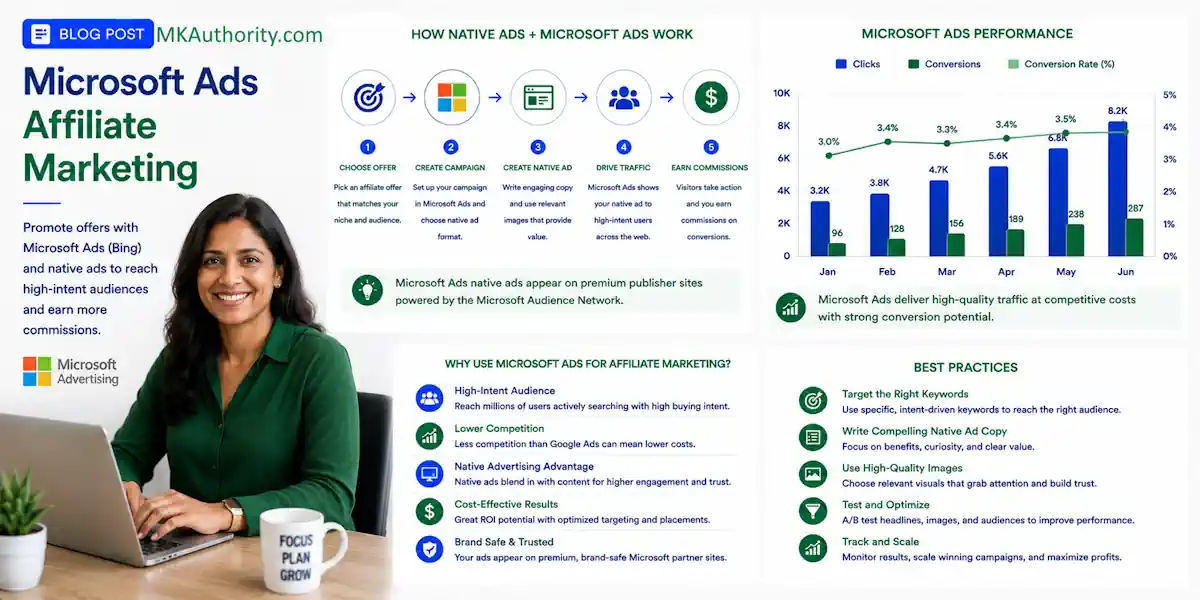

Search ads can put an affiliate offer in front of people already looking for answers, but that doesn’t mean every click becomes a commission. Microsoft Ads affiliate marketing works when the offer, the ad, the landing page, and the numbers all match up.
This is not about throwing money at traffic and hoping for the best. Beginners historically referred to this strategy using Bing Ads, but regardless of the name, successful affiliate marketing is about starting small, staying compliant, tracking every step, and finding out what the market is telling you.
Let’s get into the practical side of it.
Key Takeaways
- Microsoft Advertising can be used to promote affiliate offers, but you must follow platform policies plus the rules of the affiliate network and merchant.
- Search campaigns are usually the simplest place for beginners because the visitor is already searching for something.
- Using a transparent landing page or bridge page often gives you more control than sending traffic straight to your affiliate link.
- Track clicks, opt-ins, sales, refunds, and cleared commissions separately.
- Start with a test budget you can afford to lose while you learn what the data is saying.
Microsoft Ads Affiliate Marketing Starts With Intent, Not Hype
Microsoft Advertising lets you show ads across Bing and its search partner network, as well as the Microsoft Audience Network. That matters because search traffic usually has intent behind it, helping you reach your target audience more effectively.
Somebody types “best email marketing service for small business” because they want options.
They are not scrolling past cat videos and suddenly getting hit with an offer.
That gives Microsoft Ads affiliate marketing a good starting point for affiliates who want to reach people with a problem already on their mind. While platforms like Google Ads often command higher click costs, the Bing Ads ecosystem can offer a more budget-friendly entry point with less aggressive competition.
Now, that does not mean Microsoft Advertising is a magic traffic button.
You still need a quality offer, honest ad copy, a useful page, and a clear plan for what happens after the click. If the ad promises one thing and the visitor lands on a page full of vague hype, you lose trust fast.
Microsoft Advertising does not operate as a universal affiliate commission program. You are buying ads to send visitors to an offer where you may earn a commission. That is separate from Microsoft’s own Microsoft 365 for business affiliate program, which has its own terms and eligible products.
Platform policy is not optional. Your ads, keywords, landing pages, claims, and business practices must follow Microsoft Advertising requirements. Microsoft has updated and refined its policies over time, so don’t rely on an old YouTube video or a random Facebook post.
Check current policy changes, including this 2026 Microsoft Advertising policy update recap, before launching something in a sensitive niche.
A campaign can get clicks and still be a bad campaign. If it creates refunds, complaints, weak leads, or a loss after costs, the click volume means nothing.
Affiliate networks and merchants also have their own rules. Some allow paid search but ban bidding on their brand name, while other merchant programs restrict affiliate publishers from using specific direct-linking strategies.
Others allow brand terms only with written approval.
Some merchants prohibit direct linking, coupon wording, email promotion, or certain countries.
Read the terms before you create ads.
Don’t assume a commission link means you can advertise any way you want.
Pick Offers That Can Carry Ad Costs
The biggest beginner mistake in affiliate marketing is choosing an offer because the commission looks exciting. A $100 commission sounds awesome, of course. But if the sales page converts poorly, refunds are high, or the merchant blocks paid search, that big number is not much use.
Look for an offer that solves a real problem and has a clear audience. A business tool for email marketers, a training course for freelancers, or a software product for e-commerce sellers can work if the offer is legitimate and the search intent is there.
Before spending money, check a few basics:
- Is paid search traffic allowed by the affiliate network and merchant?
- Are branded keywords restricted, limited, or banned?
- Does the landing page make accurate claims and clearly explain the product?
- Is the commission paid after a refund period, and how long does that take?
- Can you see conversion data, reversal data, and payment history in the affiliate dashboard?
A recurring commission can be attractive, but don’t count future payments before they clear. A reported sale is a signal. Cleared cash is what you can actually use to grow the campaign.
This is also where niche selection matters. Broad phrases like “make money online” can be expensive, competitive, and full of people looking for shortcuts. You can use a keyword planner to check search volume for tighter phrases.
A tighter phrase such as “email follow-up software for affiliate marketers” may bring fewer searches, but you need to evaluate the expected conversion rate and balance your cost per click so the math still works.
If you are deciding where paid traffic fits beside free methods, see this comparison of free traffic versus paid ads for affiliates.
Paid ads bring speed and control.
Organic content can keep producing visits after the work is done.
Both have a place.
Build a Bridge Page People Can Trust
You can sometimes send a visitor straight to an affiliate offer landing page. Yet for most beginners, a simple bridge page is the better move.
A bridge page sits between the ad and the merchant’s sales page. It gives the visitor context, helps you match the ad message to your target audience, and lets you set up proper conversion tracking before the visitor clicks an affiliate link to leave your site. It also gives you a chance to build a list, rather than hoping every cold visitor buys on visit one.
Keep it simple. One page, one audience, one main problem, one next step.
For example, if your ad says “Email follow-up tools for new affiliates,” your page could explain why follow-up matters, what the tool helps with, who it fits, and where the visitor can see the details. Don’t switch the topic halfway through. Don’t promise instant income because the product is an autoresponder.
A compliant, trust-building page should include:
- A clear explanation of what the visitor will see after clicking.
- An affiliate disclosure in plain language, placed where people can notice it.
- Accurate statements that you can support.
- A privacy policy and contact details when you collect emails or use tracking.
- A mobile-friendly design with working links and no surprise redirects.
A basic disclosure can say: “I may earn a commission if you buy through links on this page, at no extra cost to you.” It does not need to be a giant legal paragraph. It needs to be clear, visible, and honest.
Affiliate disclosure requirements can depend on your location, audience, and marketing method. Consent and privacy rules can also apply when you collect personal information or use cookies. This affiliate marketing compliance guide is useful background if you are building pages, email forms, and paid traffic funnels.
Don’t hide behind disclaimers while making wild claims. “Results not typical” does not fix an unsupported promise that someone will earn $500 a day. If you can’t prove it, don’t say it.
Start Your Microsoft Ads Affiliate Marketing : Your First Microsoft Ads Campaign
Start with a search campaign. It is usually easier to understand than trying to jump into every audience type, placement, and automated feature on day one.
Set the campaign goal around a real action. For an affiliate funnel, that might be a lead, a click through to the merchant, a sale reported through a network, or a qualified application. Your goal must match the funnel, and your chosen bidding strategy should support that primary objective.
Here is a simple first setup:
- Create a campaign around one offer and one audience problem. Don’t cram five unrelated affiliate programs into the same campaign.
- Build tightly related ad groups. If you promote email software, separate keywords about “email automation,” “email autoresponder,” and “email follow-up” when the ads and page angles differ.
- Pay close attention to match types as you build. While broad match can bring useful ideas later, starting with phrase match and exact match can protect a small budget from low quality clicks.
- Add negative keywords from the beginning. If you sell a paid tool, terms like “free download,” “jobs,” “login,” “support number,” or “crack” may not be useful clicks.
- Write responsive search ads that describe the actual offer. Use the keyword naturally, name the benefit, and tell people what they will find. You can also include relevant ad extensions to give users more ways to engage. No fake urgency. No fake reviews. No misleading prices.
- Set up conversion tracking before your campaign goes live. The Microsoft UET tag can record website actions, while your affiliate tracking setup should show what happens after a lead or outbound click.
A good beginner campaign is not complicated.
It is controlled. One offer makes it easier to tell whether the weak spot is the keyword, ad, bridge page, or offer itself.
For tracking, use Microsoft Click IDs where available, campaign naming, and affiliate sub IDs. A clean sub-ID format might identify the platform, campaign, ad group, keyword theme, and ad variation. The point is simple: when a sale comes in, you need to know where it came from.
This affiliate sub-ID tracking guide shows how tracking IDs can separate traffic sources, campaigns, ads, and landing pages. Without that data, you are guessing. And guessing is expensive when every visitor costs money.
Do the Numbers Before You Buy Clicks
You don’t need a finance degree for this. You need honest estimates and room for things to go wrong.
Use this formula to estimate your maximum value per click:
Expected commission per click = sales conversion rate x commission per sale x (1 – refund and reversal reserve)
Say an offer pays $35 per sale. You estimate that 2% of ad visitors will buy. You also keep a 20% reserve for refunds and reversals.
| Test assumption | Figure |
|---|---|
| Ad budget | $600 |
| Average cost per click | $0.60 |
| Expected visitors | 1,000 |
| Expected sales at 2% | 20 |
| Gross commission at $35 | $700 |
| Refund and reversal reserve | 20% |
| Expected cleared commission | $560 |
| Tracking and creative costs | $30 |
| Total upfront cash spent | $630 |
The campaign looks profitable at first. Spend $600, earn $700. Nice, right? But after the reserve and extra costs, the forecast shows a possible $70 loss.
The expected commission per click in this example is $0.56:
0.02 x $35 x 0.80 = $0.56
That $0.56 is not your bid target. It is your rough ceiling before landing page software, tracking tools, email costs, design work, and profit. If you pay $0.60 per cost per click, the math is already running against you. When evaluating your campaign performance and overall return on investment, these margins dictate whether you stay profitable.
A safer approach is leaving a margin.
If the estimated payable value per lead is $1.80, you might cap your cost per lead at $1.35. That leaves 25% for risk and operating costs. While monitoring your click-through rate alongside your conversion rate, you can also utilize automated bidding options like maximize conversions or target CPA once you have enough conversion data.
Set a testing budget before you launch. For many new affiliates, a $300 to $600 total test is more realistic than dropping thousands into a new funnel. The right figure depends on your cost per click and your available cash.
Most important, the test budget must be small enough that losing it does not hurt your rent, household bills, or payroll. Paid traffic is a business expense, not a rescue plan.
Read the Data Before You Change Everything
Give the campaign enough time and clicks to show a pattern. Don’t switch offers after 12 visitors because there were no sales. At the same time, don’t keep funding a clear loser because you “feel” it will turn around.
Watch the funnel in order.
If impressions are low, look at bids, keyword volume, targeting, quality score, and ad approval.
Perhaps impressions are there but clicks are weak, improve the ad relevance and click-through rate.
If clicks arrive but nobody opts in or continues, the bridge page may not match the ad promise.
If people opt in but never buy, check the follow-up sequence, the offer fit, pricing, and the merchant’s sales page. Leads are still useful if you have permission to follow up with helpful emails, and you can also utilize remarketing lists to re-engage past visitors.
A visitor who does not buy today may buy after they understand the problem better.
Do not change everything at once. Test one main variable, such as a headline, call to action, keyword group, or landing-page angle. Otherwise, you won’t know what caused the result.
Microsoft Advertising has a history of taking policy enforcement seriously, including published updates around violations and penalties. This overview of Microsoft Advertising policy updates is a reminder to fix issues properly rather than repeatedly submitting the same questionable ad.
Good data also protects you from shiny-object hopping. One bad ad does not prove the offer is dead. One sale does not prove you found a winner. Get enough information to make a business decision.
Common Beginner Errors That Drain a Budget

The first one is bidding on merchant brand names without checking the rules. This can get affiliate publishers removed from an affiliate program, even if the ad itself is approved.
The next is using income claims that sound too good to be true. “Earn $10,000 this week with no experience” may attract curiosity clicks, but it can also bring policy trouble, low-quality leads, and refund-prone buyers. In addition, stricter platforms like Google Ads enforce similar compliance rules, so review our Google Ads affiliate marketing policy guide before you rely on loose guidelines just because you are running a different network.
Another costly mistake is sending traffic to a page you never tested on mobile. Check the load time, buttons, opt-in form, disclosure, links, and thank-you page yourself. A broken button can waste an entire test while you practice affiliate marketing.
Finally, don’t confuse traffic with progress. Ten thousand cheap clicks from people who do not care about your offer are not better than 100 clicks from people actively searching for a solution.
For broader ideas on building affiliate campaigns with search, social, and other channels, these paid traffic sources for affiliate marketing can help you compare options without assuming every traffic source fits every offer.
Frequently Asked Questions About Microsoft Ads Affiliate Marketing
Can I send Microsoft Ads traffic straight to my affiliate link?
Some merchants allow direct linking, but many require a landing page or ban direct linking entirely. Using a bridge page also gives you more control, allows you to build an email list, and helps you stay compliant with platform policies.
How much budget do I need to start Microsoft Ads affiliate marketing?
For beginners, a test budget of $300 to $600 is usually enough to gather initial data without risking essential funds. This amount should be money you can afford to lose while you learn how the campaign responds.
What are sub-IDs and why do they matter for tracking?
Sub-IDs are tracking parameters added to your affiliate links that identify the exact traffic source, campaign, ad group, and keyword. Without them, you cannot accurately tell which clicks are generating your sales and which ones are wasting your money.
Final Thoughts on Microsoft Ads Affiliate Marketing
Microsoft Ads affiliate marketing can be a solid traffic source for affiliate marketers who treat it like a numbers-based business. Start with real search intent, a transparent bridge page, proper tracking, and a budget that gives you room to learn.
The goal is not to buy the most clicks. The goal is to find profitable, compliant traffic you can understand, repeat, and scale to maximize your return on investment.