 Malcolm Keith 2026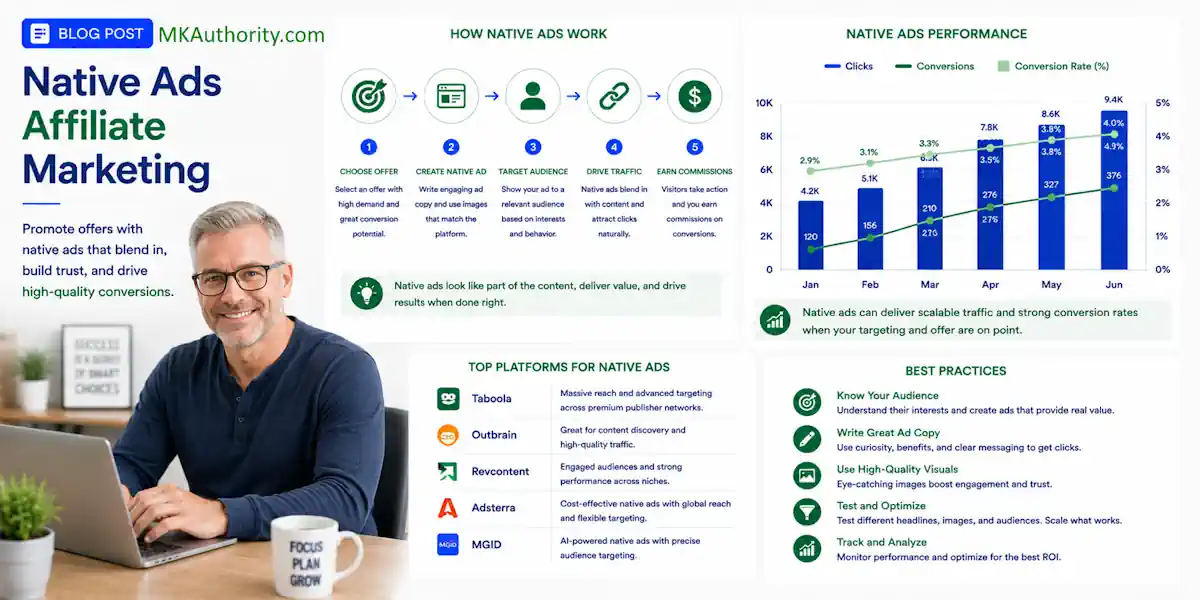

By blending seamlessly into publisher sites, native advertising helps you bypass banner blindness and capture the attention of curious readers.For beginners, native ads affiliate marketing can be a smart paid traffic source among various affiliate marketing strategies, but it isn’t a magic button.

Native advertising in affiliate marketing involves placing paid, content-driven ads that match the design and feel of the surrounding material. A reader should not feel interrupted. Instead, they see content conforming to their interests and are more likely to interact with it.
You still need an honest offer, a useful landing page, and numbers that work before you spend more money.
Start small, learn what the clicks are telling you, then build from there.
Key Takeaways
- Native advertising blends into publisher content, unlike banner display ads or search ads, which helps you reach your target audience more effectively.
- Start your affiliate marketing journey with one offer, one audience, and a test budget you can afford to lose.
- Check both the affiliate program rules and the ad network’s policies before launching your ad creatives.
- Track clicks, opt-ins, approved sales, refunds, and cleared commissions separately to measure your click through rate and overall profitability.
- A good native advertising campaign gets attention, but your landing page does the heavy lifting for your affiliate marketing goals.
How Native Ads Affiliate Marketing Works
Native advertising is paid content that matches the look and feel of the site where it appears. When you run campaigns across popular publisher sites, native advertising blends directly into the surrounding editorial content to help advertisers bypass banner blindness.
You may see a headline beneath a news article saying “You May Also Like” or “Recommended for You.” That is often a native placement.
The ad normally sends a visitor to a page that expands on the headline. For affiliate marketing, that page may introduce a product, collect an email address, or send the reader to an approved affiliate offer.
Native ads are different from display ads.
Display ads are the familiar banners, rectangles, pop-ups, and image placements. They usually look like advertising because, unlike standard native advertising formats on major publisher sites, they trigger immediate banner blindness from users.
They are also different from search ads. Search ads appear when someone types a keyword into Google or another search engine. That person already has some intent. A native ad reaches people while they are reading something else, so the headline has to create genuine interest without being misleading.
Compared to other traffic sources like push notifications, native advertising platforms rely heavily on contextual targeting and behavioral targeting to reach users based on their current reading habits and interests, sometimes extending even to mobile native ads for smartphone users.
Think of search traffic as someone walking into a shop asking for a product. Native traffic is more like showing a relevant magazine article to someone already reading in the same category.
That difference matters. A native campaign can work well with a useful pre-sell page, also called a bridge page. It warms up cold visitors before they see the offer. If you are still deciding where paid advertising fits your business, this guide to paid traffic for affiliate marketing gives a wider look at the options.
A native headline earns a click. The page after the click must earn trust.
Native Ad Networks Beginners Can Consider
You do not need accounts on every network. That is a quick way to spread a small budget too thin and learn very little.
Taboola and Outbrain, now connected with Teads, are well-known ad networks for large publisher reach. The outbrain platform can suit established advertisers, although entry requirements and minimum budgets may feel high for a first test. Reports in 2026 commonly place Taboola among the biggest native advertising networks by active creative volume.
The mgid network is often considered by affiliate marketers because it supports broad geographic targeting across health offers and lead generation. Revcontent is another choice in the landscape of media buying for direct-response advertisers, especially those testing US traffic or ecommerce offers. RichAds, Nativo, TripleLift, and NewsBreak may also fit certain offers and audiences.
Here is the simple way to look at a few options:
| Network | Often considered for | Beginner reality |
|---|---|---|
| Taboola | Large-scale content discovery | Better once your funnel is proven |
| Outbrain/Teads | Premium publisher placements | May require more budget and approval |
| MGID | Broad international affiliate traffic | Worth researching for controlled tests |
| Revcontent | Direct-response campaigns | Check offer and landing-page approval first |
| Nativo | Content-led sponsored placements | Better for strong editorial-style content |
Every network has its own approval process. A campaign for affiliate marketing that runs on one ad network may be rejected on another. Read the rules before you build the ads, not after you fund the account.
For a closer look at how tracking fits this traffic source, this native ads affiliate marketing guide covers attribution, creatives, and campaign setup ideas. If you prefer an editorial-style approach over recommendation widgets, content-led native placements are another format to understand.
Build One Small, Clean First Campaign
Don’t launch five offers, ten headlines, and three countries on day one. That feels productive, but it leaves you with a pile of random clicks and no useful answer.
Pick one offer that is allowed in paid native traffic. Ask the affiliate manager if there are restrictions on countries, claims, brand names, direct linking, email follow-up, or bonus pages. Get that answer in writing when possible.
Next, create a simple landing page. It should match the subject promised in the ad. If the headline discusses protecting family photos and work files, the page should explain cloud backup, what it does, who may need it, and the real cost. It should not suddenly switch into an unrelated make-money offer.
Your landing page needs a clear next step.
That could be reading a review, watching a short demo, or visiting the merchant’s sales page. Too many buttons and too much hype usually make a cold visitor leave.
Use this basic test process:
- Choose one offer and one country or small group of similar countries.
- Write three to five honest headline variations around different reader concerns, keeping your target audience in mind.
- Run each ad with a modest daily budget and a fixed testing period.
- Pause obvious weak ads, but do not judge every result after ten clicks.
- Improve the headline, page, or audience one change at a time.
When you venture into native advertising, your approach to media buying relies heavily on testing different ad creatives. Rotating these ad creatives prevents ad fatigue and helps maintain a healthy click through rate, especially if you also test alternative traffic sources like push notifications alongside your core campaigns.
A realistic headline could be, “What Happens When Your Laptop Dies Without a Backup?” It creates curiosity, but it does not promise impossible earnings or pretend there is an emergency. That is the kind of line native readers can take seriously.
A useful video overview of first steps is available in this native affiliate ads walkthrough. Watch it with your own campaign rules in mind. No training replaces checking the actual policy for your offer.
Truthful Ads, Affiliate Disclosures, and Better Pages
Native advertising blends seamlessly into publisher sites, which means you have to be even more careful with trust. Do not use fake news designs, made-up customer quotes, false countdown timers, or headlines that promise results you cannot prove.
Avoid lines like “Earn $500 today with no work” or “Doctors hate this simple trick.” Apart from being weak marketing, those claims can get your ads rejected and damage your account.
Your landing page should clearly identify the topic and give readers enough information to make a sensible choice. If you are promoting health offers or managing campaigns focused on lead generation, keeping your message honest is critical for protecting conversion rates and building trust on publisher sites.
Add an affiliate disclosure near the recommendation or call to action. Plain language works best: you may receive a commission if someone buys through your link, at no extra cost to them.
Keep the disclosure visible. Hiding it in tiny text at the bottom is not the way to build a business that lasts.
Also check the merchant’s sales page before buying traffic. Does it load quickly on mobile? Does it explain refunds, pricing, and support? Is the promise believable? You are sending your hard-earned clicks there, so do not send people blind.
For many running native advertising within affiliate marketing, the landing page is where the real work happens. While overcoming banner blindness starts with a strong ad, the landing page answers the questions that stop a person buying, directly driving your final conversion rates.
Know Your Numbers Before You Scale
This is where native ads affiliate marketing becomes a business instead of a guessing game. You need to know the most you can afford to pay for a cost per click before the campaign spends your budget for you.
Use this rough calculation:
Expected commission per click = sales conversion rate x commission per sale x (1 – refund and reversal reserve)
Say a product pays a $40 commission. Your landing page and offer convert at 2 percent, and you hold back 20 percent for refunds or reversals.
0.02 x $40 x 0.80 = $0.64
Your expected payable commission is 64 cents per click. Paying $1.20 per click is not a business model. It may look okay for a day if a few sales come in, but the numbers are working against you.
Even 64 cents is not your target bid. Landing page software, autoresponder fees, tracking tools, creative costs, and payment charges all come out of your margin. Give yourself breathing room. In this example, a lower click cost is far safer.
Track the source, campaign, ad, headline, and placement. Affiliate sub IDs let you attach those labels to a link, so you can see which ad produced each result. This affiliate sub IDs tracking guide shows how to organize that data.
Do not confuse reported sales with money in your bank. Some commissions stay pending. Others are reversed after refunds, duplicate leads, fraud checks, or cancelled orders. Watch approved sales and cleared payouts before declaring a campaign profitable.
If your tracker shows 100 conversions but the affiliate dashboard shows 82, stop and investigate. A small reporting gap happens. A large gap can mean blocked scripts, different attribution rules, duplicate leads, or a broken link.
Frequently Asked Questions
What are native ads in affiliate marketing?
Native ads are paid advertisements that match the look, feel, and editorial style of the publisher site where they appear. In affiliate marketing, these ads usually appear as recommended content widgets and direct readers to a landing page or bridge page before they reach the affiliate offer.
Why do I need a landing page instead of direct linking?
Direct linking rarely works on native networks because cold traffic needs context and trust before making a purchase. A well-designed landing page warms up the visitor, explains the product honestly, includes necessary affiliate disclosures, and significantly improves conversion rates.
How much budget do I need to start with native advertising?
Beginners should start with a small test budget that they can comfortably afford to lose while gathering initial data. Focus on testing one offer, one audience, and a few headline variations rather than spreading a small budget across multiple campaigns.
Which native ad networks are best for beginners?
Networks like Taboola, Outbrain, and MGID offer massive reach, but entry requirements and minimum budgets can vary significantly. Research each network’s specific approval process and advertising policies before funding your account to ensure your chosen offer complies with their rules.
Start With Data, Not Hope
Native advertising can bring targeted visitors to an affiliate offer fast, but fast traffic can empty a budget just as fast. When you compare native advertising with alternative paid traffic sources like push notifications, you quickly realize that disciplined testing is essential for affiliate marketing success.
A clean page, honest copy, proper disclosure, and careful tracking give you a real chance to learn what works, especially when you are testing mobile native ads or running ecommerce offers. Start with one offer and a small test, and let your initial ROI optimization data tell you where to go next.
The goal is not to win on your first day. The goal is to build a repeatable campaign where every click has a reason to be there, driven by careful campaign optimization and regular creative refreshes that prevent ad fatigue while keeping your native ads affiliate marketing strategy profitable.