 Malcolm Keith 2026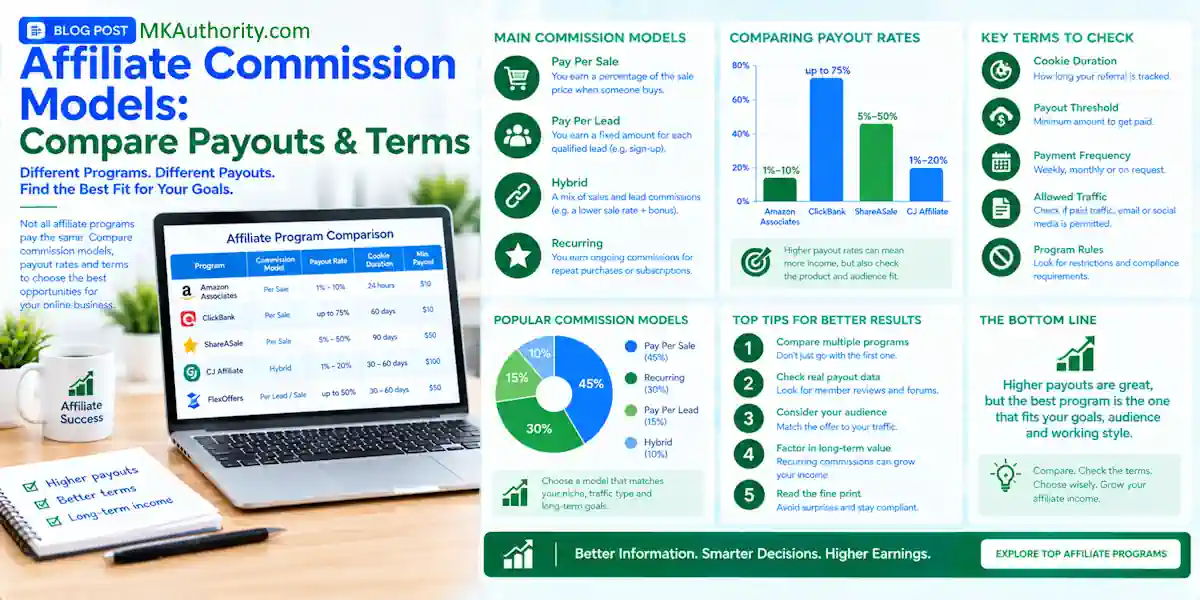

In affiliate marketing, a big commission sounds awesome… until you discover what has to happen before you get paid. Understanding affiliate commission models helps you compare commission-only payouts with fixed fees for promotions, a choice social media creators face.
Flat-rate payouts offer simple calculations, tiers reward performance, and recurring commissions can keep paying while customers stay eligible. The useful comparison is what you can realistically collect, after refunds, tracking rules, and payment delays.
Now, let’s make the numbers easy to understand.
How Affiliate Commission Models Work

A commission model answers three questions: what triggers payment, how much you earn, and whether you get paid again.
A cost per acquisition (CPA) arrangement pays for a qualifying action, such as an approved sale. Revenue share pays a percentage of eligible revenue. Neither label alone tells you whether renewals qualify.
A commission-only partner program may appeal to social media creators comparing offers. Impact’s commission structure guide covers several arrangements, but its terms determine your payout.
Here’s a quick comparison using illustrative rates, since each program sets its own affiliate commission rate.
| Model | Calculation example | Main condition |
|---|---|---|
| Fixed-dollar payout | One approved sale x $40 = $40 | The action must qualify |
| Fixed percentage | $100 eligible sale x 20% = $20 | Check the commissionable amount |
| Tiered | $100 sale x 20% or 25% | Performance determines the rate |
| Recurring | $100 monthly payment x 20% = $20 monthly | Eligible payments must continue |
These categories can overlap. A program might offer tiered rates on recurring subscriptions, for example.
Rates, qualification rules, and payment terms vary by program. Always check the current agreement before promoting.
Flat-Rate Commissions: Simple, But Read the Definition
Fixed dollars versus a fixed percentage
Some programs use “flat-rate” to mean a fixed dollar payout. Others use it for one percentage that stays the same.
That distinction matters when you compare the commission structure.
A $40 bounty pays $40 for each qualifying sale, regardless of whether the eligible purchase costs $100 or $200. Ten approved sales produce $400.
A fixed 20% affiliate commission rate applies to the eligible purchase amount. It pays $20 on a $100 purchase and $40 on a $200 purchase. Ten $100 sales produce $200.
Both are easy to calculate. However, a fixed percentage changes with order value, while a fixed-dollar commission doesn’t. Discounts, excluded products, and new-customer requirements can still affect eligibility.
One-time commissions versus creator fees
A one-time commission pays once for the qualifying event. You don’t automatically earn again when that customer renews or buys another product.
This can suit affiliates who want a straightforward offer and merchants who want a defined acquisition cost.
Now, don’t confuse that with fixed fees paid to a creator. A fee for publishing a video or newsletter placement pays for agreed work. These fixed fees don’t necessarily depend on sales.
Commission-only compensation depends on qualifying results, not agreed placement work. Social media creators may negotiate a placement fee plus commissions. That differs from commission-only compensation, and the contract should separate those payments clearly.
Tiered Commissions: More Sales, Higher Rates
Marginal and retroactive tiers pay differently
Tiered commissions increase your reward when you reach an agreed target. A partner program might base that target on approved sales, revenue, or retained customers.
The threshold can affect your affiliate commission rate, but programs don’t all calculate tiers the same way. With a commission-only offer, approved performance determines the payout.
The calculation matters more than the exciting “up to” rate.
Use $100 purchases, with 20% on the first 10 monthly sales and 25% starting at sale 11. For 15 approved sales, a marginal structure pays:
(10 x $100 x 20%) + (5 x $100 x 25%) = $325.
A retroactive structure applies the higher rate to every qualifying sale in that period. At 25% across all 15 sales, you earn $375.
Same sales. Different payout. Ask which commission structure the program uses.
Make the target worth chasing
A higher tier can give you a useful target, especially when you’re already close. But extra advertising costs can swallow the increase.
Check when tiers reset, whether refunds reduce your qualifying volume, and whether you must maintain the target monthly. Program managers should reward profitable results, rather than raw signup counts.
Tiered rates aren’t the same as multi-level commissions. Tiers change rewards for your performance; multi-level arrangements may pay on activity attributed to recruited partners.
If you’re exploring that separate structure, matrix compensation plans explained covers placement-based arrangements. Don’t assume ordinary affiliate tiers include recruitment rewards.
Recurring Commissions: Renewals Create More Opportunities
Monthly payouts versus capped terms
Recurring commissions pay on eligible repeat charges, usually subscription renewals. In SaaS and membership programs, payouts may be structured as commission-only payments tied to monthly recurring revenue.
Using a $100 monthly subscription and a 20% recurring rate, you earn $20 per eligible paid month.
Six payments produce $120. Twelve payments produce $240, assuming the price, rate, and eligibility remain unchanged.
Compare that with a $40 one-time bounty. Two recurring payments match the bounty; later eligible payments take the total higher.
However, programs may cap recurring payouts at 12 months or another period. Annual billing may also produce one larger commission rather than monthly payments. Read the billing and commission schedules separately.
Retention decides the final result
The attraction is easy to see: one referral can generate several payments. The uncertainty is how long those payments continue.
Customers cancel. Cards fail. Refunds happen. Your referral must remain eligible under the program’s rules.
“Lifetime commissions” usually refer to the qualifying customer relationship under the agreement. What lifetime commissions promise still depends on its terms, and payments aren’t guaranteed for your lifetime.
When retention data is missing, use customer lifetime value estimates to model low, middle, and high outcomes. For the $20 monthly example, three, six, and twelve paid months produce $60, $120, and $240.
Our guide to customer lifetime value for affiliates helps you account for renewals, refunds, and tracking losses.
A projected $240 over twelve months doesn’t fund today’s advertising bill. Only cleared payments belong in your available cash budget.
Hybrid Affiliate Commission Models: An Upfront Reward Plus Revenue Share
Hybrid models combine payment methods within affiliate commission models. A merchant might offer an acquisition bonus alongside a smaller recurring percentage.
Tapfiliate’s commission model comparison includes one-time payouts, recurring rewards, and bonuses. Your partner program agreement must define how its commission structure treats each component.
For a comparable calculation, use a $30 acquisition bonus plus 10% of every eligible $100 monthly payment, including the first.
After twelve paid months, the commission is:
$30 + (12 x $100 x 10%) = $150.
Unlike a commission-only arrangement, a hybrid payout can reward sales in more than one way. Any fixed fees paid to social media creators for promotional work should remain separate from the acquisition bonus and recurring commission.
The upfront payment gives the affiliate an earlier reward. The recurring portion adds earnings while the customer continues paying.
For the merchant, both commission components belong in the acquisition budget. Check whether the bonus requires a first payment, an approval period, or minimum customer retention. Also confirm what happens to both components after a refund.
Choose a Model That Fits Your Numbers
For affiliates: compare earnings per click
A bigger payout doesn’t guarantee a more profitable campaign. Conversion rate, refunds, attribution, and traffic costs all affect the result.
Here’s a separate paid-traffic calculation using explicit assumptions: a $35 commission, 2% conversion rate, and a 20% allowance for reversals.
$35 x 0.02 x 0.80 = $0.56 expected commission per outbound affiliate click.
That estimate leaves nothing for tools, fixed fees, advertising profit, or other costs if you spend the full $0.56 per click. Evaluate cost per acquisition alongside expected commission to see whether paid traffic can pay off.
Recurring offers need an additional retention estimate. Compare offers using the same time horizon and conversion window where possible. Social media creators should compare their own traffic results and costs with an affiliate network’s earnings-per-click data.
For merchants: protect margins and cash flow
Start with the money available after delivering the product. Then account for commissions, refunds, payment fees, software, support, and partner bonuses.
If a $100 sale leaves $40 after product costs, a $20 commission leaves $20 for other expenses and profit, so check whether your profit margins still work.
For subscription businesses, use conservative retention assumptions when estimating customer lifetime value. Early-stage SaaS founders should be careful about promising lifetime rates before they understand customer behavior.
Whether you’re following a Rewardful affiliate program setup or using another platform, test how purchases, renewals, cancellations, and refunds affect a commission-only program before launch.
When changing models, explain the effective date and treatment of existing referrals. Compare conversion and retention by partner and traffic source. A program-wide average can hide trouble.
Check Tracking and Payment Terms Before Promoting
The rate tells you what could be earned. The agreement tells you which transactions count.
Check your partner program agreement to see whether commissions apply to the advertised price or an amount reduced by discounts, taxes, shipping, or other exclusions. In a commission-only model, confirm whether upgrades, existing customers, and renewals qualify.
Then check attribution. A cookie window gives prospects time to purchase, but it doesn’t guarantee credit. Another affiliate’s click or a coupon-code rule may change who receives the commission.
Payment timing deserves equal attention. Record the approval period, refund window, payout threshold, payment schedule, and available withdrawal methods. A pending dashboard balance isn’t spendable cash.
For international programs, check regional eligibility, required tax forms, receiving fees, and currency conversion charges.
Also make your promotional relationship clear. The FTC’s endorsement guidance explains disclosure obligations for material connections, including affiliate relationships. Social media creators should disclose these connections when relevant.
A plain statement such as “I earn a commission if you purchase through these links” helps readers understand your incentive. Put it where people can notice it near the recommendation, rather than relying on a buried disclosure page.
Clear terms protect your budget. Clear disclosures protect your audience’s trust.
Key Takeaways
- Fixed-dollar and fixed-percentage commissions calculate earnings differently, even when both are described as flat-rate.
- Tiered payouts depend on thresholds and calculation rules; recurring payouts depend on eligible repeat payments.
- Compare expected earnings after reversals, tracking losses, and costs, then budget around money that has cleared.
Frequently Asked Questions About Affiliate Commission Models
What is a good affiliate commission rate?
A good rate supports profitable promotion while leaving the merchant enough margin to operate. Product price, conversion rate, refunds, and retention matter alongside the percentage. A higher percentage on a cheap product can pay less than a lower percentage on an expensive one.
Does a 90-day cookie mean 90 days of commissions?
No. Cookie duration concerns attribution: how long a qualifying purchase may be credited after a referral. Commission duration concerns which payments earn rewards. A 90-day cookie can belong to either a one-time or recurring program.
Pick the Affiliate Commission Models You Can Profitably Promote
These payout options give you different ways to earn, but none removes the need for testing and realistic expectations. The headline payout is only a starting point.
Before sending traffic, calculate the likely return and check the rules. Build around cleared earnings, useful products, and customers who have a reason to stay.