 Malcolm Keith 2026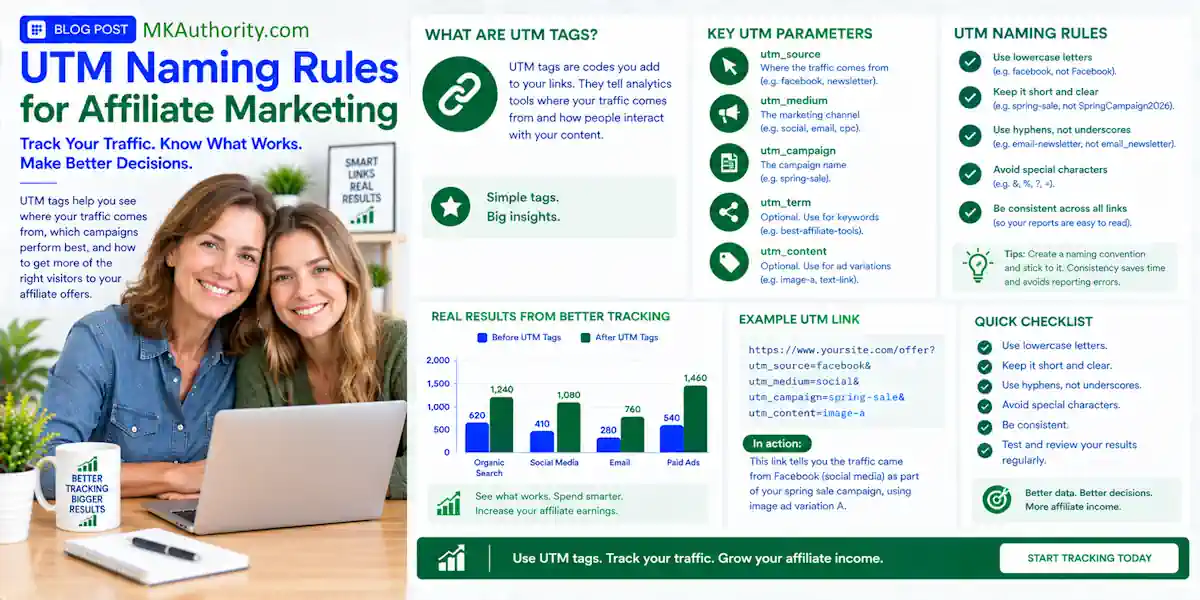

Affiliate traffic gets expensive fast when every click lands in one messy bucket. If you can’t tell which ad, email, video, or placement brought the lead, you’re not really tracking, you’re guessing. Good UTM naming rules give you a clean trail from the traffic source to your landing page.
UTM naming rules (or convention) is a standardized system of rules used by a team to write and structure UTM parameters added to website URLs. These rules keep data clean and accurate in analytics tools like Google Analytics 4 (GA4)
Add affiliate sub IDs and click IDs where needed, and you can see what deserves more budget and what needs to go.
Let’s get the naming sorted before another campaign goes live.
Key Takeaways On UTM Naming Rules
- UTM parameters should use the same source, medium, and campaign labels every time. “facebook,” “fb,” and “meta” should never become three separate report rows.
- Keep UTM parameters focused on inbound traffic to your site or bridge page. Use affiliate-network parameters and sub IDs for the outbound offer link.
- Build readable labels first. A tracker can add more detail later with click IDs, macros, and postbacks.
- Never place names, email addresses, phone numbers, customer IDs, or other personal data inside a URL.
Why Clean UTM Naming Rules Matter

A campaign can look profitable until you open Google Analytics and find six versions of the same traffic source. One person used youtube, another used yt, and a third typed YouTube-Ads. Now your report is split, your math is off, and your decisions get slower.
That’s what inconsistent UTM naming does. It creates data fragmentation, then forces you to clean spreadsheets instead of improving campaigns.
For affiliate marketers, consistent labels make traffic acquisition comparable across paid social, email, search, native placements, and video. They improve marketing analytics and make cross-channel analysis more reliable. With cleaner inputs, attribution modeling becomes more defensible.
More clicks don’t fix a weak campaign. Clear tracking shows whether the problem is the source, audience, page, creative, or offer.
The UTM Parameters You Need for Campaign Tracking
Google Analytics reads UTM parameters to identify where a visitor came from and support campaign tracking. Google’s own URL builder guidance is useful when a UTM builder standardizes manual URL creation.
Start with source, medium, and campaign
Most affiliate campaigns need these three fields every time:
| Parameter | What it identifies | Example value |
|---|---|---|
utm_source | The platform or publisher sending the click | reddit |
utm_medium | The traffic type | paid-social |
utm_campaign | The campaign you want to compare | sleep-offer-us-leads-202609 |
A basic paid Reddit link might use reddit as its source, paid-social as its medium, and sleep-offer-us-leads-202609 as its campaign.
Source answers, “Where did the visitor come from?” Medium answers, “What kind of traffic was it?” Campaign answers, “Which promotion was running?” Each field has a distinct reporting role.
Funnel’s UTM tagging overview also treats source, medium, and campaign as the basic campaign structure. Keep these values controlled and boring. Boring data is good data.
Add term and content when you need better answers
utm_term is useful for keyword themes, audience segments, or targeting groups. utm_content is where you separate ad variations, CTA positions, headlines, or placements. Give each field a distinct reporting role.
For example, a Meta campaign could use:
utm_term=lookalike-1pctutm_content=ugc-video-03-feed
A search campaign could use utm_term=best-home-gym and utm_content=responsive-ad-b. Don’t force every detail into one field. Give each field one job, then stick with it.
A Reusable UTM Naming Convention for Affiliates
The best UTM naming convention is the one your team can use without stopping to think. Keep naming conventions consistent by using lowercase values and hyphens between words. Avoid spaces, random punctuation, and long descriptions nobody can read later. Approved values, consistent separators, and lookup documentation support team-wide data governance.
Use a readable key-value template
Here is a simple format that works for most affiliate campaigns:
utm_source={source}&utm_medium={medium}&utm_campaign={offer}-{region}-{goal}-{yyyymm}&utm_term={audience-or-keyword}&utm_content={creative}-{placement}
For a YouTube review pushing a fitness offer, the values could look like this:
| Field | Example |
|---|---|
| Source | youtube |
| Medium | organic-video |
| Campaign | home-fitness-us-review-202609 |
| Term | beginner-workouts |
| Content | description-cta-a |
This setup tells you enough without turning every URL into a novel. You can see the offer, market, goal, traffic type, targeting angle, and creative placement.
Pick one naming model and don’t mix it
The key-value model uses clear labels such as home-fitness-us-review-202609. It is easy to read and works well when several people manage campaigns.
A positional model puts values in a fixed order, such as youtube-homefitness-us-desc-a. It can work, but only if everyone remembers what each slot means.
A cryptic model uses short internal codes, such as hf-us-rv-09-a. This can keep strings short, yet this cryptic model becomes a headache without a shared lookup sheet.
For most affiliate teams, readable key-value naming wins. You should know what a campaign is by looking at it for two seconds. If you need a legend to understand every link, the format is too clever.
UTMs and Affiliate-Network Parameters Do Different Jobs
This part trips people up all the time. UTMs and affiliate tracking parameters can work together, but they aren’t the same thing.
The UTMs explain the inbound visit
UTMs tell Google Analytics or another analytics platform how someone reached your landing page. They help you compare sessions, landing-page engagement, opt-ins, and outbound clicks.
Put UTMs on ads, email links, YouTube description links, social posts, and other links that send people into your funnel.
Avoid internal link tagging. UTMs belong on external traffic links, not your own internal navigation, buttons, or page-to-page links. Otherwise, you can replace the original acquisition details with an internal label and make reporting harder to trust.
Network IDs and click IDs help match commissions
Affiliate-network parameters are added to the outbound affiliate link. They may be called sub1, subid, sid, aff_sub, tid, or something else. The exact field name, parameter rules, and attribution behavior vary by network and tracking platform.
A sub-ID is a readable label you choose, such as meta-ugc03-feed. A click ID is usually a unique value generated by a tracker or platform to tie one conversion back to one click. The network’s parameter and attribution behavior, not the UTM parameters themselves, controls commission matching and attribution modeling.
Your ad can carry UTMs to your bridge page. Your tracker can store those values for conversion tracking, generate a click ID, and pass the network’s required parameter to the offer link. That’s how you connect traffic data with reported sales. For a closer look, see this guide to affiliate sub-ID tracking.
Never use personal information in either string. Campaign labels are enough.
Real UTM Naming Rules Examples for Affiliate Channels
Your UTM naming rules should stay consistent, but the useful detail changes by channel. A blog link does not need the same labels as a paid native campaign.
Paid social, native ads, and search
For paid social, use the platform as the source and a stable traffic type as the medium. Put audience or keyword detail in utm_term, then use utm_content for the creative and placement.
A Meta example could look like this:
meta | paid-social | sleep-offer-us-leads-202609 | lookalike-1pct | ugc-video-03-feed
A native campaign may use:
taboola | native | sleep-offer-us-leads-202609 | wellness-interest | headline-b-widget
For search, make the source google, use paid-search as the medium, and reserve the term field for the keyword theme. If a source sends poor-quality clicks, don’t judge it only by click count. Check leads, approved sales, refunds, and EPC.
Email, YouTube, and content links
Email links need a campaign name that identifies the promotion or sequence. Content should tell you which link placement got the click.
Try something like this for an email promotion:
email | newsletter | sleep-offer-us-promo-202609 | warm-subscribers | button-top
For YouTube, you might use:
youtube | organic-video | home-fitness-us-review-202609 | beginner-workouts | description-cta-a
If the same affiliate offer appears in your hero button, comparison table, and final CTA, give each one a different content label. Source, medium, campaign, audience, keyword, creative, and placement labels help you compare leads, approved sales, refunds, and EPC for a more realistic ROI calculation. You can then see which placement earned the click and support better campaign optimization, not only which page got credit.
Automate the Repetitive Parts, Then Test
Manual links are fine when you’re starting. Once you’re managing several offers and ad variations, manual tagging becomes a source of mistakes.
Use builders, approved fields, and macros
Google’s free Campaign URL Builder is a useful UTM builder for consistent campaign URLs. A shared spreadsheet with dropdown values for source, medium, offer, region, and goal creates a repeatable URL tagging process.
For bigger campaigns, trackers such as Voluum, RedTrack, ClickMagick, and Binom can use dynamic parameters or UTM macros to pass ad, placement, and click values. Review the syntax for the platform you use. One system’s macro may not work in another.
If you’re comparing options, these affiliate link tracking tools can help you choose based on your traffic volume and reporting needs.
Click-test every final destination
Don’t trust the link builder blindly. Open a fresh test link and inspect the final destination after every redirect to protect tracking accuracy.
A page builder, shortener, redirect script, or tracking template can strip parameters. Confirm that UTMs reach your landing page and that the affiliate-network parameter reaches the offer URL.
If you send browser and server events for the same lead, use the event IDs your platform requires. Otherwise, you can count the same lead twice.
Common Mistakes and a Simple Implementation Checklist

The biggest mistake is changing labels whenever a new person launches a campaign. Set approved values, document them for data governance, and make deviations rare.
Other common problems include using spaces, mixing upper and lowercase names, stuffing every detail into utm_campaign, and treating reported sales as final profit. Refunds and reversals can change the picture later.
Before you spend money, run through this short checklist:
- Choose approved values for sources, mediums, offers, markets, and campaign goals.
- Add UTMs to every external traffic link that sends visitors into your funnel.
- Create a separate
utm_contentvalue for each important ad or CTA variation. - Add the network-approved sub ID or click ID parameter to outbound affiliate links.
- Click-test the full path, including redirects, landing pages, and offer links.
- Compare traffic, leads, reported sales, refunds, and cleared commissions on a regular schedule.
Use the affiliate network report alongside GA4 or another marketing analytics platform to verify commissions and performance. Cleared commissions, refunds, and reversals make ROI calculation more reliable than reported sales alone. Use your analytics and tracker to decide which sources, pages, and creatives deserve more attention. This affiliate report reconciliation guide can help when the two reports don’t line up.
FAQ On UTM Naming Rules
Should every affiliate link have UTM parameters?
Every link that brings outside traffic into your own page should use them. An outbound affiliate link needs the network’s tracking parameters or sub IDs as well, if the program supports them.
What is the best separator for UTM values?
Use lowercase words separated by hyphens, such as paid-social or review-video-a. The key is consistency. Pick one style and don’t mix hyphens, spaces, underscores, and random capitalization.
Can I put customer information in a UTM or sub ID?
No. Keep URLs free of names, emails, phone numbers, customer IDs, or anything else that can identify a person. Use broad campaign labels, audience names, creative IDs, and placements instead.
Clean Names Create Better Affiliate Decisions
A good campaign name is not exciting, but it saves money. When your source, medium, campaign, audience, and creative labels stay consistent, your reports stop fighting you.
Start with the template, keep UTMs for inbound traffic, and use sub IDs or click IDs for affiliate-network attribution. Clean tracking data gives you a real basis for cutting weak traffic and scaling what works.