 Malcolm Keith 2026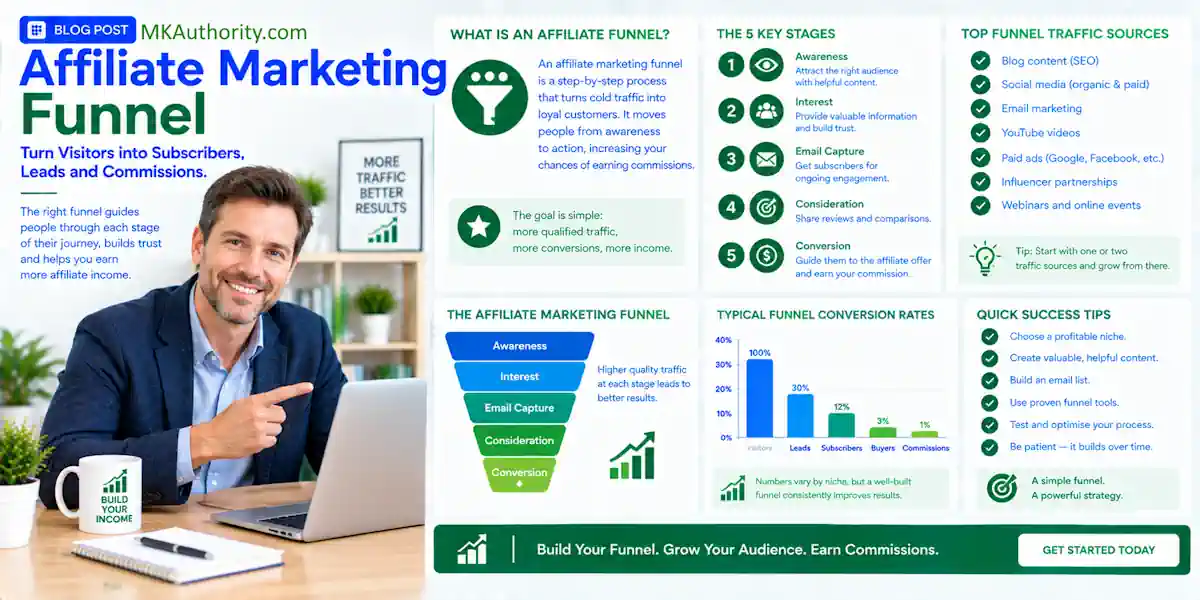

You can build a good-looking page, buy traffic, and still have no clear idea where people drop out. That gets expensive fast. An affiliate marketing funnel map helps you plan each click, message, and follow-up before you publish anything.
You don’t need fancy software to make one. Start with the person you’re trying to help and the offer you want to recommend. Then draw the route between them.
What an affiliate marketing funnel map should show
Your map is a practical view of the marketing funnel, showing the customer journey from discovery to the action you hope someone takes. That might be a merchant purchase, but your part of the journey may also include a signup or an email reply.
Give every stop a job
Write down the traffic source, your landing pages, any opt-in form, your follow-up emails, and the merchant’s offer page. Beside each stop, add one sentence describing what the visitor should do there.
For example, a comparison post helps someone choose between tools. A bridge page answers a question before sending them to an offer. An opt-in page supports lead generation by offering useful material in exchange for permission to email. If two pages do the same job, you may not need both.
Mark the handoffs
A funnel often breaks between steps rather than on the steps themselves. Does your ad promise a free traffic checklist while your landing page talks about an income opportunity? That handoff won’t feel right to the visitor.
Check that each headline, button, and email continues the same conversation. Also mark where someone can leave. You can’t force a sale, but you can make the next step easy to understand.

Choose the audience and offer before the pages
It’s tempting to start with higher commission rates. But a generous payout won’t help if the product doesn’t fit the people clicking your links.
Pick one problem you can address
Get specific about your target audience. “New affiliates getting clicks but no sales” gives you a clearer starting point than “anyone who wants to make money online.” You can speak to their traffic and tracking questions without making earnings promises.
Then choose a recommendation that helps with that problem. Explain who it’s for, what it costs if you know the current price, and where it may fall short. Relevance beats a bigger pitch. People should see why this offer belongs in the conversation.
Check the affiliate program’s terms
Before adding an offer to your map, confirm the affiliate program’s current commission rates, recurring commissions, and allowed promotion methods. Some programs restrict paid search, email, coupon use, or direct linking. Check whether the merchant accepts your intended traffic source and whether you can use tracking parameters.
If you’re buying ads, compare customer acquisition costs with confirmed commissions. A possible payout isn’t a profit figure. Refunds, declined sales, and ad spend all matter.
Draw the shortest sensible route to the offer
Now decide how much help someone needs between the first click and the merchant page. A reader comparing known products needs a different route than someone seeing a business opportunity for the first time.
Use a direct link when the reader is ready
A clear review or email can sometimes link straight to the offer, if the program and traffic platform allow it. Readers who already have context may not need another page, while landing pages can help colder visitors understand the offer.
For a colder audience, consider a pre-sell page in your affiliate funnel. Offer a brief explanation, answer an obvious objection, and share relevant, verifiable social proof when available. Don’t turn the bridge into a second sales page full of competing buttons.
Match the route to the commitment
Course funnels may need a lesson or useful sample before the recommendation. Webinar funnels ask for registration, attendance, and then a decision. A book funnel may start with a review or excerpt discussion before the book offer.
Map those extra steps only when they help someone decide. Each step gives you another place to lose a visitor, and slow page speed can add friction. Your job is to make the route helpful, not long.
A simple funnel-map example
Say you promote beginner affiliate training to people searching for help with traffic. Your draft map could look like this:
| Stop | Visitor sees | Next action | What you check |
|---|---|---|---|
| Search post | A practical article about tracking affiliate traffic | Open a free tracking checklist | Visits by source |
| Opt-in page | What the checklist includes and what emails to expect | Subscribe | Form submissions |
| Welcome email | The promised checklist and one setup tip | Use the checklist | Delivery and clicks |
| Follow-up email | How you assess beginner training | View the recommended program | Affiliate-link clicks |
| Merchant page | The program’s current offer | Decide whether to buy | Merchant-reported sales |
This is a planning example, not a prediction of results. The opt-in step supports lead generation by offering the checklist in exchange for an email address. Notice that the first email delivers what the page promised. The program appears after the visitor has received help and heard why it’s relevant.
You could draw the same map on paper or in a spreadsheet. Add a column for the actual page or email URL as you build each piece.
Decide whether to collect leads and follow up
An email list supports lead generation and gives you a way to keep helping people who aren’t ready to buy. But an opt-in adds a form, an email tool, and a promise you have to keep.
Make the signup worth the extra step
Choose a lead magnet tied to the offer. For a traffic-training audience, a short tracking checklist fits better than a broad “free business secrets” download. State what they’ll receive, that you’ll email them, and how they can unsubscribe.
When building an affiliate opt-in page, keep the form and next step clear on a phone. If a visitor doesn’t want to subscribe, don’t disguise the signup as required access to the merchant’s product.
Sketch the emails before the page goes live
Plan your email marketing sequence before the page goes live. Your first email should deliver the promised resource. A later message can explain one common mistake, show how you judge a solution, and introduce a suitable offer. Let people reply with questions, and don’t keep sending the same pitch to someone who asked for help.
You can adapt these affiliate email follow-up sequence examples to your offer. Put each email on your map with its purpose and link. If you can’t explain why a message belongs there, leave it out.
Set up tracking before traffic arrives
You don’t need to measure everything. You do need to know which traffic source brought a visitor in, where they clicked, and what the merchant later confirmed.
Name sources and actions consistently
Use distinct campaign names for each source, such as your blog, email, and paid placements, and label organic traffic separately. UTM parameters can help sort incoming traffic in analytics, while affiliate subIDs may identify placements in network reports. Keep the naming simple enough that you’ll understand it next month.
Record page visits, opt-ins, and outbound affiliate clicks where your tools permit. Google Analytics attribution settings affect how credit is assigned in its key-event reports. They don’t automatically show every sale completed on a merchant’s site.
Separate interest from confirmed income
A click is interest. An opt-in is permission to follow up. Neither is a cleared commission. Compare your funnel activity with merchant or network reports for sales, refunds, approved payouts, and commission rates.
This matters most with paid traffic. If a campaign gets leads but few affiliate clicks, review follow-up and conversion rates cautiously. If it gets clicks but no confirmed sales, check offer fit and the merchant page before increasing your budget. For more on organizing source data, see this GA4 affiliate marketing breakdown.
Put trust and program rules on the map
A disclosure and privacy check belong in the plan, not on a last-minute list after the links are live.
Show the affiliate relationship clearly
Place a plain disclosure before or near your first recommendation or promotional link. For example: “I may earn a commission if you buy through my link.” If an email contains an affiliate recommendation, make the relationship clear in that email too.
The FTC’s endorsement guidance stresses clear, conspicuous disclosures. If you need placement ideas for posts and emails, review where to place an affiliate disclosure. A notice hidden in the footer won’t help someone weighing your recommendation.
List the tools touching visitor data
Write every form, analytics tag, ad pixel, email tool, and affiliate tracker beside its map step. Keep personal details out of subIDs and URL parameters. Check that your privacy and cookie notices match the tools you use.
Where consent is required for non-essential tags, test what happens when someone accepts, rejects, or withdraws it. Server-side tracking or network postbacks may improve measurement when supported, but they don’t replace privacy obligations. Also check program rules before adding redirects or link-shortening tools.
Choose tools that fit the map, then test the route
Software can save setup time. It can’t fix a weak offer or a confusing promise. Pick your tools after you know which pages, forms, emails, and reports you need.
Keep the setup manageable
A page builder, an email service, analytics, and your affiliate dashboard may cover a basic funnel. If you’re considering Systeme.io, ClickFunnels, Convertri, or another sales funnel builder, check the current plan details yourself. Can you connect the form to your email tool? Can you edit your landing pages for mobile and test the links?
You don’t need to pay for a complicated setup to prove a simple route works. You need a setup you can maintain.
Walk through it like a visitor
Open the traffic link on your phone. Read the page, submit the form, open the first email, and follow the recommendation. Check where the disclosure appears. Test the affiliate link and confirm that your click shows up where expected.
Page speed matters when you’re paying for each visit. Check page speed on your phone before sending more paid traffic. Also look for broken buttons, cramped forms, and a headline that no longer matches the ad.
Key takeaways before you publish
Your affiliate marketing funnel map should connect one audience problem to one relevant offer. Show the route, the reason for each step, and what you’ll measure there.
Keep the promise consistent. Give subscribers what they requested, disclose your commission relationship, and judge paid campaigns using confirmed results rather than clicks alone.
Your pre-publishing checklist
Run through these checks before the first post or ad goes live:
- Confirm the offer fits the audience and review the affiliate program’s current promotion rules.
- Read every traffic headline, landing page, button, and email in order. Does the promise stay the same?
- Check page speed by confirming each relevant page loads reliably on a phone. Then test the opt-in, resource delivery, unsubscribe option, and affiliate link.
- Place clear affiliate disclosures before recommendations, including in promotional emails.
- Check tags, consent settings where required, privacy notices, and tracking parameters for personal data.
- Record what each tool measures and where you’ll find confirmed sales and commissions.
If a step fails, repair it before adding traffic. That’s easier than paying to discover a broken form.
Frequently asked questions about an affiliate marketing funnel
Do I need an opt-in page in every affiliate marketing funnel?
No. A review for readers ready to compare products can link directly to an offer if the rules allow it. Add an opt-in when you have something useful to send and a genuine reason to follow up.
Can I track every affiliate sale in my own analytics?
Usually, you’ll need the merchant or network report to confirm purchases and commissions. Your analytics can track activity on pages you control, but merchant-side sales data may be limited or delayed.
Should I start with webinar funnels or course funnels?
Start with the simplest route that fits the offer and audience. Add a webinar or course step when it provides information people need before deciding. More pages alone won’t make a recommendation more convincing.
Conclusion On Building An Affiliate Marketing Funnel
A page can look finished while the visitor’s route is still full of gaps. Your map makes those gaps visible before you spend time or money promoting it.
Choose a relevant offer, give each step a clear job, and test the whole route yourself. Then publish your affiliate marketing funnel with a plan you can measure and improve.


