 Malcolm Keith 2026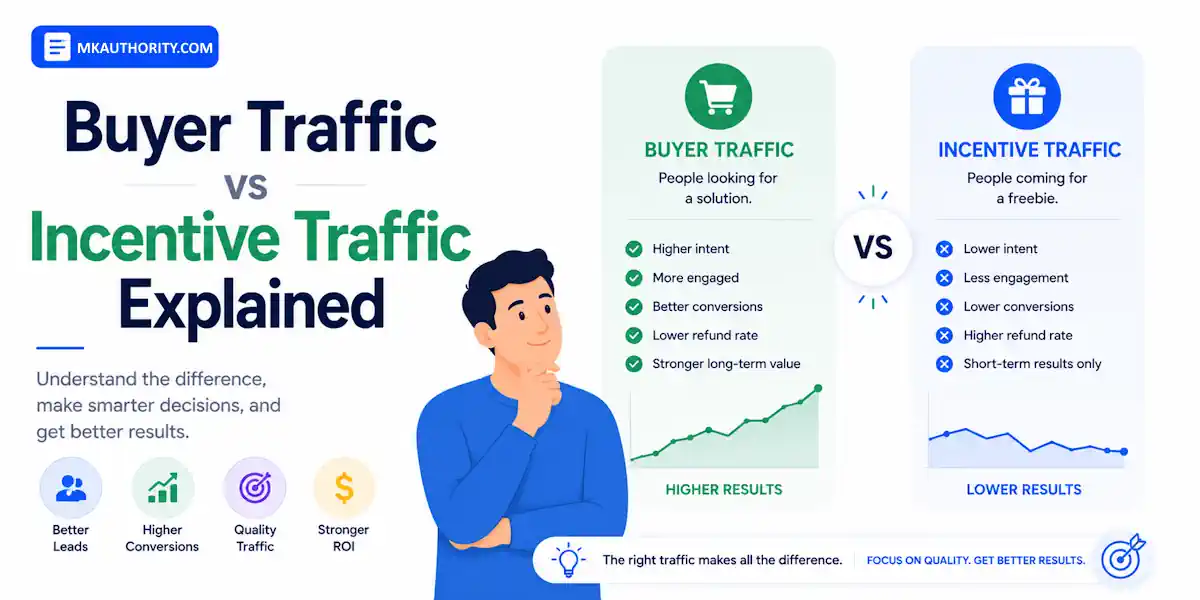

Not all traffic carries the same value. A hundred clicks can look exciting until you realize most of those visitors never wanted the offer in the first place.That is the real issue when looking at buyer traffic vs incentive traffic.
One group clicks because they want help, a product, or an answer.
The other often clicks because they want a reward first (incentivised), and the offer is merely a secondary or little concern.
If you are new to affiliate marketing, understanding this distinction can save you money, wasted tests, and a lot of frustration.
Key Takeaways On Buyer Traffic vs Incentive Traffic
- Intent is the defining factor: Buyer traffic consists of users actively searching for solutions or products, whereas incentive traffic is driven by the desire for a reward, often resulting in lower lead quality.
- Quality over volume: High click numbers can be deceptive; focusing on buyer traffic typically leads to better conversion rates, fewer junk sign-ups, and a lower risk of chargebacks or reversals.
- Prioritize compliance: Always verify if an offer permits incentivized traffic, as using it where prohibited can result in scrubbed leads, withheld payments, or a permanent ban from your affiliate network.
- Test with precision: Avoid mixing traffic sources or swapping offers too rapidly; start with controlled tests using clear tracking links to identify which traffic truly drives revenue rather than just vanity metrics.
What buyer traffic and incentive traffic actually mean
Buyer traffic is traffic from people who already have intent. They might be searching for a review, comparing tools, looking for a discount, or trying to solve a problem. They are not random, and they are much closer to a final purchase decision. Finding the exact search phrases those buyers type is what affiliate keyword research is for: spotting low-competition terms that still signal purchase intent.
Incentive traffic comes from people who take an action because they get something in return, such as points, cash back, credits, a sweepstakes entry, or another reward. Because the offer itself may not be the primary reason for the click, incentivized traffic often requires a more strategic approach to manage.
When you rely on incentive traffic, you must be careful to distinguish between genuine interest and a simple desire for a reward.
Here is the simplest side-by-side view comparing buyer traffic vs incentive traffic.
| Traffic type | Why people click | Common sources | Usual outcome | Main concern |
|---|---|---|---|---|
| Buyer traffic | They want a solution, product, or information | Search, review content, email lists, targeted ads | Better conversion odds | Can cost more or take longer to build |
| Incentive traffic | They want a reward for the action | Reward apps, offerwall rewards, virtual currency, loyalty sites | Higher click volume, weaker intent | Low-quality leads and policy issues |
The gap is intent, and that is what matters.
Think of it like foot traffic in a store. A person walking in to buy shoes is different from a person walking in only because someone offered a free coupon for entering. Both count as visitors, but only one is likely to pull out a credit card.
This is why beginners often get confused. Your dashboard may show high numbers of clicks, opt-ins, or installs, but those metrics do not tell the whole story regarding user quality. When running CPA offers, it is vital to remember that clicks alone do not represent actual value or intent. A click is only a clue, not proof of interest, and it is certainly not proof of a sale.
Why buyer traffic usually converts better
Buyer traffic tends to win because it starts with interest, not bribery. The visitor already wants something. Your job is to match the right offer to that need.
A person searching for the best beginner email marketing tool is closer to buying than a person clicking an offer wall for points. The first visitor is evaluating options. The second may only want the reward.
That difference shows up in conversion quality. This type of high-intent traffic, often generated through organic traffic strategies, typically brings:
- higher conversion rates
- stronger lead quality
- fewer junk sign-ups
- lower refund and reversal risk
It also feels cleaner. When you focus on non-incent traffic, you are helping someone make a choice instead of trying to squeeze an action from a distracted click.
Cheap clicks can get expensive fast when the wrong people are doing the clicking.
For beginners, buyer traffic is usually easier to understand and improve. If a review post does not convert, you can adjust the headline, pre-sell angle, or offer match. If incentivized clicks do not convert, the problem may be the traffic itself.
This does not mean buyer traffic is always cheap or easy. Search ads cost money. Content takes time. Email lists take work. However, the people arriving from those sources usually make more sense for offers tied to real purchases, which leads to a much better return on investment.
If you are thinking about ads, this guide on paid traffic strategies for affiliate marketing fits well with a buyer-intent approach. The same rule applies every time: send the offer to people who already care.
When incentive traffic can work, and when it breaks the rules
Incentive traffic is not inherently bad, as it serves a specific purpose in the digital landscape. The problem arises when beginners assume that every click is a high-value prospect.

Certain business models are specifically built for rewarded actions. This includes mobile app installs, survey campaigns, or specific lead generation efforts where the advertiser explicitly permits incentivized traffic.
Common formats where this strategy appears include content locking and rewarded video ads. Some networks detail these nuances in this overview of incentivized traffic.
Even when allowed, quality can remain a concern. A user might complete a sign-up just to claim the reward and never return. This behavior creates low-quality leads, which hurts the advertiser and can damage your reputation with the network if your performance metrics drop.
This is where compliance becomes critical. Many advertisers and affiliate networks either ban incentive traffic entirely or restrict it to specific CPA offers. If the offer description mentions no incent, no rewarded traffic, or requires genuine user intent, you must follow those instructions to avoid violations.
Several warning signs should prompt caution:
- The campaign is a cost per action model where payouts depend on strict lead quality.
- The traffic source primarily rewards users for clicking links or submitting information.
- The landing page creates confusion regarding the actions required by the user.
- The network has a compliance page detailing traffic restrictions that you have not thoroughly reviewed.
A single bad habit can cost you much more than a lost commission. Violating these rules can lead to scrubbed leads, reversed payouts, or having your account permanently flagged. When promoting CPA offers, misleading tactics are the primary risk.
Never promise unauthorized rewards, imply that an offer is mandatory when it is not, or utilize deceptive practices like fake urgency, fabricated reviews, or recycled, low-quality traffic.
If you want to maintain a long-term career, always read the offer page and network guidelines. If any terms regarding incentivized traffic appear unclear, ask your account manager for clarification before sending traffic.
That five-minute check is much more valuable than receiving a compliance warning later.
How beginners should choose the right traffic source
Start with the offer, not the traffic source. That one habit is the foundation of a successful user acquisition strategy.
Ask a few plain questions.
- Is this a product people buy after research?
- Is it a free lead form?
- Is rewarded traffic allowed?
Does the advertiser care more about volume or long-term user quality? For instance, if you are promoting mobile apps, your success will often depend on app store optimization to attract high-intent users, as strong mobile app ranking is often the key to consistent downloads.
If the offer has a real price tag, buyer traffic is usually the safer bet. Review articles, comparison pages, tutorial videos, email follow-up, and search-based traffic all line up better with purchase intent.

If your budget is tight, free traffic sources for affiliate marketing can help you test angles without jumping straight into paid traffic sources. While organic traffic is slower, it teaches you what people respond to before you commit capital.
Conversely, if you are exploring more aggressive tactics, remember that content locking is a method that requires very specific offer matching to ensure the user experience remains positive.
If you want a wider mix of channel ideas, this roundup of affiliate traffic strategies gives a broad look at various options.
Keep your first tests small. One offer. One traffic source. One landing page angle. That gives you clean feedback.
Many beginners make the same mistake. They mix three traffic sources, swap offers every two days, then have no clue what caused the result. Slow down. A controlled test beats chaos.
Also, don’t fall in love with traffic volume. More visitors only help when the traffic matches the offer. Otherwise, you are pouring water into a bucket with holes.
Track conversions before you scale anything
Clicks are the start, not the final score.
You need to know which source produced the action, what kind of action it was, and whether it stayed approved. That matters even more when comparing buyer traffic with incentivized traffic, because weak traffic can look good at first.
Robust tracking is your primary tool for fraud prevention, ensuring that your budget is spent on legitimate users rather than bot activity or bad actors.
Use a simple system:
- Create separate tracking links for each traffic source.
- Add sub IDs or tags so you can see which ad, post, or placement produced the click.
- Watch the full chain, including clicks, opt-ins, sales, approval rates, and reversals.
- Cut anything that brings volume but no real conversion value.
If your network shows EPC, approval rates, or refund data, pay attention to it. These numbers, combined with engagement metrics, tell you far more than raw clicks ever will. When running CPA offers, you must track these details to protect your return on investment and ensure you are not paying for low-quality leads.
Volume still matters, but only after you have found a fit. The relationship between traffic and conversions gets stronger when the visitors actually want the offer. As you move toward advanced methods like programmatic advertising, you will need to implement strict filters to maintain your conversion rates and protect against invalid traffic.
Fraud prevention is a continuous process that keeps your campaigns healthy as you scale.
Keep your promotion honest, too.
- Don’t hide affiliate links behind fake claims.
- Don’t say everyone gets approved if they don’t.
- Don’t use reward language unless the advertiser or network allows it.
Good tracking plus clean promotion will save you from bad decisions.
A beginner does not need fancy software to start. A spreadsheet, clear link tags, and basic discipline are enough. Keep a close eye on the lifetime value of the customers you acquire; your goal is to find which traffic brings real, sustainable results rather than vanity numbers.
Frequently Asked Questions About Buyer Traffic vs Incentive Traffic
Is all incentive traffic considered low quality?
Not necessarily, but it is often lower quality than buyer traffic because the user’s primary motivation is the reward rather than the product. While it can be useful for specific models like mobile app installs or surveys, it frequently leads to users who do not engage with the offer long-term.
How can I tell if an offer allows incentive traffic?
Always check the specific offer description and network guidelines before promoting. If the terms explicitly state “no incent,” “no rewarded traffic,” or require “genuine user intent,” you must avoid using reward-based tactics to prevent account violations.
Why does buyer traffic usually lead to better ROI?
Buyer traffic consists of people who are already in the market for a product or service, meaning they are further along in the buying cycle. This intent-driven behavior typically results in higher conversion rates and higher-quality leads that are more likely to result in sustained sales.
What should I do if my clicks are high but conversions are low?
This is a major red flag that your traffic source may not be a good match for the offer. You should analyze your traffic quality, check your tracking data to see if you are accidentally using incentivized traffic for a non-incent offer, and consider shifting your focus toward sources that attract high-intent users.
Final Thoughts On Buyer Traffic vs Incentive Traffic
The fundamental difference between these traffic types boils down to intent. Buyer traffic typically delivers superior performance because the visitor is already searching for a solution.
While incentive traffic can generate volume, it is vital to understand the distinction between standard reward-based visitors and incentivized traffic, which often requires a more strategic approach to ensure the quality remains high enough to satisfy advertisers.
If you are just starting out and looking at buyer traffic vs incentive traffic, take the safer path.
Carefully match your offer to the traffic source, track every test you run, and always review the network rules before you begin promoting. By focusing on these fundamentals, your clicks will carry more value, and your affiliate business will have a much stronger chance of long-term success.



