 Malcolm Keith 2026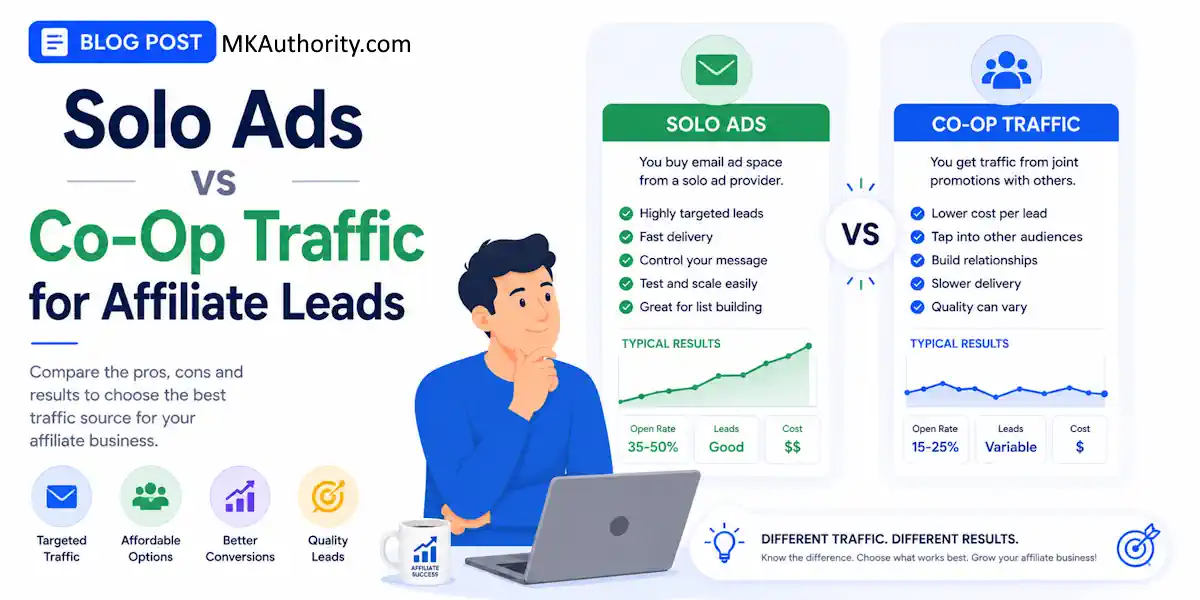

Buying traffic sounds easy, right up until the leads do not buy.That is where the debate regarding solo ads vs co-op traffic gets real.
Both can send people to your affiliate marketing sales funnel.
Only one may fit your offer, your budget, and your tolerance for guesswork.
If you want better affiliate leads, start with what each traffic source is really selling.
Key Takeaways
- Quality over Cost: The success of your campaign is determined by traffic quality and niche alignment, not just the lowest cost per click.
- Solo Ads for Speed: Solo ads are generally better for gathering quick, actionable data and building a targeted list through established vendor relationships.
- Co-op Traffic for Testing: Co-op traffic can serve as a lower-pressure testing lane for those with smaller budgets, though it often comes with less transparency and mixed audience intent.
- Tracking is Essential: Without unique tracking links and a deep understanding of your funnel’s conversion rates, paid traffic becomes a gamble rather than a strategic investment.
- Verify Before Buying: Always demand clarity on traffic sources, filtering methods, and bot detection; if a provider cannot answer basic questions, the risk of poor quality is high.
What solo ads and co-op traffic actually are
Solo ads are simple on the surface. You pay a solo ad vendor to send a promotional email to their subscribers, and that message directs readers to your landing page. This form of email marketing is straightforward because you are essentially buying clicks rather than guaranteed leads or sales.
So, if you order 200 clicks, the vendor mails their subscribers until your tracking link registers 200 visits. After that, your page has to do the rest.
Co-op traffic works differently. A co-op pools traffic from one or more sources, then divides that volume among members or buyers. While these sources can provide targeted traffic through banner placements, traffic exchanges, or social media, they often lack the singular focus found in a dedicated mailing list.
That sounds convenient, but it also means the traffic can feel like a black box if the operator does not show what is happening behind the scenes.
If you are still getting your head around affiliate funnels, this quick guide to affiliate marketing basics helps frame where your strategy fits.
The reason people compare solo ads and co-op traffic is obvious. Both:
– promise a shortcut to eyeballs.
– attract marketers who want leads now, not six months from now.
– can work, but both can also waste your paid traffic spend fast.
For beginners, here is the cleanest way to think about it. Solo ads are usually one vendor, one list, one mailing. Co-op traffic is usually many sources, one package, mixed intent. To succeed, you must ensure you are reaching the right target audience, as that difference matters more than most sales pages admit.
The real fight is list quality, click quality, and tracking
In the solo ads vs co-op traffic debate, the winner usually isn’t the cheaper source. It is the source with better traffic quality.
A solo ad can be excellent if the vendor has a real, active mailing list in your niche. It can also be awful if that list is tired, freebie-hunting, or hammered with offers every day.
You are not buying magic.
You are buying access to a niche audience for a few minutes.
Many marketers start by using a platform like Udimi to find a trusted solo ad broker who can deliver consistent results.

Co-op traffic has the same problem, only with more moving parts.
If the operator blends several sources together, one weak source can drag the whole campaign down.
You may get clicks, but not attention.
You may get opt-ins, but not buyers.
Here is the side-by-side view of solo ads vs co-op traffic that matters most:
| Factor | Solo ads | Co-op traffic |
|---|---|---|
| Source clarity | Often clearer if the vendor shares niche and mail history | Often lower if sources are blended |
| Click intent | Can be stronger with a niche-matched list | Usually more mixed |
| Cost per click | Variable based on the seller and audience quality | Often standardized but varies by provider |
| Tracking | Cleaner with one vendor and one link | Harder when traffic comes from several channels |
| Scale | Easier to repeat a winning buy | Harder to scale if quality is inconsistent |
The table hides one painful truth. Transparency changes everything.
With solo ads, you can ask smart questions. How fresh is the list? What niche is it in? How often do you mail it? What offers have done well? Good vendors will give you enough to judge fit.
With co-op traffic, you need similar clarity. What are the sources? Are clicks incentivized? Are they tier-1 countries? Robust bot detection and AI-filtered traffic are now essential requirements for any credible operator to ensure you are receiving high-quality visitors.
If the answer is fuzzy, your results will be fuzzy too.
Cheap clicks that do not opt in are still expensive.
This is also why the relationship between targeted traffic and your overall conversion rate matters more than raw visitor counts. A hundred visitors with buying intent beat a thousand random clicks every time.
Click tracking has to be tight before you buy either source. Use tracking links for each order to monitor your performance. Track clicks, opt-ins, cost per lead, and sales. If possible, track first-click and last-click data inside your funnel tools. Without that, you are flying blind.
Some co-op buyers also report slow delivery and limited reporting, which you can see in user feedback on Trafficblaster.pro. That does not mean every co-op is weak. It means you should not buy one on blind faith. Always verify the traffic quality before committing your budget.
When solo ads are the better choice, and when co-op traffic fits
Solo ads usually win when you want speed and cleaner testing.
Let’s say you have a simple lead magnet for a home business offer. Your squeeze page already converts at 30 percent or better from cold traffic. Your email sequences are written, and your bridge page is compliant.
In that case, a solo ad makes sense because you can isolate one vendor, test one angle, and get fast data. It is an ideal method for serious email list building.
Solo ads also fit when your offer matches a known niche. Biz opp, make-money-online, network marketing, personal development, and some survival or finance angles often show up in these ecosystems. Working with a reliable solo ad broker can help you identify high-quality traffic for your specific affiliate offers.
That is not a promise of profit, but it is where the format tends to shine.
They are also better when you want to build your own audience, not just chase instant commissions. Even a break-even solo ad can be useful if the leads are responsive and your follow-up converts later.
Co-op traffic may make sense when your budget is smaller and your expectations are realistic.
Maybe you do not want to drop a few hundred dollars on one vendor yet. Maybe you want a slower drip of traffic while you test headlines, forms, and email hooks. A decent co-op can help with that, though your return on investment may be slower, requiring careful monitoring of your cost per acquisition.
It can also fit front-end affiliate marketing offers with broad appeal, where the goal is lead volume first and sales later. By focusing on targeted traffic, you can drive users toward free guides, simple webinar registrations, or low-friction opt-ins.
If your funnel needs a lot of warming up, co-op traffic can be acceptable, as long as the source is not junk.
Where people get burned is treating co-op traffic like premium intent traffic.
It usually is not.
It is often better viewed as a low-pressure testing lane.
For marketers who want a wider paid traffic picture, these paid traffic strategies for faster affiliate sales can help you compare traffic networks and campaign styles. If your budget is thin, pair paid tests with free traffic sources for affiliate marketing so every lead does not come from your wallet.
Red flags, compliance issues, and a simple way to decide between solo ads vs co-op traffic
The biggest red flag with solo ads is fake certainty. If a solo ad vendor promises massive results, perfect opt-in rates, or high-converting targeted traffic without proof, back away. Real vendors talk about averages, niches, delivery, and past performance. They do not guarantee riches.
Another warning sign is vague sourcing. If a co-op owner will not explain where the clicks come from, how they filter traffic, or whether traffic is incentivized, assume the worst. Not because every operator is shady, but because good operators answer basic questions.
Watch for these patterns before you spend:
- No sample stats, no screenshots, and no guidance regarding your expected click-through rate.
- Claims that every buyer gets the same results.
- No refund or replacement policy for bad delivery.
- Traffic that arrives too fast and bounces too hard.
- Offers that sound broad, but never mention niche fit.
Compliance matters too, especially in affiliate marketing. The vendor may own the list, but you still own your landing page, your follow-up, and your claims. If your bridge page makes income promises, weight-loss claims, or medical claims you cannot support, bad traffic will not be your only problem.
For business opportunity and health-related offers, that risk gets bigger.
Your opt-in page should have a privacy policy.
Emails should be permission-based and honest, ensuring your mailing list remains healthy.
Your affiliate program rules still apply, even when someone else sends the click, so always ensure your mailing list messaging aligns with your target audience.
Five questions to ask before buying traffic
Use this quick filter before you place an order:
- Do I know my conversion rate from cold traffic?
- Can I track each source with a unique link?
- Is this audience close to my offer, or am I guessing?
- Do I know where the traffic comes from?
- Can I afford to test more than once before judging it?
If you answer no to three or more, wait. Fix the funnel first. Paid traffic is an amplifier. It does not fix a weak page, a weak offer, or a weak follow-up.

Frequently Asked Questions About Solo Ads vs Co-op Traffic
Can I guarantee a specific number of sales with solo ads?
No, you cannot guarantee sales with solo ads or any other traffic source. You are purchasing clicks, not conversions; your landing page, offer, and email follow-up sequence are responsible for converting those visitors into actual buyers.
How can I tell if a co-op traffic source is legitimate?
A legitimate provider will be transparent about where their traffic originates and how they filter out bots or incentivized clicks. If a provider is vague or refuses to explain their sources, you should treat the traffic as low quality and avoid it.
Why is tracking so important when buying paid traffic?
Tracking allows you to identify exactly which sources are delivering profitable leads and which are simply wasting your budget. Without detailed click and opt-in data, you are flying blind and cannot optimize your funnel for a better return on investment.
Is it better to start with solo ads if I am a beginner?
Solo ads are often recommended for beginners because they provide a cleaner, more controlled environment for testing one angle at a time. This allows you to learn how your offer performs with a specific, niche-matched audience before scaling your spend.
The better choice is the one you can verify
The debate regarding solo ads vs co-op traffic is not settled by price per click. Instead, it is settled by fit, transparency, and tracking. Ultimately, your goal is to maximize your return on investment by prioritizing traffic quality and sustainable email marketing practices.
Solo ads are often the better choice when you need faster data, stronger niche matching, and cleaner testing for your mailing list. Co-op traffic can make sense when you are testing on a smaller budget, provided you understand that mixed traffic sources require lower expectations. Regardless of the method you choose, if you cannot verify the source or measure the outcome, keep your money in your account.