 Malcolm Keith 2026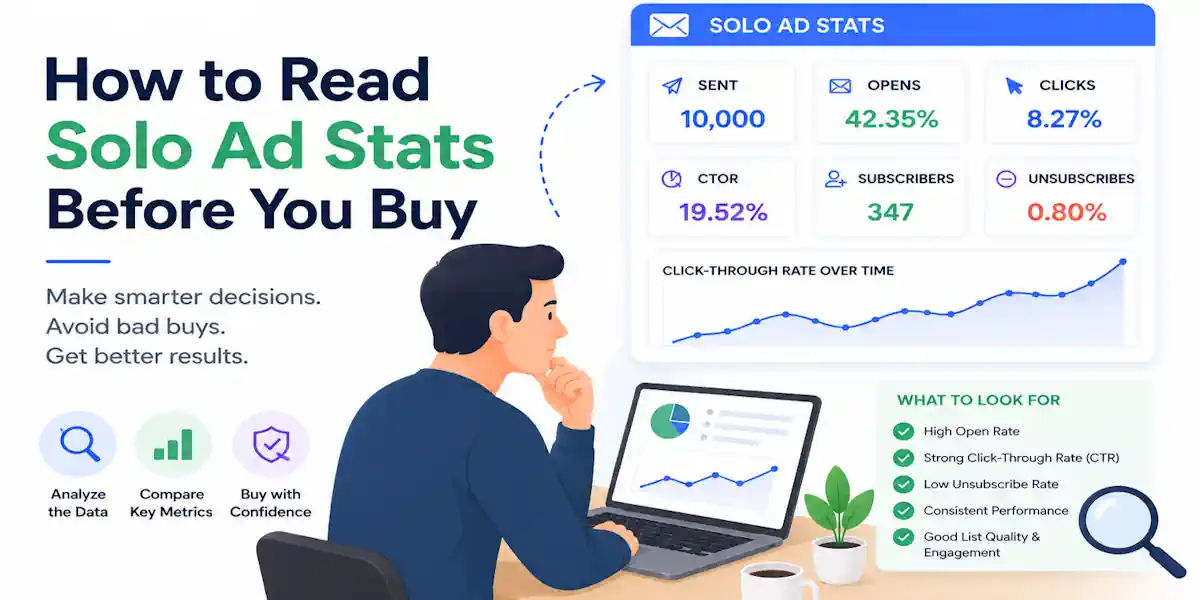

A screenshot of solo ad stats can make a bad solo ad vendor look like a goldmine, often proving more persuasive than a standard sales pitch. This is exactly why so many buyers get pulled in by high opt-in percentages on a squeeze page, impressive click counts, and a few cherry-picked sales screenshots, only to wonder why their campaign failed to convert later on.
The point of reading solo ad stats is not to hunt for one magic number that guarantees success. Instead, the goal is to figure out whether the seller’s traffic actually fits your specific offer, your landing page, your tracking setup, and the audience you are trying to reach.
That is the whole game when it comes to buying traffic effectively.
Key Takeaways On Solo Ad Stats
- Stats are context, not a guarantee: Seller screenshots represent past performance under specific conditions, which may not translate to your unique funnel, offer, or target audience.
- Small tests reveal more than averages: Relying on large, historical averages can hide poor performance in recent runs; always start with a small test to verify quality before scaling.
- Implement independent tracking: Never rely solely on seller-provided data, as raw click counts can be padded with low-quality traffic; using your own tracking software is the only way to verify real, unique visitors.
- Evaluate the funnel holistically: High opt-in rates or sales are often heavily influenced by your landing page, bridge copy, and follow-up emails, meaning a failure to convert isn’t always the seller’s fault.

A solo ad stats sheet can help, but it can’t tell the whole story
Solo ad seller stats are a clue, not a verdict. They show what happened in some past campaign, perhaps for list building or a previous promotion, under specific conditions. Change the page, the hook, the market, or the follow-up emails, and the outcome of your sales funnel can change fast.
That is the first mistake buyers make. They treat seller numbers like a guarantee.
A seller might show a strong opt-in rate from a broad free lead magnet, then your tighter business opportunity page gets half that. That does not always mean the seller lied. It may simply mean the traffic and the offer were not a match.
The opposite can happen too. A seller’s stats can look average on paper, but their list may fit your niche better than the flashy seller everyone talks about.
What matters most is context. Ask:
– what kind of offer produced the stats.
– whether the clicks went to a one-field opt-in page or a longer bridge page.
– what countries were included, how the traffic was tracked, and how recent the run was.
A screenshot with no date and no setup behind it is close to useless.
Another trap is sample size. One sale from 50 clicks can look amazing. Over a bigger test, it may disappear. Small runs swing hard. One buyer gets lucky, another does not, and both post screenshots like proof from the mountaintop.
If you are buying targeted traffic for affiliate marketing or network marketing offers, this matters even more. Biz-op, home business, and lead gen funnels can react wildly based on the headline, pre-sell angle, and email sequence. That is why a smart buyer reads stats beside the funnel, not in isolation.
What the common solo ad stats are really telling you
Most sellers show the same handful of numbers. The problem is not the numbers themselves; the problem is how buyers interpret them.
Here is the quick version of what those metrics actually mean.
| Metric | What it may tell you | Easy way to misread it |
|---|---|---|
| Clicks | How much traffic was delivered | Assuming every click was unique or human |
| Click-through rate | How engaging the offer copy is | Ignoring the placement of the link |
| Cost per click | How expensive the traffic is | Forgetting that lower cost often implies lower intent |
| Opt-in rate | How well traffic matched the page | Treating it as pure seller quality |
| Sales | Whether an offer converted | Forgetting follow-up emails often closed the sale |
| Tier 1 share | Where the clicks came from | Assuming Tier 1 always means better |
| Repeat buyers | Whether people buy again | Assuming repeats mean current quality is still strong |
Clicks and unique clicks
A raw click count is the easiest number to pad. If a seller on a platform like Udimi promises 200 clicks, ask whether those are unique clicks or total clicks. One person can click more than once, and some clicks originate from low-quality sources, accidental taps, or automated junk that slips through weak filtering.
You also want to know how those clicks were verified. Relying solely on seller-side data is risky, so you should always implement your own click tracking. If a seller resists the use of third-party tracking software, consider that a major warning sign.
Delivery speed also matters; while a fast blast can make statistics look exciting, a slower, steadier run often provides much cleaner data for your analysis.
Opt-in rate
This is the number buyers obsess over, yet it is the one they misread most frequently. An opt-in rate says as much about your landing page as it does about the traffic source. For example, a high-value lead magnet presented with a curiosity-driven headline will usually convert differently than a dry webinar registration page.
When a seller claims their traffic achieved a 45 percent opt-in rate, your next question should be about the context. If your conversion rate is struggling, remember that traffic can only do so much. If you are trying to optimize your funnel, these best landing page tools for traffic conversion can give you a better shot at turning clicks into subscribers.
Sales, earnings, and EPC
Sales often look like the final answer, but they rarely provide the full picture. A sales statistic without context is a shiny object. You must determine if the sale happened on the front end or through an email follow-up sequence days later. Consider the cost per lead versus the actual return on investment you are seeing from the campaign.
The same logic applies to earnings per click. A few lucky sales on a small run can make your EPC look artificially inflated, even if the traffic quality is low. Do not reject or purchase traffic based on a single sales screenshot, as these numbers can stabilize or drop significantly over a larger volume of clicks.
Tier 1 traffic, list freshness, and repeat buyers
Tier 1 traffic is often marketed as a premium commodity. It can certainly be effective, but it only matters if those specific regions align with your offer. If your content speaks to a U.S. audience, but the provider sends mixed Tier 1 traffic from countries that do not fit your funnel, your performance will suffer.
Additionally, the freshness of the seller’s email list is critical. A seller may have a large audience, but if those subscribers have seen the same offers for months, response rates will plummet. Always ask whether the clicks are coming from the seller’s own curated email list or from recycled traffic sources. Finally, while repeat buyers can signal reliability, do not assume it guarantees your specific offer will convert; some buyers return simply because the clicks are cheap, not because the quality is high.
Good solo ad stats do not prove you will win. They only show there may be something worth testing.
Red flags that should slow you down
The biggest red flag is a solo ad vendor who only shows best-case numbers. Anyone can post a single campaign that hit, but you should be wary of fake traffic that might be inflating those results. What you really want is recent data from runs that resemble your own.
Ask for results from the last few months, not the glory days. You should also request examples that reflect your specific niche targeting. MMO traffic behaves differently from general lead generation, and both differ significantly from health, finance, or local offers. Furthermore, inquire about the ad copy used in those previous runs to see if the messaging aligns with your brand.
Watch for blended data in the solo ad stats provided to you. Some sellers lump several runs together and present an average that hides weak campaigns. That is not necessarily fake, but it can still mislead you. You need to know exactly what happened on one clean run, with one offer, and one consistent setup.
Another red flag is fuzzy tracking. Before buying, set up your own tracker or at least a tagged link. This quick breakdown of ClickMagick, Google Analytics, and UTM tracking is a useful starting point if your setup is loose.
Independent write-ups can help as well. Comparing a seller’s claims with recent solo ad provider reviews may help you spot patterns, but remember that reviews are not absolute proof. Your funnel is your funnel. If a seller gets defensive when you ask these normal questions, pay attention. That reaction often tells you more than any screenshot they could provide.
The follow-up questions worth asking before you buy
You do not need a courtroom cross-examination. You do need a few plain questions that cut through the fluff to ensure you are getting what you pay for.
- Ask what kind of offer produced the stats. A free lead magnet, a low ticket tripwire, or specific swipe copy used in the autoresponder sequence are not the same test. Each approach yields different engagement results.
- Ask whether the clicks were unique, filtered, and tracked on both sides. If you cannot verify delivery, you cannot accurately judge the quality of the clicks.
- Ask what countries made up the run. While Tier 1 traffic is the industry standard, it can be too broad if your funnel requires a more specific audience demographic.
- Ask how recent the data is. Traffic quality can fluctuate as lists age or as sellers source new buyer leads. Checking for recent activity helps you calculate a more accurate cost per acquisition for your campaigns.
- Ask whether the traffic originated from the seller’s own list. If they broker traffic from a third party, you want that information on the table before you commit.
- Ask whether you can start small. A 100 to 200 click test tells you more about the potential for conversions than a polished sales pitch ever will.
If you are newer to driving paid traffic for affiliate marketing, this due diligence matters even more. Small tests protect your budget and give you cleaner readouts to analyze.
One more thing, do not ask only about the seller. Ask yourself whether your own setup is ready. Is your headline clear? Does your bridge page match the email swipe copy? Are you tracking opt-ins and sales the same way every time? Weak tracking makes good traffic look bad, and weak pages do the same.
Frequently Asked Questions About Reading Solo Ad Stats Sheets
Why shouldn’t I trust the sales screenshots a seller sends me?
Sales screenshots are often cherry-picked from a seller’s best-performing campaigns and lack necessary context. They don’t account for your specific offer, your landing page design, or your follow-up sequence, all of which heavily influence whether or not a lead actually converts.
How can I tell if the clicks I am receiving are high quality?
The best way to verify traffic quality is to use your own third-party tracking software rather than relying on the seller’s dashboard. By analyzing the traffic yourself, you can identify patterns, filter out bot or automated clicks, and see exactly how many unique visitors are actually engaging with your landing page.
Is Tier 1 traffic always the best choice for a campaign?
Tier 1 traffic is generally considered higher quality, but it is only valuable if it matches the specific geographic needs of your offer. If your product or business opportunity is only relevant to a specific country, paying a premium for broad Tier 1 traffic from other regions will likely result in wasted budget.
What should I do if a seller gets defensive when I ask questions?
If a seller reacts negatively to standard questions about their traffic sources, tracking methods, or recent performance, consider it a significant red flag. Transparency is essential in solo ads, and a reputable seller should be willing to discuss their list-building methods and provide context for the stats they share.
Final Thoughts On Reading Solo Ad Stats
The safest way to evaluate solo ad stats is to treat them like evidence rather than a promise. Numbers matter, but they only provide a complete picture when you understand the offer, the landing page, the tracking methods, and the audience behind them. When you are involved in affiliate marketing, remember that a well-optimized landing page is the best partner for high-quality clicks from a seller’s email list.
A small, well-tracked test always beats a beautiful screenshot. If you keep this in mind, you will buy traffic with your eyes open, ensuring your strategy is based on data rather than just hope.