 Malcolm Keith 2026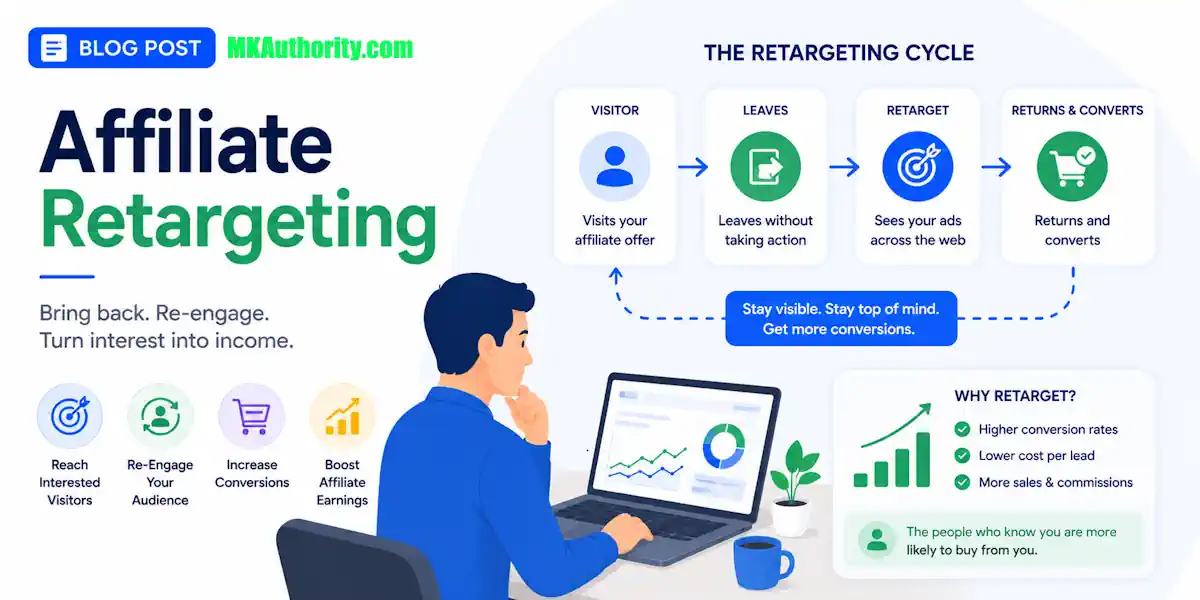

Affiliate retargeting sounds expensive until you strip it down to what it really is. You are paying to follow up with people who already showed interest in your offers. You aren’t paying to reach cold strangers.
Also, users often get distracted. Retargeting gently nudges them back to the page they were looking at with your affiliate link.
The strategy of affiliate retargeting uses tracking pixels to re-engage users who clicked on your affiliate links but left without making a purchase. It boosts conversion rates by serving targeted ads to a highly qualified, warm audience across social media and display networks.
A tracking pixel is a transparent 1×1 pixel image embedded in the code of websites or emails. When a user loads the page or opens the email, the browser silently requests the image from a server, logging data like the user’s device, visit time, IP address, and location
That is good news if you are a solo affiliate or a one-person home business. You do not need a giant budget, a media buyer, or a stack of fancy software. Instead, you need a page you control, clean tracking, and a simple plan for warm traffic that moves users through the buyer’s journey without overspending.
Once that part is clear, affiliate retargeting gets a lot less intimidating.
Key Takeaways On Affiliate Retargeting
- Own your landing environment: To successfully retarget, you must send traffic to a page you control rather than directly to the merchant, allowing you to fire tracking pixels and build audiences.
- Keep your setup lean: Avoid expensive enterprise software by using free native tools like Google Tag Manager, platform-specific pixels, and your affiliate network’s built-in sub ID tracking.
- Prioritize intent over volume: Focus your limited budget on small, high-intent audiences—such as those who clicked your affiliate link—rather than broad segments that dilute your message.
- Use simple, helpful creative: Retargeting ads should be direct and helpful, serving as a reminder or a natural continuation of the previous user experience rather than complex brand-building ads.
- Monitor profit carefully: Maintain a strict focus on your net profit by tracking spend versus commission, ensuring that your acquisition costs do not exceed your potential payout.
Start affiliate retargeting with a funnel you actually control

Here is the mistake that burns a lot of beginners: they send traffic straight to the merchant and hope the network does the rest. That can work for clicks. It doesn’t work well for retargeting.
If you don’t control the page before the affiliate click, you usually can’t place your own tracking pixel. No pixel means no audience. No audience means no retargeting.
If you don’t own the page where the click lands, you don’t own the audience either.
Your low-cost setup should start with one simple asset you own. While a Facebook pixel is a common choice for these platforms, the core requirement for successful remarketing campaigns is owning the landing environment. You might use a review post, a comparison page, a quiz, a short-form bridge page, or an email opt-in page.
Using choice pages is another excellent strategy for small budgets, as they allow you to organize multiple affiliate links while keeping your funnel tight.
One offer, one angle, one call to action.
This is where small budgets win. Warm visitors are cheaper to re-engage than cold prospects, and they convert better because they already know what you showed them. That’s why affiliate retargeting still works in 2026, even with privacy changes and higher ad costs.
The logic hasn’t changed.
Follow-up still beats starting from zero.
A good starter funnel looks like this:
- Run traffic to a page you own.
- Deploy a tracking pixel on that page to capture data for link-level retargeting.
- Track outbound affiliate clicks as a custom event.
- Build an audience from those visitors and clickers.
- Show them a short reminder ad for 7 to 30 days.
That’s it. No agency nonsense. No overbuilt system.
Offer choice matters too. If a commission is tiny, retargeting can still work, but your math gets tighter. Recurring software offers, higher-ticket training, subscription boxes, financial tools, and some health products usually give you more room.
You can also utilize smart links to optimize your redirects and improve the efficiency of your follow-up efforts. If you’re promoting a $15 payout, every wasted click hurts. If you’re promoting a $75 commission or a recurring plan, you can afford more follow-up.
For a practical look at the mechanics, Geniuslink’s guide to affiliate link retargeting is worth a read.
Set up tracking without paying for an enterprise stack
The most cost-effective retargeting system is often the one already built into the ad platform you are using. Meta, TikTok, Microsoft Ads, and Google Ads remarketing tools all provide free tracking tags that are essential for affiliate publishers. Start by implementing these native solutions to capture audience data without overhead.
Place your tracking tags using Google Tag Manager, which is free, or use a lightweight plugin if your site runs on WordPress. Fire the base pixel on all pages in the funnel, then add one or two events that matter for your specific goals.
For most affiliates, these are enough:
- Page view on the bridge or review page
- Outbound click on the affiliate button
- Lead event on an opt-in form, if you collect email
That outbound click event matters more than many people realize. A visitor who reads half a page is warm, but a visitor who clicks through to the merchant is much hotter. By monitoring your conversion rate and earnings per click for these specific segments, you can treat those groups differently to maximize your revenue.
If you want one upgrade beyond native pixels, add a low-cost click tracker. That gives you cleaner outbound click data, sub IDs, and easier split testing. You do not need the priciest option.
Many solo affiliates do fine with simple tools first, then add more reporting later.
If you want to compare current options, this round-up of best affiliate link tracking tools is a good place to start.

Even without paid tracking software, make sure every campaign uses UTM parameters and, when your network allows it, a sub ID or click ID. That lets you match ad set traffic to your affiliate links and specific commissions. Some affiliate platforms also support post back tracking.
If yours does, use it.
If it does not, you will be doing more manual matching inside your dashboard.
A lean setup can stay cheap:
- Google Tag Manager for tracking pixel placement, which helps with geo-targeting and mobile deep linking to ensure visitors reach the correct offer
- Native ad platform pixels for audience building
- Your affiliate network’s sub IDs for click tracking
- A spreadsheet for early ROI checks
- A tracker only after you have enough traffic to justify it
Keep your setup boring. Boring is good. Boring means the data is easier to trust.
Build smaller audiences with stronger intent
A small budget doesn’t need huge audiences. It needs the right people inside the audience.
Start with behavior, not vanity. Relying on audience segmentation allows you to move away from broad vanity metrics toward highly targeted custom audiences that reflect real intent. “All visitors in the last 180 days” sounds big, but it usually waters down intent and wastes spend. Think shorter and warmer.
Here is a better starting point:
| Audience | Retargeting window | Frequency cap |
|---|---|---|
| All page visitors | 14 to 30 days | 1 impression per day |
| Visitors who stayed longer or viewed key pages | 7 to 14 days | 1 to 2 impressions per day |
| People who clicked your affiliate link | 3 to 7 days | 1 to 2 impressions per day |
| Email leads who did not buy | 14 to 30 days | 3 to 5 impressions per week |
The takeaway is simple. The hotter the action, the shorter the window can be. Much like managing cart abandonment in e-commerce, visitors who clicked your affiliate links represent the highest intent and deserve the most immediate follow up.
If your traffic volume is low, don’t slice audiences into dust. Start with two groups: all visitors and affiliate clickers. Once volume grows, break out leads, video viewers, or people who hit a comparison page.
Frequency cap matters more than many beginners think.
Retargeting gets creepy fast when the same ad follows someone everywhere. A good starting range is 5 to 12 impressions per week, depending on platform and audience size. If performance drops and comments get negative, pull it back.
Also exclude people who already converted, if you can track that cleanly. At minimum, exclude leads who reached a thank-you page and buyers imported from your email list or customer file. Paying to chase someone who already bought is like mailing coupons to the cashier after the receipt is printed.
First-party audiences help here too. Uploading an email list, retargeting video viewers, or building audiences from site engagement gives you a backup when browser cookies miss people.
Privacy rules changed the old playbook, but owned data gives small marketers an edge over those relying on low-intent pop traffic or broad influencer-driven traffic, both of which require significantly larger budgets to see a return.
Write simple ads, control spend, and measure what matters
Retargeting ads don’t need to be clever. They need to feel familiar.
Most of the time, one clean image, one direct promise, and one call to action are enough. If someone already visited your page about a tool, course, or supplement, don’t show them a vague branding ad.
Instead, use dynamic retargeting ads to display the exact product they previously viewed, which helps significantly improve your conversion rate. Remind them what they looked at and why it mattered.
Think in plain language:
“Still comparing email tools?” “Watch the walkthrough before you decide.” “See why people pick this option first.”
If display ads feel too expensive, consider using push notifications as a low-cost alternative to engage your audience. That tone works because it matches intent. You’re not forcing the first conversation. You’re continuing it.
Keep the creative simple. Launch two versions, not ten. Change one thing at a time, usually the headline or image. On a small budget, too many variations spread data so thin that nothing becomes clear.
Budget-wise, many solo affiliates can start with $5 to $15 a day for retargeting. Put most of that into the hottest audience first, usually outbound clickers or strong-engagement visitors. If your audience is tiny, don’t spend more than it can absorb. An empty room doesn’t get louder because you raised the budget.
Now the part that decides whether this stays on or gets cut: your return on investment and return on ad spend.
Before you launch, know your break-even cost per acquisition. If your average commission is $60 and refund rates are low, maybe a $20 to $30 retargeting cost per acquisition still works. If your commission is $25, you need cheaper conversions or a backend offer that makes the numbers whole.
A quick formula works fine:
Net profit = affiliate commissions – ad spend – tracking costs
Check four numbers every week: spend, outbound clicks, conversions, and revenue. If click-through rate is decent but conversions are weak, the offer or landing page may be the problem. If frequency is high and click-through rate is sinking, refresh the ad or shorten the window.
One more thing, don’t get sloppy with compliance.
Your bridge page should have a privacy policy, affiliate disclosure, and cookie consent where required. If you’re using marketing cookies in places covered by GDPR, UK GDPR, or similar rules, use a consent manager that blocks non-essential tags until the visitor agrees.
On WordPress, tools like Complianz or CookieYes are common low-cost options.
Ad platform policy matters too. Don’t:
– imply personal attributes like “Are you in debt?” or “Do you have this health problem?”
– make medical or income claims you can’t back up.
– pretend you’re the merchant if you’re not.
If you’re in finance, housing, employment, or credit, special ad category rules can limit targeting options.
If that sounds familiar, this special ad category discussion shows the kind of issue marketers run into fast.
Clean setup, modest spend, honest ads.
That’s how small-budget affiliate retargeting keeps working.
Frequently Asked Questions On Affiliate Retargeting
Do I need a massive budget to start affiliate retargeting?
No, you can start with as little as $5 to $15 per day by focusing your budget on the highest-intent audiences. By avoiding expensive third-party tools and staying disciplined with your spend, you can effectively re-engage warm visitors without needing a large capital investment.
Why can’t I just send traffic directly to the affiliate offer?
Sending traffic directly to the merchant prevents you from placing your own tracking pixels, which means you cannot capture data or build retargeting audiences. Without ownership of the landing environment, you lose the ability to track who visited your site and who is interested in your specific angle.
How many ad variations should I create for a small budget?
It is best to launch only one or two simple versions to avoid spreading your data too thin. When you have a limited budget, you need enough data points on each ad to determine if it is working, and adding too many variations makes it impossible to see clear results.
How do I avoid being ‘creepy’ with my ads?
Use frequency capping to ensure you aren’t overwhelming your audience with the same ad repeatedly. A good starting range is 5 to 12 impressions per week, and if you see performance dip or negative comments, simply pull back on the frequency to make the experience feel more natural.
Final thoughts
Small-budget affiliate retargeting is the most efficient way to scale your reach without burning through your capital. This strategy works best when your setup remains lean and your audience is already warm.
You do not need an expensive enterprise stack or complex tools to see results; you only need a system that your traffic can support.
Start by focusing on one page you control, one tracking pixel, one high-intent audience, and one ad that feels like a natural follow-up to the user experience.
Simple wins here because it is easier to track, cheaper to test, and much harder to mess up. By building consistent re-marketing campaigns, you can create a reliable feedback loop that leads to more stable long-term earnings.