 Malcolm Keith 2026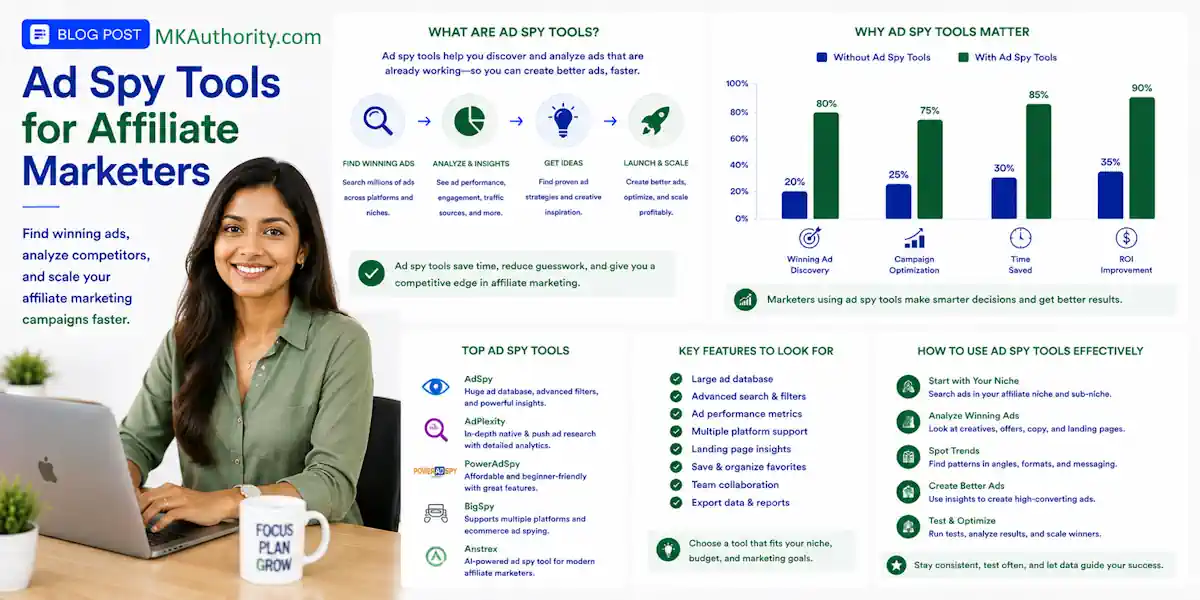

Ad spy tools for affiliate marketers are software platforms that let them search, filter, and analyze advertisements of fellow successful marketers and competitors across social networks and search engines. They can track live and historical ad creatives, estimated budgets, audience engagement, and landing pages to help affiliate marketers gain vital feedback and spot viral trends and successful marketing angles.

In digital advertising, a polished set of ad creatives can attract attention quickly. But attention alone doesn’t prove profitability. Without the offer, angle, landing page, and numbers, you may be chasing a shiny object that never made a penny.
The best ad spy tools help you research ads already running, understand your market, and spot useful market trends. They help affiliate marketing teams build better campaigns without blindly burning through their budget. They aren’t a shortcut to copying someone else’s work, but a smarter way to find ideas and test confidently.
Key Takeaways On Ad Spy Tools
- Ad spy tools are research platforms, not shortcuts to profitability. Use them to study public ads, market trends, audience language, landing pages, and campaign angles before creating original tests.
- Choose a tool based on your intended traffic source and research needs. AdSpy and Eachspy suit Meta research, Anstrex focuses on native and push traffic, AdPlexity offers deeper funnel intelligence, and BigSpy provides broad discovery on a tighter budget.
- Free resources such as the Meta Ad Library and TikTok Creative Center are useful for early research, but they usually lack advanced historical filtering, redirect analysis, and affiliate-focused tracking data.
- Engagement metrics such as likes, views, and CTR can show attention but do not prove profitability. Track CPC, opt-in rate, conversion rate, EPC, refunds, and cleared commissions across the full funnel.
- Study competitors ethically by using public information, following affiliate and platform rules, and creating original ads without copying protected creative, branding, testimonials, or unsupported claims.
What Affiliate Marketers Should Look for Beyond Ad Creatives
Basic ad research is easy. You search a keyword, find a video with lots of likes, then think, “This must be a winner.”
Well, maybe. But strong engagement metrics can indicate attention without proving campaign performance or profit.
A creative can pull clicks because it is funny, shocking, or controversial. Those clicks may not turn into leads, buyers, or cleared affiliate commissions. That is why affiliate marketers need more than a big collection of ads.
The strongest ad intelligence platforms help you look at the complete promotion path:
- The ad hook, headline, visual, and call to action.
- The language used by the target audience in comments and reactions.
- The landing page or bridge page used after the click.
- Redirect chain analysis, tracking parameters, and tech stack detection that reveal the public path without implying access to private systems.
- How long the campaign has been active.
- Whether the advertiser is testing multiple angles for the same offer.
A viral-looking ad is a research lead, not permission to spend your whole budget.
This matters a lot in affiliate marketing. You may be promoting a supplement, software platform, lead-generation offer, finance product, or online training program. For product-led offers, e-commerce intelligence can provide context about product demand and customer language. The offer can be good, but the traffic source, message, and funnel still have to match.
Together, these signals can reveal market trends and show how an ad connects to its downstream funnel.
A basic creative browser shows you the front door. Advanced affiliate campaign intelligence helps you see what happens after someone walks through it.
The Best Ad Spy Tools for Affiliate Marketers
These tools differ in pricing structure, multi-platform coverage, and the depth of indexed ad creatives. Each piece of ad spy software is valuable only when its ad intelligence reveals useful campaign performance clues.
Pricing below reflects public plan information reported in August 2026. Plans, search limits, indexed ads, and platform coverage can change, so always check the vendor’s current pricing page before you subscribe.
| Tool | Where it is strongest | Reported starting price | Best fit |
|---|---|---|---|
| AdPlexity | Funnel research, landing pages, native, push, social | Social from $99/month | Affiliates who need post-click research |
| AdSpy | Meta ads and comment search | About $149/month | Facebook and Instagram researchers |
| BigSpy | Broad ad discovery with free access | Free plan, paid tiers vary | Beginners on a small budget |
| Anstrex | Native, push, and pop traffic | About $79.99 to $89.99/month | Media buyers outside Meta |
| PowerAdSpy | Multi-platform creative research | From about $49/month | Marketers wanting wider coverage |
| Eachspy | Affiliate offer and tracking clues | $25 to $59/month | Affiliates researching Meta funnels |
The right platform depends on where you plan to buy traffic. Don’t pay for a giant TikTok database if your first test is native ads. Keep it simple and match the tool to your campaign.
AdPlexity for deeper funnel and landing-page research
AdPlexity is one of the strongest choices when you need more than ad screenshots. It is built for affiliate marketing and media buyers, with products for social, native, push, mobile, desktop, and other traffic types.
The big upside is its focus on post-click intelligence and landing page intelligence. Depending on the product you choose, you can inspect landing pages, compare promotions, and study how advertisers present an offer after the ad click. That saves serious time when researching lead-gen pages, quiz funnels, advertorials, or direct-response offers.
The trade-off is the price. AdPlexity is not the cheap beginner option, and different databases are sold separately. Its Social product has been listed at $99 per month or $950 per year, while broader packages can cost more. Check the current details in AdPlexity’s 2026 tool comparison.
Choose AdPlexity if you already have a traffic source in mind and need to study the funnel, not simply collect creative ideas.
AdSpy for Meta ads, comments, and proven angles
AdSpy is a long-running favorite for Facebook and Instagram research. Its real strength is depth. You can search by text, page name, engagement metrics, country, landing-page domain, and other filters that help cut through a massive amount of noise.
Comment search is one of its most useful features. Look for repeated questions such as, “Does this work for beginners?” or “How much does it cost?” Those comments often reveal the exact objections your own bridge page or email follow-up needs to answer.
The upside is clear, strong Meta coverage and historical creative research. The downside is that it is mostly a Meta-focused tool, and the monthly cost around $149 can feel steep if you are only spending a small amount on ads.
AdSpy is a good fit if Facebook or Instagram is your main traffic source and you want to research active angles, hooks, and audience pain points without bouncing between dozens of advertiser pages.
BigSpy for broad research on a tighter budget
BigSpy is often where new affiliate marketers start. It offers a free plan and broad platform coverage, which can include Meta, TikTok, YouTube, Pinterest, Google-related placements, and other channels depending on the plan.
That broad coverage lets you search several platforms before committing to one. The index can also support e-commerce intelligence for categories such as dropshipping products. Repeated signals may suggest potential winning products, but ad volume alone does not prove profitability.
The drawback is less post-click depth than premium affiliate-focused tools. You may find lots of creatives, but not the landing-page capture, affiliate-network filtering, or redirect detail you would get elsewhere. Paid pricing also varies widely by plan. Some lower tiers have been listed near $9 per month, while a larger multi-platform plan has appeared at $149 per month.
A 2026 affiliate spy-tool comparison also places BigSpy among the lower-cost entry options. It is a solid choice for learning what is out there before you invest in a heavier platform.
Anstrex for native, push, and pop campaigns
Anstrex is for the affiliate marketer who is not relying on Meta ads. It is well known for native advertising, push notification traffic, and pop traffic. Those channels can work well for advertorials, utility offers, sweepstakes, lead generation, and certain direct-response campaigns.
Its appeal is specialization. Reported coverage includes more than 27 native networks, 38 push networks, and 32 pop networks. That gives you a better view of campaigns running outside the usual Facebook and TikTok crowd.
The downside is that native and push traffic come with a learning curve. You need tighter tracking, stronger filtering, and a clear understanding of the ad network’s rules. Prices have been reported around $79.99 to $89.99 per month, depending on the product and current plan.
Anstrex is a smart choice if you already understand native or push traffic, or you are ready to learn it properly instead of treating it like easy traffic.
PowerAdSpy for multi-platform creative discovery
PowerAdSpy sits in the middle for marketers who want wide creative coverage without starting at premium pricing. Higher plans have been associated with Facebook, Instagram, YouTube, Pinterest, Google Ads, Reddit, Quora, native ads, and display placements.
The benefit is variety and cross-platform ad analysis. You can look at a product category across several platforms and see how the message changes. A short TikTok-style demo may use emotion and speed. A native ad may lead with a problem-focused headline. A Google ad may focus on a direct search term.
The limitation is that broad coverage does not always mean deep funnel data on every platform. Its reported plans start near $49 per month, then rise with more features and platform access. A wider 2026 ad spy tool pricing comparison is useful when comparing these moving plan levels.
PowerAdSpy is best for the affiliate who needs creative discovery across several channels and is still deciding where to put their first serious ad budget.
Eachspy for affiliate offer clues
Eachspy is a more focused option for affiliates who want clues about the offer behind a Meta campaign. Its reported data can include the visible offer domain, affiliate ID patterns, vendor IDs, Facebook pixel details, and related campaign signals.
That can be useful when researching how an affiliate funnel is put together. You may spot repeated vendors, common offer types, or the same advertiser testing multiple pages.
The good part is its lower entry price, with plans reported around $25 per month for Starter and $59 per month for Pro. The weak point is narrower coverage than a bigger multi-platform tool.
Eachspy makes sense for an affiliate marketer studying Facebook-based promotions who wants more than creative screenshots but cannot justify an expensive enterprise-style subscription.
Free Ad Spy Tools Still Have a Place
A free ad spy tool is a sensible starting point if you’re new to affiliate marketing. Learn the research process before paying for several subscriptions.
The official Meta Ad Library, often called the facebook ads library, is the obvious starting point for Facebook and Instagram. Search by advertiser, keyword, or topic. Use creative and activity filters to study the ad copy, active creatives, and page names. You can also see how many versions an advertiser is running.
TikTok Creative Center offers a practical starting point for a tiktok ad spy workflow. Study video trends, popular formats, ad styles, and performance signals. This can help you understand current market trends without claiming access to premium funnel data. Look at how quickly a hook appears, how the creator frames the problem, and how the call to action is delivered.
Free sources are great for finding:
- Repeated hooks, claims, product demonstrations, and ad creatives.
- Advertisers running many variations of one idea.
- Questions and objections in public comments.
- New products or offers that are getting attention.
- The tone your audience responds to.
What they usually do not give you is deep historical filtering, landing-page indexing, redirect chain analysis, downloadable page files, or affiliate-focused tracking clues.
Used together, these official libraries provide useful multi-platform coverage for early research. Upgrade when your campaigns need deeper data and your budget can support it.
A Simple Workflow for Turning Research Into Better Campaigns
Finding an ad is easy. Turning research into better marketing campaigns takes more discipline.
A five-step ad intelligence process
- Start with the offer and target audience. Search for the real problem your offer solves, not only the product name. If you promote sleep products, search phrases around tiredness, snoring, restlessness, bedtime routines, and related pain points.
- Look for patterns across multiple advertisers. One ad can be luck, but repeated hooks and formats across ten advertisers are stronger clues. Save those recurring patterns in a swipe file. They may help you evaluate potential winning products, but repetition alone does not prove profitability.
- Read comments like market research. Comments can show confusion, skepticism, desires, price objections, and complaints about competing products. Write down the exact themes, then answer them honestly in your own content.
- Trace the public funnel. Open visible destinations and record the sequence. Does the ad go to a product page, quiz, lead magnet, review article, webinar registration, or email opt-in page? Look at the promise, proof, headline, call to action, and form fields. Do not try to bypass logins, cloak detection, paywalls, or restricted content.
- Create original tests and a clear conversion strategy. Build two or three angles using what you learned. Change the story, hook, proof, visual, or audience problem. Never lift another marketer’s video, copy, branding, testimonials, or unverified claims.
Now track the full journey.
Your affiliate sub IDs guide can help label the traffic source, campaign, ad set, creative, and placement.
Pair those sub-IDs with reliable link tracking tools. Together, they make it possible to evaluate campaign performance by source, campaign, creative, ad set, and placement. You can also see clicks, opt-ins, conversions, refunds, and final payouts in one clear picture.
CTR and likes are useful engagement metrics, but they are not the finish line. Watch CPC, opt-in rate, cost per lead, lead-to-sale rate, EPC, refund rate, and cleared commissions.
A simple planning formula keeps your spending grounded:
Expected commission per click = sales conversion rate x commission per sale x (1 – refund reserve)
For example, a $35 commission with a 2% sales rate and a 20% refund reserve gives an expected value of $0.56 per click. That is a rough ceiling, not a target bid. You still need money left for the landing page, email software, tracking, creative work, and profit.
Choose a Tool That Fits Your Actual Budget
The most expensive platform is not always the best one for you. Its pricing structure should be assessed alongside your available traffic budget and the money reserved for the actual test. If you only have $200 to test a campaign, paying $149 each month for a spy tool can leave almost nothing for traffic.
Start with your intended traffic source. Use AdSpy or Eachspy if you are focused on Meta. Pick Anstrex if you are studying native or push. Consider AdPlexity if your main need is landing page intelligence and deeper post-click research. BigSpy is a practical early choice when you need broad discovery without a huge commitment.
Your monthly subscription is a real campaign cost. Put it in the same spreadsheet as ad spend, landing-page fees, autoresponder costs, tracking software, and creative expenses.
Before spending, set a maximum loss you can handle. If losing $300 would affect rent, food, bills, or payroll, do not make that your test budget. Start smaller, improve your page with free traffic, or build a reserve first.
For help choosing channels once your numbers are ready, review these paid traffic sources for affiliate marketing. The traffic source should fit the offer and creative, not the latest hype.
Use Competitor Ad Tracking Ethically
Ad research is legitimate market research when you study public ads and follow platform rules. You may not copy protected creative work, logos, testimonials, or branding, imitate competitor strategies, or make unsupported claims.
Do not assume an active competitor ad is compliant or profitable. It may be losing money or heading toward a policy violation. It may also rely on backend email sequences or brand reputation you do not have.
Read your affiliate program rules before launching. Check whether brand bidding, direct linking, certain keywords, email promotion, bonuses, or display URLs are restricted. Follow platform rules, too. If you earn a commission, disclose that relationship clearly before people click or buy.
Your job is not to clone another affiliate’s campaign. Your job is to understand what the market wants, then give people a clearer and more honest path to a useful solution.
Frequently Asked Questions About Ad Spy Tools
What is an ad spy tool?
An ad spy tool helps marketers research public advertising campaigns across platforms. Depending on the tool, it can reveal ad creatives, engagement signals, landing pages, comments, traffic sources, and other clues about how a campaign is structured.
Which ad spy tool is best for affiliate marketers?
The best choice depends on your traffic source and the depth of research you need. AdSpy or Eachspy may fit Meta-focused campaigns, Anstrex is suited to native and push traffic, while AdPlexity is a stronger option for deeper landing-page and funnel research.
Are free ad spy tools useful?
Yes, free resources such as the Meta Ad Library and TikTok Creative Center are useful for learning what advertisers are testing and spotting recurring hooks or formats. They generally do not provide the historical filtering, redirect analysis, or affiliate tracking clues available in paid platforms.
Do ad spy tools prove that an ad is profitable?
No. An active ad or strong engagement may indicate attention, but it does not confirm sales, profit, cleared commissions, or campaign stability. Use ad intelligence as a research lead, then verify performance through your own tracking and testing.
Is it legal to copy a competitor’s ads?
Public ad research is legitimate when you follow platform rules and applicable laws, but copying protected creative work, branding, testimonials, or unsupported claims is not an ethical strategy. Use competitor research to understand market needs and build an original, honest campaign.
Final Thoughts On Ad Spy Tools
The best ad spy tools reveal market trends, offer evidence of active markets, and make real campaigns easier to study. The resulting ad intelligence should guide decisions, not replace testing, tracking, or good judgment.
Start with public ad libraries, choose one paid platform that matches your traffic source, and study the full funnel before spending. Likes and reported sales are signals, but campaign performance and engagement metrics matter more.
At the end of the day, cleared commissions, not likes or reported sales, tell you whether the campaign is building a real business.