 Malcolm Keith 2026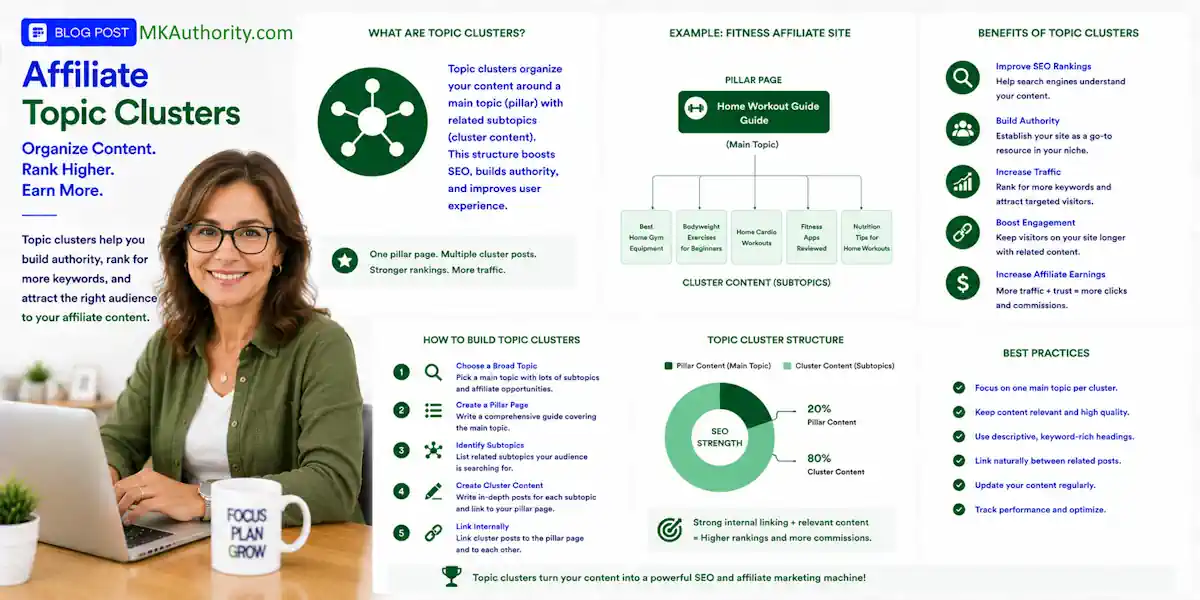

Most new affiliate sites don’t fail because owners run out of ideas. They fail when disconnected articles replace a focused content strategy for earning organic traffic.Affiliate topic clusters give a small website a clear job: become genuinely useful around one problem before covering the entire internet.
You don’t need 100 thin posts, expensive SEO software, or a big team. A sensible, patient plan and consistent depth around one subject help a small site develop topical authority.
For instance, this website and blog are centered around the subject of affiliate marketing and all the nuances that can be involved.
Key Takeaways About Affiliate Topic Clusters
- Build one focused topic cluster around a real problem instead of publishing disconnected affiliate articles.
- Choose a pillar topic that matches your experience, has room for useful supporting pages, and connects naturally to products or services you can honestly discuss.
- Give every page one clear search intent, then use relevant internal links to connect the pillar page with its cluster pages.
- Prioritize first-hand value, clear affiliate disclosures, honest limitations, and useful comparisons over thin content or aggressive sales copy.
- Measure clicks, leads, sales, refunds, and cleared commissions—not just organic traffic—and improve the pages already earning attention.
Why affiliate topic clusters fit a small-budget site

A topic cluster is a group of closely related pages built around one main subject. The broad hub is your pillar page. The focused articles around it are cluster pages.
Think of it like a small shop. If your site has one shelf for email tools, another for crypto, one random product review, and a post about dog food, visitors and search engines have no clear idea what the shop sells. A clear site structure gives the site a department, then fills that department with helpful answers.
For an affiliate marketer, this matters because readers rarely buy the first time they land on a page. Their buyer journey may start with a beginner question, continue with comparisons, and end with a review. Different pages can satisfy each search intent as they move closer to a decision.
Google’s people-first content guidance asks a basic but important question: would this page still help someone who came directly to your site? That is the right standard for an affiliate site. Focused coverage can also build topical authority by earning reader trust over time.
Traffic isn’t guaranteed. Rankings aren’t guaranteed. Still, topic clusters are more useful than disconnected publishing because related pages support one another and give readers clearer next steps.
Pick a pillar topic with room to grow
Your pillar page should cover a real problem around a focused core topic. It should give affiliate topic clusters room to grow through several useful pages. It also needs a natural link to affiliate products, tools, training, or services you can honestly discuss.
“Best laptop” is way too broad for a new site. “Best cloud backup for home businesses” is more focused. It leaves room for guides, comparisons, setup help, storage questions, and honest product reviews.
Use the one-page test before committing
Write your possible pillar topic at the top of a Google Sheet. Under it, list at least six questions a real beginner might ask. Treat those questions as possible subtopics.
For cloud backup, those questions could include backing up a Windows laptop, comparing cloud storage with external drives, choosing storage capacity, protecting family files, and reviewing a service after real use. Each answer could become one of your cluster pages. If you struggle to list five useful questions, the idea may be too narrow.
On the other hand, if the list turns into 40 unrelated subtopics, tighten it. A new site does better when it owns one small piece of the market first.
Match the topic to your experience and offers
Don’t pick a pillar only because keyword research shows high search volume. Consider keyword difficulty too, but let both metrics inform your judgment rather than replace your experience.
Choose a subject that fits a sustainable content strategy and gives your pillar page enough room to grow. That focus can help you build topical authority over time.
If you have used autoresponders, link trackers, landing-page builders, or traffic platforms, those are better starting points. You can add screenshots, show your workflow, explain what annoyed you, and point out who should not buy the tool.
That kind of first-hand value is hard to copy. It also helps readers trust your recommendation when an affiliate link appears later.
Audit what you already published
Even a small blog can become messy fast. Start a content audit of existing URLs before commissioning new pages for your topic clusters.
Open Google Search Console and export the pages and queries appearing in search results with impressions. Then make a plain spreadsheet with each URL, the page’s main topic, search intent, whether it supports the pillar page or cluster pages, affiliate offer, traffic, and any obvious overlap.
Look for pages that answer the same question with different headlines. A post called “Best Email Tools for Beginners” may overlap heavily with “Top Autoresponders for New Marketers.” You usually don’t need both.
When search engines find overlapping URLs, they may struggle to choose the best result. This can lead to keyword cannibalization between your own pages.
Your spreadsheet can also reveal content gaps, including missing subtopics that deserve their own page.
Keep the stronger URL, merge the useful material, then redirect the weaker page if it has no separate purpose. This gives each page a clearer role.
Also check for old product reviews, expired programs, broken affiliate links, and orphaned URLs. These issues can hurt crawlability and make pages harder to discover.
Relevant internal linking can pass link equity to important pages. A page that is not connected to anything is easy to forget, and it is harder for visitors to find.
A page can be well written and still underperform if no relevant page points readers toward it.
Map each page to one search intent
Now you’re ready to plan the cluster. Do not begin by collecting 200 keyword ideas. Start with the searcher’s problem and the job each page must do.
Organize related pages into topic clusters, then give each URL one primary purpose. An informational guide should not try to become a product review halfway through. A comparison page should compare, while a review should show real evaluation. This content strategy covers useful subtopics and reduces keyword cannibalization by giving every page a clear role.
Here is a simple map for organizing these affiliate topic clusters around a cloud-backup example:
| Page | Main reader question | Page role |
|---|---|---|
| Cloud backup for home businesses | What type of backup setup makes sense? | Pillar page |
| How to back up a Windows laptop | What steps should I take first? | Beginner guide |
| Cloud backup vs external hard drive | Which option fits my situation? | Comparison |
| How much cloud storage do I need? | How much capacity is enough? | Planning guide |
| Best cloud backup services for families | Which tools fit multiple users? | Buyer-focused comparison |
| A hands-on service review | Is this tool worth paying for? | Review page |
The pillar page introduces the broad choices and acts as a content hub with a clear center. Each of the cluster pages goes deeper into one choice without repeating the full pillar page. The beginner guide, comparison, and review reflect the buyer journey, from learning the basics to deciding whether to buy.
This map also makes future content easier. When a new keyword idea appears, you can ask one simple question: does it strengthen this cluster, or is it taking the site off course?
Build a pillar page that helps before it sells
A pillar page is not a giant list of affiliate links. It is the center of related topic clusters, giving people the bigger picture before they choose a path.
For example, a useful cloud-backup pillar could explain the types of backups, storage needs, security basics, common mistakes, and how readers can choose a service. It can link to deeper guides when readers need more detail.
Google recommends clear site structure, relevant internal linking, and compact titles and headings in its sitelinks documentation, which can help distribute link equity. That helps search engines and visitors know where to go next, though links don’t guarantee rankings.
Give the pillar an honest point of view
You don’t get E-E-A-T points for drawing a pretty cluster diagram. Trust comes from accuracy, first-hand experience, clear limits, and honest recommendations.
State who the page is for. Explain where one solution falls short. Mention when a free option may be enough. If you haven’t tested a product, don’t write as if you have.
A reader can smell a copied review a mile away. They may still click your link, but they probably won’t come back.
Link outward only when it helps the decision
Your pillar should link to every closely related supporting page. Those cluster pages belong in the same topic clusters when they answer a nearby question or support the same decision. It shouldn’t link to every article you’ve ever published.
A reader looking at backup choices may need your comparison guide. They probably don’t need to jump to a random post about Facebook ads. Keep the path clean and useful.
Add a short summary below each major subtopic, then offer the deeper article as the next step. This lets the pillar page direct readers to deeper resources without pushing them around.
Create supporting pages one useful article at a time
Small budgets have one big advantage: they force you to focus. Instead of ordering 30 cheap articles that repeat each other, publish cluster pages at a pace of one solid article each week.
That pace creates a sustainable content strategy for affiliate topic clusters. It gives you time to research, write, add screenshots, and link each article properly. For a small site, this is a lean form of content marketing. It also lets you see what readers search for before building more pages.
Use a free research routine
Start with Google Search Console if your site already has impressions. It shows the phrases people use to find your pages, even when you are not ranking well yet.
Then use Google autocomplete, related searches at the bottom of search results, Google Trends, and Keyword Planner to find content gaps and extra ideas. A quick review of affiliate SEO keyword research basics can also help you separate broad subjects from buyer-focused searches.
Don’t judge an idea by search volume or keyword difficulty alone. Low-demand beginner questions can be valuable long tail keywords when they match search intent. Such a query can lead naturally to a helpful tool, review, or comparison.
It may bring more relevant organic traffic than a broad term attracting people who will never buy.
Add details AI and thin content cannot provide
You don’t need to own every product in a comparison. But you do need a clear method.
Explain what you checked, then cover useful subtopics. Compare pricing, refund terms, limits, customer support, setup steps, and integrations. Show who each option fits, and connect the page back to the pillar page through internal linking.
When you have used a tool, include your own screenshots, setup notes, or a real issue you ran into. If you have not used it, say so. You can still write a useful research-based comparison, but do not invent results or personal stories.
Before publishing, use a simple SEO content checklist to catch missing headings, images, links, metadata, and other basic on-page details. Then read the page once as a beginner would.
Internal linking gives the cluster its shape
Internal linking is not an afterthought. It is how your pillar and cluster pages show readers that the content belongs together in topic clusters.
Each supporting page should link back to the pillar page with clear wording. It should also link to other cluster pages when those pages answer the reader’s likely question.
If someone is reading “cloud backup vs external hard drive,” a natural next link is “how much cloud storage do I need?” That is useful. Linking to five unrelated posts in a footer is not.
Google’s guidance on crawlable links explains that search engines need crawlable links to discover pages. Good crawlability starts with giving every important page a link from at least one other page on your site. Purposeful links can strengthen site structure and pass relevant link equity, but they don’t guarantee rankings. That is a simple rule, and many affiliate bloggers miss it.
Use normal, descriptive anchor text
Avoid vague anchors like “click here” or “read this post.” Tell readers what they will get.
Make your anchor text accurately describe the destination. Use phrases such as “compare cloud backup with external drives” or “see the beginner link-tracking setup.” Keep the words relevant to the destination page.
Once a month, add two internal links to older posts when they fit naturally. This small habit can repair decaying site structure without buying another tool.
Put disclosures and trust before commissions
Affiliate content can help readers and still earn commissions. There’s nothing wrong with that. The problem begins when the commercial relationship is hidden or the review turns into an unbalanced sales pitch.
The FTC says affiliate relationships should be disclosed clearly, so readers can properly judge a recommendation. Its endorsement guidance for affiliates explains this clearly.
Place the disclosure where readers will see it
Put a short disclosure near the top of a review, comparison, or buyer guide. It should appear before prominent affiliate links or buttons.
Simple wording works: “I may earn a commission if you buy through links in this post, at no extra cost to you.”
Don’t bury it in the footer or hide it inside a lengthy terms page. For practical wording and placement ideas, use these FTC affiliate disclosure examples.
Trust also means showing the downsides. Explain who should skip the offer, what the product doesn’t do, and whether the price makes sense for a beginner.
Measure content by actions, not exciting traffic
A page with 1,000 visits from organic traffic can produce nothing. Another page with 50 visitors can produce leads, affiliate clicks, and sales. Traffic alone isn’t the finish line.
Track impressions and clicks in Search Console. Then track outbound affiliate clicks, opt-ins, approved sales, refunds, reversals, and cleared commissions. Use subIDs when an affiliate program allows them, so you can follow the buyer journey from article visit to click, lead, sale, refund, and cleared commission.
A good affiliate conversion tracking guide can help you set up the basics without turning your site into a technical mess.
Use expected EPC to keep paid tests realistic
Organic content costs time, but many affiliate marketers later add paid traffic. Before spending a dollar, work backward from what a visitor may be worth.
Expected commission per click = sales conversion rate x commission per sale x (1 – refund and reversal reserve)
Say an offer pays $35, your expected sale rate is 2%, and you allow 20% for reversals. Your rough expected EPC estimate is $0.56.
That doesn’t mean paying $0.56 per click is safe. Your landing-page tools, email software, tracking costs, and profit margin still come out of that number. Treat it as an estimate, not a guaranteed CPC. Reported commissions feel good. Cleared cash tells you if the content and offer are working.
If readers click but don’t buy, review search intent and offer fit before publishing more posts. These affiliate conversion fixes can help you spot where the page-to-offer path is breaking.
A practical 90-day affiliate topic clusters plan
Use this 90-day schedule to develop one focused core topic and one of your site’s affiliate topic clusters. You do not need to rush this. A new site needs consistency more than a massive publishing sprint.
Days 1 to 30: choose and prepare
Pick one pillar topic, list six to eight supporting pages, and complete a content audit of existing posts. Build the pillar page and publish two beginner-focused cluster pages.
Set up Search Console, a simple spreadsheet, and link tracking where possible. Don’t worry if traffic is tiny at this stage. You are building the foundation.
Days 31 to 60: add depth and buyer intent
Publish two or three more cluster pages. Include one comparison and one page that helps buyers evaluate an option.
Use internal linking to connect every new article to the pillar. Update old posts when the topic fits. Share each article through one or two channels you can maintain, such as email, YouTube, Pinterest, or a relevant social account.
Days 61 to 90: improve what is getting attention
Check Search Console for pages earning impressions. Improve headings and add missing answers to better match search intent. Use keyword research to guide one new page based on real search queries.
Refresh the strongest article before chasing a brand-new niche. Deepen the topic clusters already attracting attention. Add one honest review only if you have enough information and a sensible way to disclose your relationship. Keep notes on clicks, leads, sales, and cleared payouts.
Common mistakes doing affiliate topic clusters that waste a small budget
The biggest mistake in topic clusters is producing thin cluster pages that repeat the same advice in different words. Five weak posts do not build topical authority just because they link to each other.
Another mistake is building a pillar page around a subject that’s too broad, even when its search volume looks tempting. A new affiliate site can’t realistically cover “make money online” in a useful way.
It can focus on long tail keywords such as “link tracking for beginner affiliates” or “email tools for a home business.” That narrow scope leaves room to cover useful subtopics in depth.
Do not create separate pages for tiny wording changes either. “Best email tool for beginners” and “top beginner email marketing tool” probably belong on one strong page. Publishing both risks keyword cannibalization, and near-identical URLs can resemble duplicate content when they offer no distinct value.
Finally, don’t treat AI search as a shortcut. Nobody can guarantee that your page will appear in an AI answer or specific search results. Clear answers, original experience, logical structure, and helpful links remain the safer way to serve search engines.
Frequently Asked Questions About Affiliate Topic Clusters
What is an affiliate topic cluster?
An affiliate topic cluster is a group of closely related pages built around one focused subject. The pillar page covers the broader topic, while supporting pages answer specific questions, comparisons, and buying concerns.
How many pages should a small affiliate site publish in a cluster?
Start with a pillar page and six to eight useful supporting-page ideas, then publish one strong article at a time. The goal is depth and clear page roles, not a large collection of thin posts.
Does every cluster page need to promote an affiliate product?
No. Beginner guides and informational pages should help readers understand the problem before they are asked to buy. Product recommendations work best when they naturally fit the reader’s next decision and are supported by honest information.
How should affiliate topic clusters be measured?
Track impressions and clicks in Google Search Console, then measure outbound affiliate clicks, leads, sales, refunds, reversals, and cleared commissions. Traffic is useful context, but it does not show whether the content and offer are producing sustainable results.
Build depth before you build volume
Affiliate topic clusters work because they give every article a job. The pillar page gives readers direction. Supporting pages solve smaller questions. Internal linking connects the path, and honest recommendations give the site a reason to exist.
Start with one subject you can explain with confidence. Use affiliate topic clusters to deepen it rather than chase every offer. Publish useful pages, track the actions that matter, and improve what readers already respond to. That takes patience, but it is how a small affiliate site becomes worth trusting.