 Malcolm Keith 2026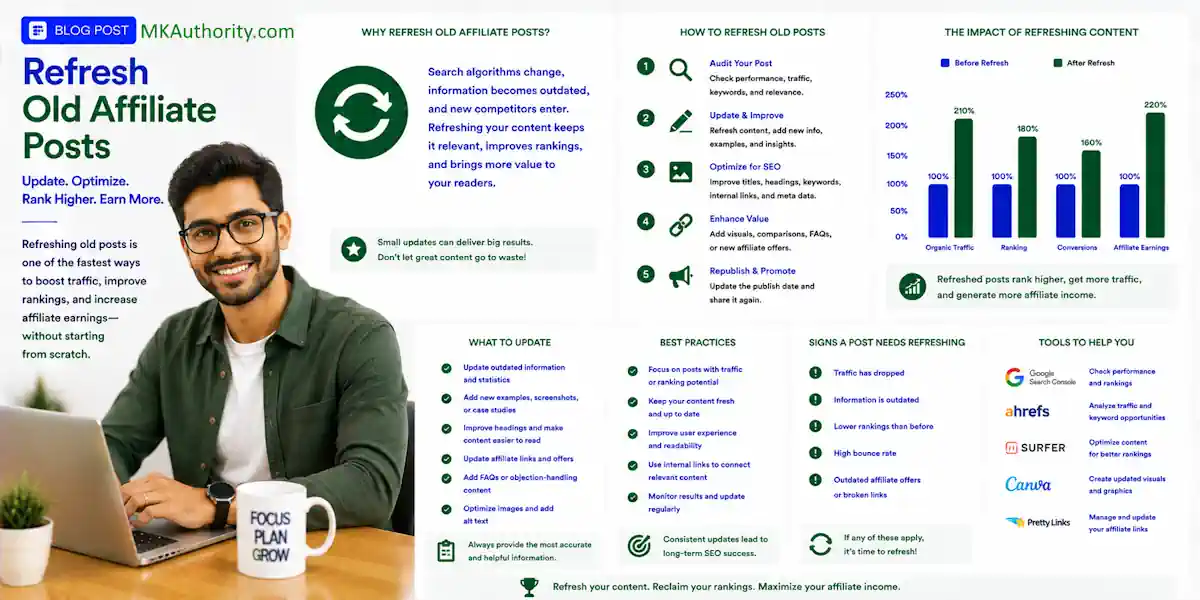

An old affiliate post can keep pulling impressions while quietly losing the clicks, trust, and commissions it once earned. That usually happens when the offer changed, the price moved, the screenshots look ancient, or the page no longer answers what people came to find. To refresh old affiliate posts, start by finding high-potential pages in your analytics, fixing broken links, and replacing outdated product recommendations with current alternatives.
When you refresh old affiliate posts, don’t treat it like changing a few dates and hoping Google notices. Your job is to make the page more useful for the person searching today, while protecting the rankings it has already built.
Pick Posts That Have a Real Chance to Recover
Not every old post deserves your time. Start with pages that already have some search visibility, affiliate clicks, or past conversions. A page sitting on page two of Google is often a better refresh candidate than a page nobody has found in three years.
Start with pages already getting impressions
Open Google Search Console and filter the Performance report by page. Google’s Performance report overview shows clicks, impressions, average CTR, and average position, which gives you a quick picture of what the post is doing.
Look for pages with one of these patterns:
- Impressions are steady or rising, but clicks have dropped.
- The post ranks for useful buyer phrases, yet it sits around positions 6 through 20.
- Traffic is still coming in, but affiliate link clicks or commissions are weak.
- The product is still active, but the article has not been touched in a year or two.
A post ranking for “Product X pricing,” “Product X review,” or “Product X alternatives” has clear buyer intent. Don’t throw that opportunity away because the post feels old.
Leave truly dead topics alone
Some offers disappear. Some tools get acquired, shut down, or become a poor recommendation. If the business no longer exists, don’t polish a dead sales page.
You have three better choices. Redirect the URL to a closely related and genuinely useful post, turn it into a discontinued-product notice with current alternatives, or remove the page if it has no value left.
A post with 30 monthly clicks and a clear buying query can be a stronger asset than a broad post with 2,000 curiosity visits.
How to Refresh Old Affiliate Posts Without Guessing
Before you write one new paragraph, find out what the visitor wants. Search intent is the difference between a page that gets traffic and a page that helps someone make a decision.
Check the queries behind the ranking
In Search Console, open the page and review the queries bringing impressions. A post called “Best Email Autoresponder” may rank for very different searches:
- “AWeber pricing”
- “AWeber vs GetResponse”
- “Is AWeber good for affiliate marketing”
- “How to use AWeber for beginners”
Those searchers don’t all need the same thing. A person looking for pricing wants current costs and plan limits. Someone comparing platforms wants differences, trade-offs, and a clear recommendation.
Keep the phrases already bringing qualified traffic. Build better answers around them instead of stuffing them into every heading.
Google’s people-first content guidance is simple at its core. Write content that helps a real person, not content built mainly to chase search traffic.
Match the page type to the reader’s decision
A review post should not read like a manufacturer brochure. A comparison post should not hide the other option. A tutorial should not spend 1,500 words selling before it shows the steps.
Here is a quick before-and-after example for a software review:
| Weak old section | Better refreshed section |
|---|---|
| “This tool is awesome and easy to use.” | Explain who it suits, what setup takes, and where beginners may struggle. |
| A price from 2023 | List the current plan details, add the date checked, or link readers to the official pricing page. |
| One affiliate button | Add pros, cons, alternatives, and a clear recommendation for different needs. |
| A generic product image | Use your own dashboard screenshot or a labeled walkthrough where possible. |
The stronger version helps the visitor decide. That is what gets you better clicks and fewer disappointed buyers.
Audit Every Claim, Link, Price, and Screenshot
Old affiliate content can become risky fast. A broken link is annoying. A false claim about price, availability, income, health, or results can cost you trust.
Run a practical page audit
Go through the full post as if you were a first-time reader. Click every button, text link, image link, and comparison-table link. Then check these details:
- Confirm the product is still available and the linked plan is the correct version.
- Check whether your affiliate tracking link still credits properly through the redirect.
- Remove price claims that are no longer accurate, especially “lowest price” or “best deal” language.
- Replace screenshots that show old logos, outdated dashboards, expired bonuses, or discontinued plans.
- Re-check refund terms, free-trial rules, cookie duration, and program restrictions.
- Delete unsupported income claims, exaggerated results, and features the company no longer offers.
If pricing changes often, don’t pretend it is fixed. Say when you checked it, explain what the reader gets for that level, and send them to the merchant for the current figure.
For affiliates using tracking and cloaked links, review the rules and risks of affiliate link cloaking before changing redirects. A broken redirect can wipe out commissions while the page still looks fine.
Keep disclosures close to the recommendation
A clear disclosure isn’t something to hide at the bottom of a page. Readers should see it before they hit the first affiliate recommendation or purchase button.
The FTC says financial relationships with brands need clear and conspicuous disclosure. Its Endorsement Guides FAQ is a useful reminder that vague or buried wording is not enough.
A plain disclosure works well:
“This post contains affiliate links. If you buy through one of my links, I may earn a commission at no extra cost to you.”
You can also review these FTC affiliate disclosure examples before publishing. Laws, platform rules, and affiliate-program terms can vary, so keep your wording current and honest.
Add the Proof That Thin Reviews Don’t Have
This is where a real content refresh can separate your post from 20 recycled reviews saying the same thing. Don’t make up experience. If you used the product, show what you learned. If you haven’t, be open about that and avoid acting like a hands-on user.
Add first-hand details where you have them
Maybe you tested a landing-page builder, ran an email sequence, bought traffic to a bridge page, or used a training course for a month. Put that useful experience into the post.
Add details such as:
- What took longer than expected during setup.
- The feature you used most often.
- A limitation that matters to beginners.
- A screenshot of a real workflow, with private information removed.
- The type of marketer who should skip the tool.
A sentence like “I found the email automation easy to start, but tagging got confusing once I built more than one funnel” has more value than five paragraphs of sales copy.
Use original images when you can. If you use product structured data, keep it accurate and tied to visible page content. Google’s product structured data documentation explains how product information can appear in Search, but markup is not a promise of rich results.
Improve comparison tables and buying choices
Comparison tables can do a lot of heavy lifting for affiliate content. They help readers compare features without bouncing between six browser tabs.
Keep the table focused on decision points. For an autoresponder comparison, that could mean beginner setup, automation depth, affiliate-policy fit, price range, support, and who it is best for.
Don’t force one winner for everybody. A cheap tool may suit a new home-business owner. A more advanced system may make sense for someone with an established list and several offers.
This is also how you fix a page that gets clicks but no sales. If people are confused or the offer doesn’t match their needs, more traffic won’t solve it. This guide on affiliate conversion problems can help you spot where the page is losing buyers.
Protect Rankings While You Improve the Page
A good refresh is not a total rewrite for the sake of it. If the URL already ranks for useful terms, preserve the parts that earned that visibility.
When you refresh old affiliate posts, keep what is already working
Don’t change the URL slug unless it is clearly wrong. Don’t remove a section that ranks for a valuable query just because you want a cleaner page.
Keep the main topic, useful headings, internal links, and terms that match the page’s current search demand. Then add better information around them.
For example, if an old “ClickFunnels review” ranks for pricing questions, don’t erase the pricing section. Update it, make it clearer, and add context about who may need another option.
Make only meaningful technical updates
Update the title and meta description if they no longer match the page. Improve the opening so visitors quickly understand who the post is for. Add a table of contents if the article is long and hard to scan.
Check mobile formatting too. Tables must scroll or stack properly. Buttons should be easy to tap. Screenshots should be readable without pinching the screen.
After publishing, inspect the page in Search Console. Check that Google can access the updated URL, then request indexing if the changes are substantial. Don’t request indexing for a couple of comma changes.
Track Search Traffic and Affiliate Results Together
A refresh is not successful because a page looks nicer. It needs to attract the right people and help them take a useful next step.
Take a baseline before editing
Record the page’s last 28 days, then compare it with an equal period after the refresh. Track Search Console clicks, impressions, CTR, average position, top queries, device type, and country where relevant.
In your analytics and affiliate dashboard, track:
- Affiliate-link clicks from that page.
- Opt-ins, if the post sends visitors to a lead magnet.
- Sales, refunds, reversals, and cleared commissions.
- EPC, or cleared commissions divided by affiliate clicks.
- Which offer, merchant, or comparison-table link produces results.
A higher CTR can feel awesome, but it is not the finish line. A headline may attract more clicks from people who never buy. You want traffic that matches the offer, not random visitors who leave fast.
Judge earnings after commissions settle
Reported commissions are encouraging, but they are not always spendable money. Refunds, chargebacks, tracking gaps, and reversals can reduce what you actually keep.
Use this simple planning formula when you are deciding whether the page can support paid promotion later:
Expected commission per click = sales conversion rate x commission per sale x (1 – refund and reversal reserve)
If a $35 offer converts at 2%, and you allow a 20% reserve, the expected payable value is $0.56 per click. That is a rough ceiling, not a safe traffic bid.
When you refresh old affiliate posts, give changes time to settle. Search behavior changes, competitors update pages, and Google may test your page for new queries. Watch the trend, learn what moved, and change one major thing at a time.
Final Thoughts On How To Refresh Old Affiliate Posts
Your old affiliate content is not useless because it is old. It becomes weak when it stops helping the person behind the search.
Check the intent, fix the facts, add honest experience, make decisions easier, and track cleared commissions, not vanity clicks. A useful refresh can protect the traffic you already earned and give readers a much better reason to trust your recommendation.