 Malcolm Keith 2026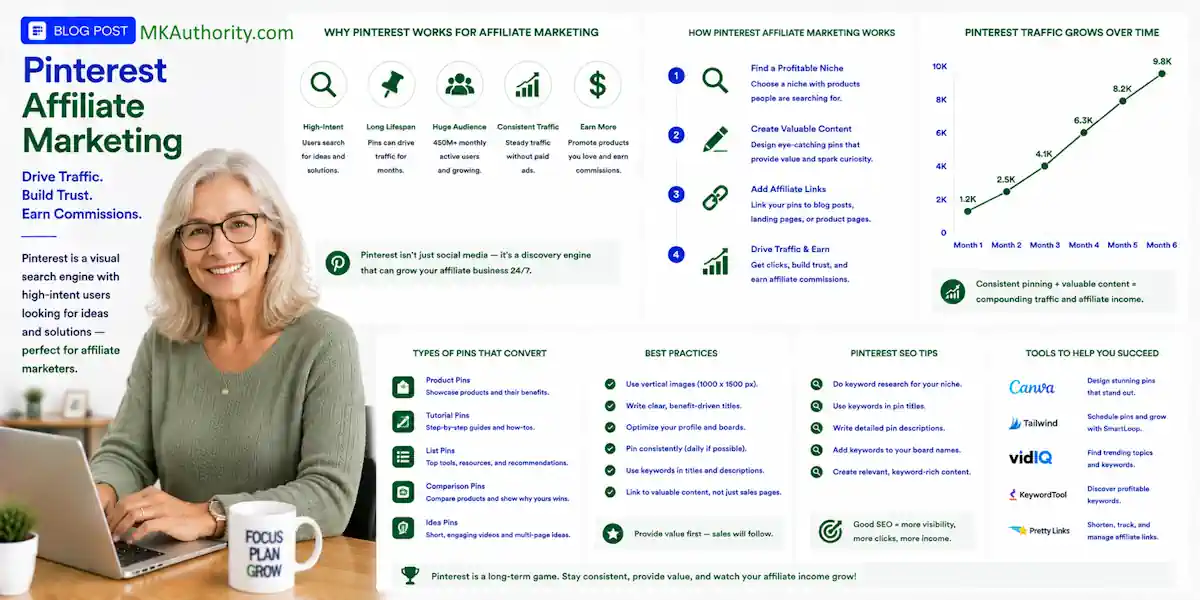

Pinterest marketing can help beginners get useful products in front of high intent shoppers through search-friendly visual content. You don’t need a huge audience or daily live videos to get started. With this affiliate model, you earn a commission when someone buys through your tracked affiliate link.
But let’s keep expectations realistic. Pinterest marketing can bring attention and clicks, yet profit depends on the offer, traffic quality, landing page performance, follow-up, and whether commissions are approved and cleared after refunds or reversals. A high click-through rate feels good, but cleared earnings are what matter.
The process is simple when you take it step by step: choose a niche, join a suitable affiliate program, create helpful Pins, send visitors through a basic funnel, and track clicks, leads, sales, and EPC. A bridge page or beginner-friendly affiliate funnel software can help you build trust before recommending a product. Remember to disclose affiliate relationships clearly in your Pin and on the landing page.
Now, let’s begin with choosing the right niche.
Key Takeaways On Pinterest Marketing
- Choose a focused niche, join suitable programs, and compare beginner-friendly affiliate programs with options such as shopify collabs. Review merchant terms, product fit, commission rules, and Pinterest traffic permissions before joining.
- Create original, useful Pins that match search intent, offer clear value, and avoid repetitive or spammy affiliate content.
- Send visitors to a relevant article, opt-in page, or affiliate bridge page setup guide instead of relying on random links.
- Track CTR, opt-ins, EPC, refunds, reversals, and cleared commissions, because clicks alone don’t prove profitability.
- Disclose affiliate relationships clearly near your recommendation, following the FTC’s endorsement guidance.
How Pinterest Marketing for Affiliate Beginners Works

For beginners, the process starts with one important decision: choosing products people already want, search for, and feel comfortable buying. A beautiful Pin may attract attention, but the offer must solve a clear problem after the click.
What You Can Promote on Pinterest
Pinterest works well for products with strong visual appeal or clear search intent, including:
- Home products, organization tools, recipes, kitchen equipment, and meal-planning resources.
- Beauty products, fashion items, crafts, books, and creative supplies.
- Software, online courses, memberships, and useful marketing tools.
- Services, consultations, and lead-generation offers that help people take a specific next step.
Physical products usually pay a one-time commission. Amazon Associates is a recognizable option for promoting many physical products. Digital products may offer higher payouts, while software programs can provide recurring commissions as long as the customer keeps paying. Lead-generation offers pay when someone completes an approved form, application, or trial.
You can also use Shopify Collabs to discover merchants and creator partnerships that fit your audience. Before joining an affiliate network, compare its rules, cookie windows, payout conditions, and approval requirements.
Don’t choose an offer only because it advertises a large commission. Check the product quality, refund policy, cookie duration, payout schedule, approval rules, and whether Pinterest traffic is allowed. If you use Shopify Collabs, verify each participating merchant’s Pinterest and direct-link policies. Some programs restrict direct social traffic, paid advertising, link shorteners, or direct affiliate links.
Pinterest’s affiliate link guidance also stresses original, useful content and clear disclosure. If you claim an eligible website, rich pins can add structured product details and useful context. They don’t replace original content or disclosure. A helpful Pin should match what the searcher expects, not push a random product in front of them.

Pinterest Business Account or Personal Account?
A pinterest business account is the better choice for affiliate work. It’s free and gives you access to Pinterest Analytics, the Business Hub, website claiming, and advertising tools where available. Pinterest Analytics helps you evaluate impressions, saves, outbound clicks, and audience response. You can review Pinterest’s business tools before creating your account.
Start with a clear business name and a helpful, searchable profile description. Apply pinterest seo principles to your board names and Pin text, using phrases your audience searches for naturally. Review pinterest trends to validate product and topic demand before selecting a niche. Claim your website when possible, and keep your colors, profile image, and Pin style consistent. If you use an opt-in page, connect it to a simple follow-up funnel, such as this affiliate opt-in page guide.
A business profile doesn’t guarantee reach, clicks, or income. Pinterest still rewards useful content, accurate targeting, regular testing, and patience. You are building a searchable traffic source, not pressing a button for automatic sales.
Set Up Your First Pinterest Affiliate Funnel Step by Step
A simple Pinterest affiliate funnel doesn’t need five offers, ten landing pages, and a massive advertising budget. Start with one focused audience, one offer, one useful page, and a small group of Pins. Then connect tracking before you send traffic.
Choose a Niche, Audience, and Offer Before Making Pins
“Home products” is too broad. A better angle is helping renters organize small kitchens with space-saving storage products and practical setup ideas. Now your audience, problem, and content direction are clear.
Before joining an affiliate program, compare:
- The commission rate, payout amount, and recurring potential.
- Approval rules, cookie duration, and traffic restrictions.
- Refund, chargeback, and reversal policies.
- Tracking quality, reporting, and payout threshold.
- Whether an affiliate network or Shopify Collabs offer allows direct Pinterest traffic, paid ads, or affiliate links.
Read the official terms, and avoid claims about guaranteed income, instant results, or product benefits you can’t prove. If you’re considering Shopify Collabs, confirm its merchant-specific approval and traffic rules first. A commission shown in your dashboard is not the same as cleared cash.
Before building around Shopify Collabs, confirm attribution windows, refund handling, and payout terms. These details can affect whether your funnel is profitable.
Your first offer should solve one obvious problem for one specific group of people.
Build a Helpful Landing Page That Matches the Pin
Send the Pin to a fast, mobile-first page with a clear headline, a short explanation, and one useful resource or comparison. The benefit should be obvious within a few seconds. A beautiful page still fails when visitors don’t understand what happens next.
Use readable text, compressed images, one main call to action, and an optional email form. If you collect email addresses, ask for clear permission in plain language, such as, “Send me the small-kitchen organization guide and occasional tips.” Never use prechecked boxes or unclear consent.
A simple funnel looks like this:
Pin -> landing page -> optional opt-in -> thank-you page -> helpful email sequence -> affiliate recommendation
A bridge page strategy can help you track visitors and build trust before the affiliate click. Direct affiliate links create a shorter path, but an intermediate page can improve message match, tracking, and trust. Place an honest affiliate disclosure near the recommendation and link, not only in the footer. For FTC compliance, the notice should be conspicuous, written in plain language, and easy to understand. These disclosure examples can help.

Create Pins People Want to Save and Click
Start with keyword research before drafting Pin titles, descriptions, and board names. Make vertical Pins with a strong visual, readable text overlay, one specific benefit, and one clear call to action. Test video Pins against static image Pins to see which format earns more saves and clicks.
One offer can support several honest angles:
- A small-kitchen organization checklist.
- A comparison of storage options.
- A short tutorial.
- A problem-and-solution idea.
- A realistic before-and-after example.
Use natural keywords in the Pin title, description, board name, and landing page. Keep future Pins aligned with related landing pages so the message stays consistent. Match the Pin’s promise exactly, avoid fake urgency and copied designs, and test one major change at a time. Track impressions, clicks, opt-ins, sales, refunds, reversals, and cleared commissions, not clicks alone.
Choose Pinterest Affiliate Content and Traffic Strategies That Fit Your Budget
Organic Pinterest content takes patience, while paid advertising provides faster data with more financial risk. For most beginners, a smart affiliate marketing strategy starts with useful organic content, validates the funnel, and tests paid traffic later.
Organic Pinterest Marketing for Beginners
Start with real Pinterest searches, not guesses about what sounds popular. Use keyword research to support pinterest seo, and check pinterest trends for rising topics. Treat trend volume as a clue, not proof of profitability.
Publish useful Pins consistently and organize your boards around clear topics. A renter’s small-kitchen board makes more sense than one filled with unrelated affiliate products. Refresh designs with new images, headlines, or angles, but don’t publish near-duplicate Pins that add no value.
A tailwind scheduler can help maintain a consistent publishing rhythm, but scheduling can’t fix thin content. Add seasonal pins for holidays and recurring buying periods when they fit your audience.
Connect every Pin to the most relevant article, guide, comparison, or opt-in page. A blog first strategy lets a helpful post or guide explain the problem before an affiliate recommendation. Creators can also use shopify collabs to find merchant collaborations, provided they confirm approval and content requirements.
Build several related resources so your account feels like a helpful library, not a collection of sales links. This gives visitors more reasons to trust your recommendations.
Saves show that your content appeals to people, but clicks and downstream actions matter more for affiliate income. Track visitors, opt-ins, sales, refunds, reversals, and cleared commissions. Affiliate conversion tracking helps you see what happens after the Pin gets attention.

When Pinterest Ads Make Sense
Paid Pinterest traffic makes sense after your landing pages, offer, tracking, and disclosure are ready. Start with one audience, one campaign goal, one offer, and one page. Then create a few creative variations and change one major factor at a time.
For example, you might spend $10 per day for seven days and review the campaign on day eight. Treat paid campaigns as controlled traffic generation experiments, not guaranteed revenue. Only use money you can afford to lose, because no result is guaranteed.
Don’t scale based on clicks alone. Compare CPC, conversion rates, cost per lead, EPC, lead quality, refunds, and cleared commissions. If you use shopify collabs, follow the participating merchant’s rules for paid traffic, attribution, and approval.
Direct affiliate links create the shortest path, but they may provide weaker tracking, less trust-building, and greater policy or program approval risk. A useful bridge page adds one step, yet it can improve message match, explain the recommendation, and collect first-party data with permission.
Before launching ads, review Pinterest’s advertising guidelines, your affiliate program’s paid-traffic rules, and applicable advertising laws. For shopify collabs partnerships, confirm merchant approval, attribution terms, and disclosure requirements before publishing. Pinterest also requires clear commercial disclosures for qualifying partnerships, so don’t hide the relationship.
Track the Numbers That Show Whether Your Pinterest Funnel Makes Money
A high click-through rate can feel awesome, but clicks alone don’t prove your Pinterest affiliate marketing funnel is profitable. Track the full journey from impression to cleared commission, then fix the weakest step instead of celebrating one attractive number.
Here are the main formulas to keep nearby:
- CTR = clicks divided by impressions.
- CPC = ad spend divided by clicks.
- Opt-in rate = leads divided by landing-page visitors.
- CPL = total costs divided by leads.
- Lead-to-sale rate = sales divided by leads.
- CPA = total cost divided by conversions.
- EPC = cleared commissions divided by clicks.
- ROI = profit divided by total cost.
- ROAS = attributed revenue divided by ad spend.
ROAS can look good while your campaign loses money because revenue isn’t profit. Software, email, tracking, creative, payment processing, and traffic costs still reduce your margin. You can review these affiliate funnel metric formulas as you build your tracking sheet.
Diagnose the Weakest Part of the Funnel
Use the numbers like a map. They show you where visitors stop moving.
Compare conversion rates at each funnel step instead of relying on CTR alone. Impressions, saves, and clicks are useful engagement metrics, but cleared commissions and profit determine whether the funnel works.
If impressions are high but CTR is low, improve the Pin’s visual, headline, audience targeting, or promise. A controversial headline may attract cheap clicks from people who never wanted the offer. Sometimes a lower CTR produces more profit because it sends better-qualified visitors.
If CTR is healthy but opt-ins are weak, inspect the landing page. Check its loading speed, message match, headline clarity, mobile layout, and form length. Does the page deliver exactly what the Pin promised? If not, the visitor has a good reason to leave.
When leads arrive but EPC is poor, review the offer fit and follow-up sequence. Check lead quality, approval rates, sales lag, refunds, reversals, and whether the product matches the original promise.
Track Cleared Commissions, Not Just Reported Sales
Affiliate dashboards can show different numbers because programs use different attribution windows, duplicate-click rules, reporting delays, refund periods, and approval systems. Reporting from a merchant partnership or shopify collabs relationship may also differ from your affiliate dashboard. Reconcile pending commissions, refunds, reversals, and attribution windows before judging performance.
Record these numbers in one spreadsheet or tracking system:
- Impressions, clicks, and unique visitors.
- Leads, confirmed sales, and gross commissions.
- Cleared commissions and all cash costs.
Work backward from payable value. When possible, use cleared commissions to calculate EPC:
Expected commission per click = sales conversion rate x commission per sale x (1 - refund and reversal reserve)
A $35 commission, a 2% sales conversion rate, and a 20% reserve produce $0.56 per click. That is a rough ceiling, not a safe bid. Allow enough time for the sales cycle, and never scale from one unusually good day or a tiny sample.

Avoid the Mistakes That Drain Beginner Pinterest Affiliate Budgets
Pinterest marketing for beginner affiliates can become expensive when you chase clicks instead of building a reliable funnel. Before spending money, check the offer, landing page, traffic quality, disclosures, and follow-up process.
Avoid these common budget drains:
- Sending Pinterest visitors to an unrelated offer or promoting too many products at once.
- Using hype-heavy claims, fake urgency, or promises of guaranteed passive income.
- Copying another creator’s Pin images, descriptions, or landing-page text.
- Hiding your affiliate disclosure in a footer instead of placing it near the recommendation.
- Collecting email addresses without clearly explaining what subscribers will receive.
- Skipping mobile testing, even though many Pinterest users browse on phones.
- Buying traffic before checking the offer’s terms, including any Shopify Collabs approval rules.
A low CPL isn’t automatically good. Leads may be fake, unresponsive, duplicated, or unlikely to buy. Check lead quality, replies, sales, refunds, reversals, and cleared commissions. Also, don’t trust a headline commission rate until you’ve checked approval requirements, payout thresholds, cookie rules, refund periods, and reversal policies.
The FTC’s endorsement guidance says financial relationships should be disclosed clearly alongside the endorsement. Clear placement supports FTC compliance, rather than treating a disclosure as a cosmetic footer detail. Pinterest also expects original content and transparent commercial relationships. Your email follow-up should be permission-based, useful, and easy to unsubscribe from.

How to Scale Without Losing Control
Start with one funnel, one audience, and one offer. First, confirm that the leads are genuine and that earnings are approved and clearing. Then improve the weakest step before increasing traffic.
Raise your budget gradually, perhaps by 10% to 20%, and change only one major variable at a time. Separate campaigns by audience, creative, placement, and offer so your results remain readable. For Shopify Collabs partnerships, track each source separately. You can track affiliate traffic sources with sub-IDs instead of guessing which Pin or audience produced a commission.
Keep a record of winning Pins, headlines, landing-page versions, and follow-up emails. Constantly starting over throws away useful data. Your email list and helpful content can become long-term assets, but subscribers should receive real value, not nonstop pressure to buy.
Pinterest marketing for affiliates isn’t guaranteed passive income. Only risk money you can safely lose, and pause any campaign that cannot show credible progress toward cleared profit.
Frequently Asked Questions About Pinterest Marketing
Getting started on Pinterest is straightforward, but the rules, costs, and numbers still matter. These answers cover common questions after setting up your first funnel.

Can beginners use Pinterest affiliate links directly?
Sometimes. Pinterest may allow direct affiliate links, but eligibility depends on its current policies and the specific program’s terms. Programs such as Shopify Collabs may also impose link, attribution, or paid-traffic conditions.
Check both sets of rules before publishing. Pinterest expects commercial content to be disclosed and add original value, as explained in its commercial content guidelines.
A useful landing page often builds more trust, improves tracking, and gives you a chance to collect email permission. A direct path is shorter, but a helpful bridge page gives you more control.
Do I need a website to start Pinterest affiliate marketing?
Not always. Some programs allow links without a website, while others require one or restrict social traffic. For example, check the website, social-traffic, and approval requirements for amazon associates before applying.
When possible, start with one simple owned page. It can include your disclosure, useful content, tracking pixels, and an email form that explains exactly what subscribers will receive.
How much money do I need to start?
Organic posting can begin with very little cash. Paid ads require a controlled test budget, and you should set a maximum loss before launching.
Track ad spend, software, email, tracking, and creative costs. Never use money needed for rent, food, bills, or payroll. If losing the test amount would create a real problem, start with free traffic.
How long does it take to make money on Pinterest?
Organic reach and search visibility often take time. Paid traffic provides faster data, but faster data doesn’t guarantee sales.
Your results depend on niche demand, Pin quality, offer fit, funnel conversion, and follow-up. A reported commission can also be delayed or reversed, so judge the campaign using cleared cash.
What should an affiliate disclosure say?
Use plain language, such as: “This post contains affiliate links. If you buy through one, I may earn a small commission at no extra cost to you.”
Place the notice where people can easily notice it, close to the recommendation or affiliate link. The FTC’s endorsement guidance doesn’t support hiding important information in a footer.
What is the most important Pinterest affiliate metric?
No single metric tells the whole story. CTR measures attention, opt-in rate measures your page, and EPC shows what each click is worth after commissions are counted.
Find the earliest weak step, but keep watching cleared profit. A high CTR is nice, yet a lower CTR with better leads can produce more money.
Conclusion On Pinterest Marketing
This Pinterest approach isn’t a shortcut to instant passive income. It’s a real business process that starts with one useful offer, a focused Pin, and a matching landing page. Add a clear disclosure, use original content, and give visitors a helpful reason to continue instead of sending them toward a random sales link.
Track the full funnel, including clicks, opt-ins, sales, refunds, reversals, EPC, and cleared commissions. A high CTR can feel awesome, but it doesn’t prove your campaign makes money. If you plan to test paid traffic, compare your expected payable commission per click with your actual costs, and use affiliate link tracking tools to see which Pins and pages are producing real results.
Keep your budget safe, focus on engaged leads rather than vanity metrics, and improve one weak step at a time.
For Pinterest marketing, your practical next action is simple: choose one niche, select one quality offer, and draft your first helpful Pin.